
The Fourth Amendment to the U.S. constitution protects citizens from unreasonable searches and seizures and requires a judicially sanctioned warrant to search private premises. Tracking someone’s location or use of electricity using electronic devices have instigated two court cases that are determining the direction of judicial thinking on electronic surveillance.
GPS tracking
Over a year ago a conviction was overturned because the police did not obtain a warrant before installing a GPS in a suspect’s car. In that case the Supreme Court without dissent agreed that the police violated a citizen’s rights when they attached a GPS device to his Jeep and monitored his movements for 28 days.
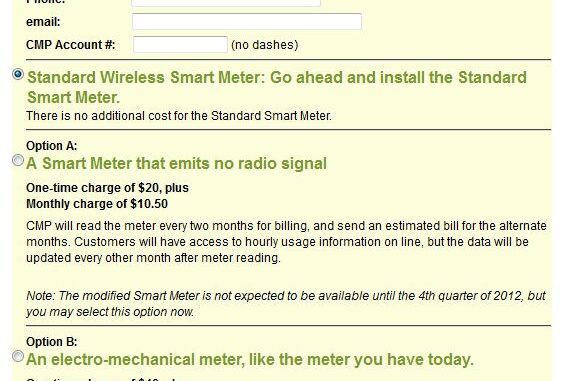
The Maine Public Utilities Commission (PUC) authorized the Central Maine Power Company to install smart meters in homes. Customer can opt out, but they were required to pay both an initial fee and a recurring monthly fee.
- Standard wireless smart meter – no additional charge
- Smart meter without radio transmitter – $20 one-time charge and $10.50 monthly charge
- Electro-mechanical meter – $40 one-time charge and $12 monthly charge
Some customers objected because of privacy concerns, but the Maine Public Utilities Commission dismissed the complaint. The case has now come to the Maine Supreme Court. The appellants contend that the smart meter records electricity usage information which can be used to reveal when a person is at home, when they are asleep, and at what times they are using specific appliances, that this information gets transmitted to the smart grid, and that it represents an impermissible search for which no consent has been given. The appellents cited Kyllo v. United States (2001), a U.S. Supreme Court privacy decision in which the Court held that using technology to collect data or information that otherwise could not be obtained without a physical intrusion constitutes a “search” under the Fourth Amendment.

Be the first to comment