
The challenge of increasing urbanization in a world where anthropogenic pressure on the environment has become threatening is driving the digitalization of urban planning and design, construction and maintenance and operations of urban infrastructure. Building information modeling and laser and photogrammetric scanning of entire cities is resulting in comprehensive digital twins of the above ground infrastructure of cities. But the below ground has been neglected. There is a growing recognition that the subsurface needs to be included in urban planning and construction to reduce the risks of conflicts with subsurface infrastructure and to maximize the benefits of subsurface resources.
One of the challenges identified by the European COST Sub-Urban program is a communications gap between urban planners and subsurface experts. To begin to improve the level of communication between urban planners and subsurface experts, Geodan and TNO organized a preconference workshop “Utilizing subsurface data for urban planning, design, construction and maintenance” at the GEO|Design+BIM conference in Amsterdam.
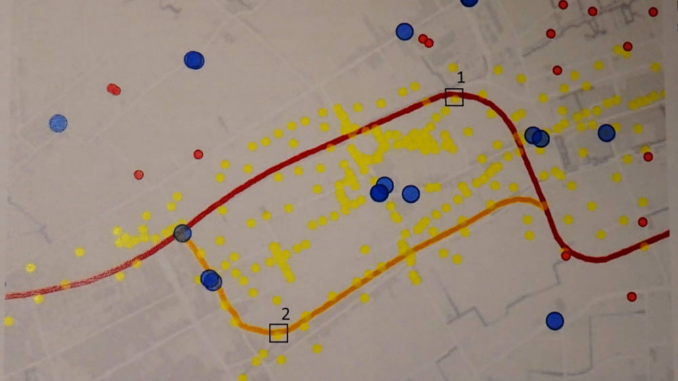
The workshop was a hands-on event with real data from a part of the Netherlands. It was led by Cindy Teeven and Ceciel Fruijtier from Geodan and Rob van der Krogt from TNO. In the simulation in which all participants in the workshop participated, a decision had to be made about the preferred route for a new highway. The alternatives were a route that skirted existing buildings and followed the route of an existing railway and regional road and a route that went through the countryside. An online GIS system provided layers of typical 2D information from public databases that might be relevant to the decision process including the location of existing residential and business buildings, historical and conservation sites, existing infrastructure such as roads and railways, and so on. Each of the participants was assigned a role to play: people of the place, traffic engineer, civil engineer, regional government, environmental authority, and local business council. After an hour with the data we were asked to report on the decision that had been reached on a preferred route. Primarily for reasons relating to reducing traffic through populated areas, the choice of most of the stakeholders was the route through the countryside. However, the “civil engineers” raised a red flag about this route because of the risk of poor soil conditions that could make this route challenging and expensive. Clay and peat, which are prevalent in the Netherlands, are susceptible to subsidence when a load is placed on them and are therefore to be avoided whenever possible when building any kind of structure. In contrast a great deal was known about the soil conditions of the alternative route because infrastructure and houses had been built along it for many years.
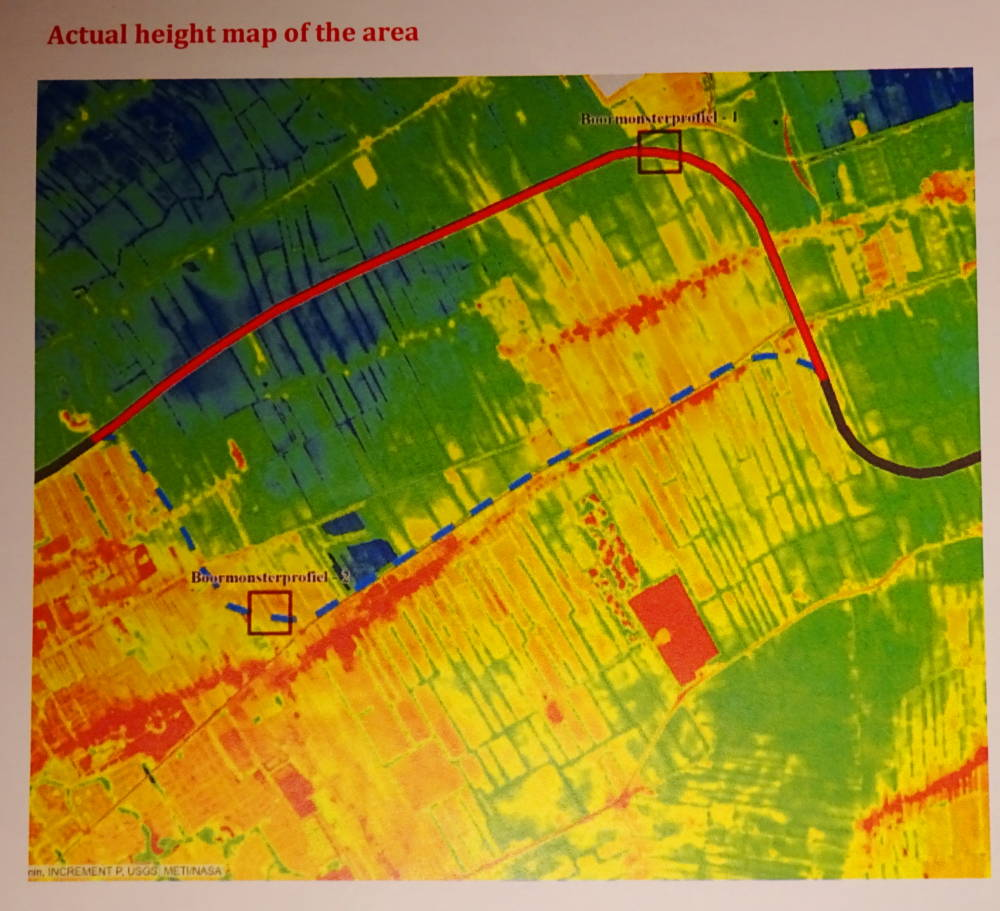
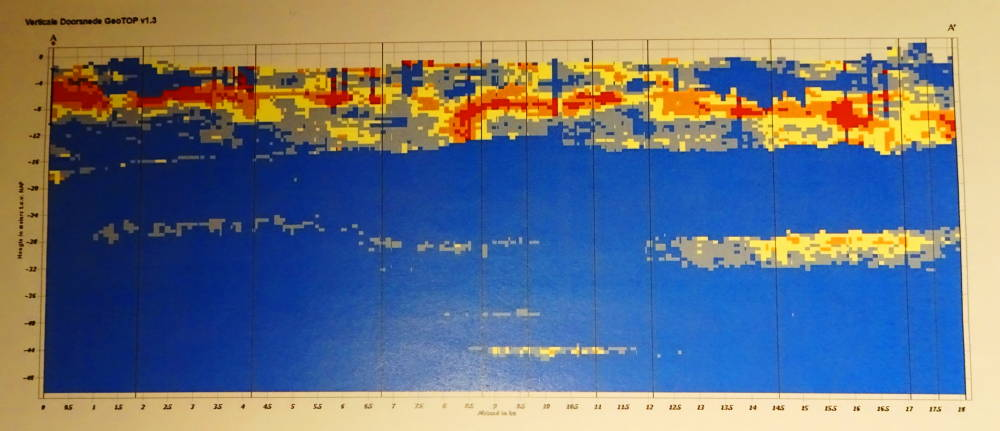
After the first hour it was announced additional information was provided including a digital terrain model (DTM) showing surface elevation for the area and a model of the subsurface composition of the terrain – whether sand, peat or clay – to roughly 50 meters interpolated from bore holes and groundwater sampling sites in the region.
The DTM showed that the route skirting existing infrastructure was generally higher by a couple of meters than the alternative route through the countryside where the land was low lying suggesting subsidence. The subsurface soil composition model was used to create profiles showing the probability of clay and peat in the subsurface along the proposed routes. The 3D model revealed a high probability of clay and peat in the subsurface along the route through the countryside. In light of the new information about the subsurface, participants were requested again to arrive at a decision for the preferred route. Armed with the new subsurface information several of the stakeholders changed their minds. For the “civil engineers” the new subsurface information confirmed their fears about the risk of the route through the countryside.
The cost of an elevated highway or viaduct over the extensive peat and clay fields would be much more expensive than the alternative route skirting existing infrastructure. If the simulation had included cost and it had been made clear that the cost would have to be borne through a rate increase, I would expect that more of the stakeholders would have changed their minds.
It was explained at the end of the workshop that the workshop was based on a historical event in the north of Holland. At the time it was decided to build the route through the countryside. After extensive construction delays and rising costs, it was ultimately resolved in a high profile court case. The outcome was that the construction contractor and the regional government agreed to split the much higher cost of building a viaduct through the countryside.
The workshop was effective in illuminating the risk of decision making without information about the subsurface. In this case there was some data about the subsurface although historically it was only consulted after the initial decision. The reality in much of the world is that there is little information publicly available about the subsurface. Many construction projects proceed blindly with respect to what lies below the surface. In the United States poor information about what lies below the surface is the leading cause of construction delays and cost overruns. Construction bids are routinely inflated significantly to accommodate the risks associated with the lack of knowledge about the subsurface. Poor information about the subsurface costs the world economy trillions of dollars. What is underway in the Netherlands with the Key Registry for the Subsurface or BRO is the beginning of a practical solution to this problem. The world should be watching.

Be the first to comment