
Energy efficient residential buildings market to grow to $84 billion by 2020

According to World Business Council for Sustainable Development,
buildings account for 40 % of the world’s energy use. According to the
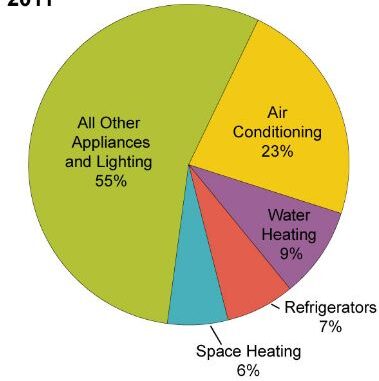
Energy Information Administration n the U.S.in 2011 71% of electric
power was consumed by buildings, residential (37%) and commercial
(34%).  Not surprisingly increasing the energy efficiency of buildings is a prime
target of government and private initiatives around the world.

A new report Energy Efficient Homes from Pike Research analyzes the global energy efficient homes market, including building envelope improvements, lighting, HVAC and major appliances, water heating, energy audits, and soft costs associated with energy efficiency.

Globally, the total energy consumed by buildings is projected by the IEA to rise from 31,983 terawatt-hours (TWh) to 51,253 TWh by 2050.  More than half of the energy consumed by buildings is consumed by residential buildings.  

Pike Research projects that the energy efficient housing sector will grow from an annual market value of $14 billion in 2012 to almost $84 billion by 2020 and that more than 118 billion square feet of energy efficient residential space will be built over that period.

The definition and what constitutes an energy efficient home varies widely across the world, though there are international efforts to standardize some aspects of energy efficient building.  The International Code Council has released the International Green Construction Code (IgCC) which creates a regulatory framework for new and existing buildings and establishes minimum green requirements for buildings and the International Energy Conservation Code (IECC) which sets minimum design energy performance standards for several global climate zones.
Geoff Zeiss

Geoff Zeiss

Geoff Zeiss has more than 20 years experience in the geospatial software industry and 15 years experience developing enterprise geospatial solutions for the utilities, communications, and public works industries. His particular interests include the convergence of BIM, CAD, geospatial, and 3D. In recognition of his efforts to evangelize geospatial in vertical industries such as utilities and construction, Geoff received the Geospatial Ambassador Award at Geospatial World Forum 2014. Currently Geoff is Principal at Between the Poles, a thought leadership consulting firm. From 2001 to 2012 Geoff was Director of Utility Industry Program at Autodesk Inc, where he was responsible for thought leadership for the utility industry program. From 1999 to 2001 he was Director of Enterprise Software Development at Autodesk. He received one of ten annual global technology awards in 2004 from Oracle Corporation for technical innovation and leadership in the use of Oracle. Prior to Autodesk Geoff was Director of Product Development at VISION* Solutions. VISION* Solutions is credited with pioneering relational spatial data management, CAD/GIS integration, and long transactions (data versioning) in the utility, communications, and public works industries. Geoff is a frequent speaker at geospatial and utility events around the world including Geospatial World Forum, Where 2.0, MundoGeo Connect (Brazil), Middle East Spatial Geospatial Forum, India Geospatial Forum, Location Intelligence, Asia Geospatial Forum, and GITA events in US, Japan and Australia. Geoff received Speaker Excellence Awards at GITA 2007-2009.

View article by Geoff Zeiss

Be the first to comment

Leave a Reply

Your email address will not be published.


*