
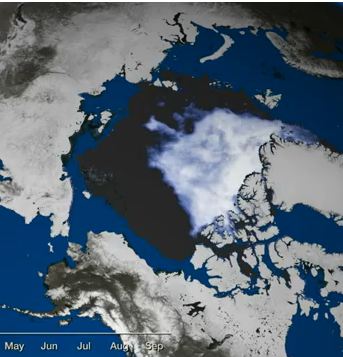
State of the world’s climate
According to the 2012 State of the Climate report released August, 2013 by the American Meteorological Society (AMS)
- Four major independent datasets show 2012 was among the 10 warmest years on record.
- Minimum Arctic sea ice extent in September and Northern Hemisphere snow cover extent in June each reached new record lows. Arctic sea ice minimum extent (1.32 million square miles, September 16) was the lowest of the satellite era and 18 percent lower than the previous record low extent of 1.61 million square miles that occurred in 2007.
- A new melt extent record occurred July 11–12 on the Greenland ice sheet when 97 percent of the ice sheet showed some form of melt, four times greater than the average melt this time of year.
- The Antarctic maximum sea ice extent reached a record high of 7.51 million square miles on September 26. This is 0.5 percent higher than the previous record high extent of 7.47 million square miles that occurred in 2006.
- Four independent datasets indicate that the globally averaged sea surface temperature for 2012 was among the 11 warmest on record.
- Heat content in the upper 2,300 feet, or a little less than one-half mile, of the ocean remained near record high levels in 2012. Overall increases from 2011 to 2012 occurred between depths of 2,300 to 6,600 feet and even in the deep ocean.
- Sea level reached a record high: Globally, sea level has been increasing at an average rate of 3.2 ± 0.4 mm per year over the past two decades.
- Continuing a trend that began in 2004, oceans were saltier than average in areas of high evaporation, including the central tropical North Pacific, and fresher than average in areas of high precipitation, including the north central Indian Ocean.
- Global tropical cyclone activity during 2012 was near average, with a total of 84 storms, compared with the 1981–2010 average of 89. Similar to 2010 and 2011, the North Atlantic was the only hurricane basin that experienced above-normal activity.
- Major greenhouse gas concentrations, including carbon dioxide, methane, and nitrous oxide, continued to rise during 2012. Global CO2 emissions from fossil fuel combustion and cement production reached a record high in 2011 of 9.5 ± 0.5 petagrams of carbon. A new record of 9.7 ± 0.5 petagrams of carbon is estimated for 2012.
- Atmospheric CO2 concentrations increased by 2.1 ppm in 2012, reaching a global average of 392.6 ppm for the year. In spring 2012, for the first time, the atmospheric CO2 concentration exceeded 400 ppm at several Arctic observational sites.
- Cool temperature trends continue in Earth’s lower stratosphere: The average lower stratospheric temperature, about six to ten miles above the Earth’s surface, for 2012 was record to near-record cold.( Increasing greenhouse gases and decline of stratospheric ozone tend to cool the stratosphere while warming the planet near-surface layers.)
Impact of humans
A draft of the United Nations IPCC Fifth Assessment Report (AR5) report leaked to the New York Times says that it is “extremely likely” that humans caused “more than half of the
observed increase in global average surface temperature from 1951 to
2010.” The draft report predicts that sea levels will rise by between 29 and 82cm by the end of the century, with scientists “fairly confident” that sea level will be closer to the upper limit. The report is being circulated for final review and will be released September 2013 to November 2014.
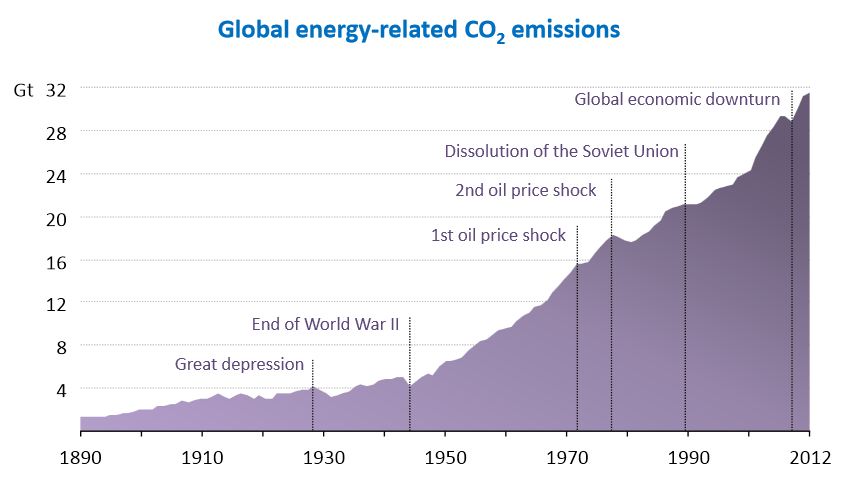 Energy-related emissions
Acording to the International Energy Agency (IEA), the energy sector accounts for two thirds of greenhouse gas emissions. CO2 emissions reached a record high in 2012 growing by 1.4% to reach 31.6 Gt in 2012.
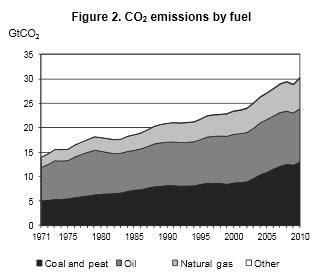 CO2 emissions by fuel type
According to the IEA, in 2010, 43% of CO2 emissions from fuel combustion were produced from coal, 36% from oil and 20% from
gas. Between 2009 and 2010, CO2 emissions from the combustion of coal increased by 4.9% and represented 13.1 GtCO2. Without additional abatement measures, the IEA projects that emissions from coal will grow to 15.3 GtCO2 in 2035.
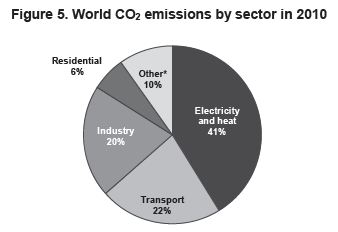 CO2 emissions by sector
Generation of electricity and heat was by far the largest producer of CO2 emissions and was responsible for 41% of world CO2 emissions in 2010. Worldwide, this sector relies heavily on coal, the most carbon- intensive of fossil fuels, amplifying its share in global emissions. Countries such as Australia, China, India, Poland and South Africa produce between 68% and 94% of their electricity and heat through the combustion of coal.
Between 2009 and 2010, total CO2 emissions from the generation of electricity and heat increased by 5.6%, while the fuel mix remained unchanged. CO2 emissions from coal increased by 4.7% and from natural gas by 9.5%.
 Carbon intensity
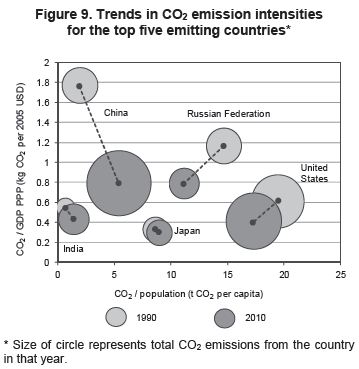
In 2010 among the five largest emitters of CO2, China, the Russian Federation and the United States have reduced their CO2 emissions per unit of GDP between 1990 and 2010.
Emissions per capita
Among the five largest emitters in 2010, the levels of per-capita emissions ranged from 1 tCO2 per capita for India to 5 tCO2 per capita for China to 17 tCO2 per capita for the United States. In 2010, the United States alone generated 18% of world CO2 emissions with a population of less than 5% of the global total. China contributed about thes same share of world emissions (24%) while accounting for 20% of the world population. India, with 17% of population, contributed more than 5% of CO2 emissions.

Be the first to comment