
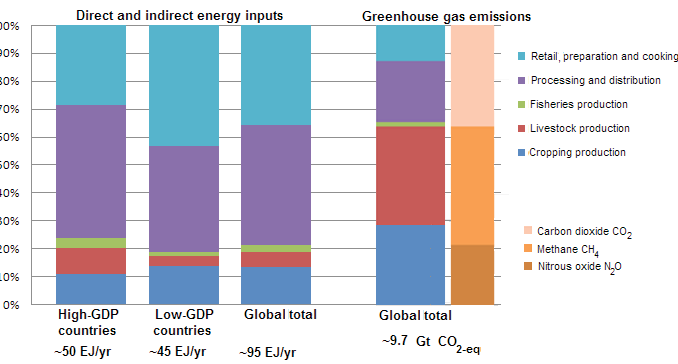
The UN Food and Agriculture Organization (FAO) has projected that by 2050 a 70 % increase in food production will be necessary to feed a world population of nine billion. The FAO’s first ever global assessment of the world’s land concludes that 25% of the earth’s is badly degraded and that a sustainable intensification of agricultural producitivity is required to meet the growing demand. In the past few decades the use of fossil fuels by agriculture has made a significant contribution to increasing agricultural producitivity through farm mechanization, higher fertilizer production and improved food processing and transportation.
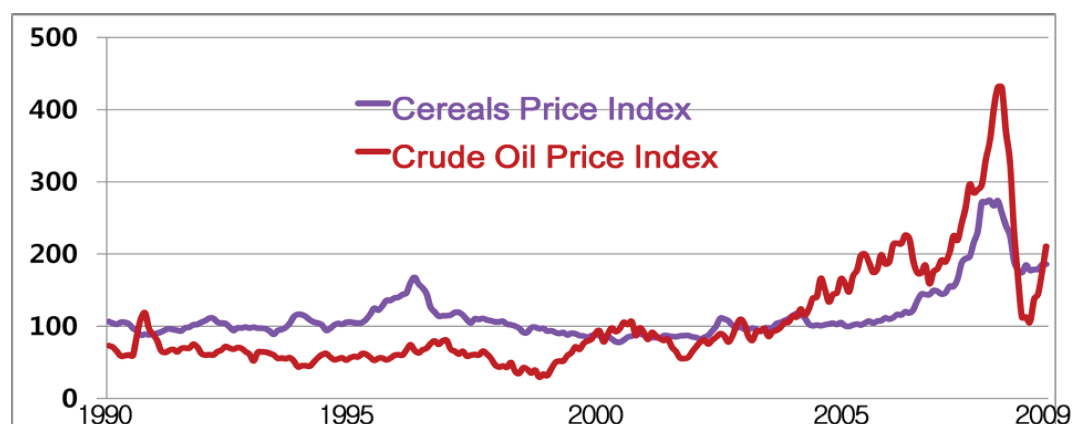 The food sector is now responsible for 30 percent of the world’s total energy consumption. Food prices tend to be linked with global energy prices. The food sector also contributes over 20 percent of total GHG emissions. The challenge we now face is to develop global food production systems that emit fewer GHG emissions, have a secure energy supply and are not dependent on fluctuating energy prices while at the same time providing food security.
According to the FAO one-third of the food we produce is not consumed and a significant share of total energy inputs are included in these losses. In low-GDP countries most food losses occur during harvest and storage. In high-GDP countries, food waste occurs mainly during the final stages of retail, preparation, cooking and consumption.
To meet increasing food demand in a sustainable way, a recent FAO paper Energy-smart Food for People and Climate recommends a major long-term program based on three foundations,
- energy access,
- energy efficiency
- energy substitution through the greater deployment of renewable energy systems
It recommends that local and national governments adopt policies that combine food and energy security to help meet sustainable development objectives while contributing to ‘Climate-Smart Agriculture’.

Be the first to comment