
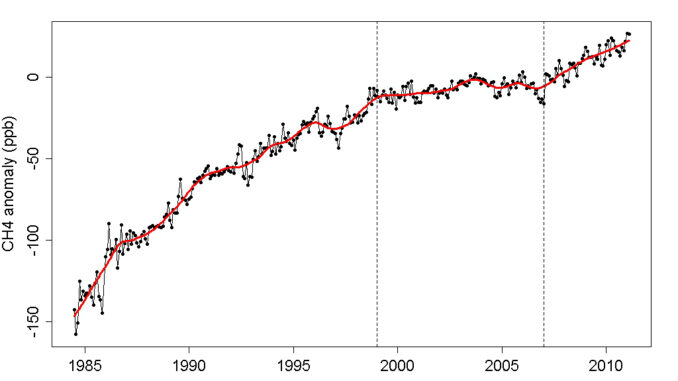
Methane is one of the more potent greenhouse gases for global warming. The concentration of methane in the atmosphere stabilized from about 1999 to 2007, but since 2007 began rising again. A recent study suggests that the more than 30% increase in U.S. methane emissions over the 2002–2014 period could account for 30–60% of the global growth of atmospheric methane seen in the past decade. The EPA has just initiated a process to update rules covering existing oil and gas sources.
Today the EPA Administrator, Gina McCarthy, signed the three final rules that are intended to reduce emissions of methane, volatile organic compounds (VOCs) and other toxic air pollutants from new, reconstructed and modified oil and gas sources. The new rules were issued in response to the President’s Climate Action Plan: Strategy to Reduce Methane Emissions.
The new rules apply to new oil and gas wells using hydraulic fracturing (fracking)
- Well completions (non-wildcat and non-delineation wells)
- Well completions (exploratory and delineation wells and low pressure wells).
- Fugitive emissions from well sites and compressor stations.
- Equipment leaks at natural gas processing plants
- Various types of equipment used at well sites and natural gas processing plants such as pneumatic compressors, pumps and controllers.
There are new reporting requirements. The final rule requires owners or operators to submit initial notifications and annual reports, in addition to retaining records to assist in documenting that they are complying with the provisions of the New Source Performance Standards.
Owners or operators of wells are required to submit an initial notification two days prior to the commencement of each well completion operation. This notification must include contact information for the owner or operator, the United States Well Number, the latitude and longitude coordinates for each well, and the planned date of the beginning of flowback.
The final rule includes new requirements for monitoring and repairing sources of fugitive emissions at well sites and compressor stations. An owner or operator must submit an annual report, which covers the collection of fugitive emissions components at well sites and compressor stations within an area defined by the company.
The EPA has estimated emissions reductions for 2020 and 2025. As a result of these new rules the EPA estimates that in 2020, emissions will be reduced by 300,000 tons of methane; 150,000 tons of VOC; and 1,900 tons of HAP. The emission reductions anticipated in 2025 are 510,000 tons of methane; 210,000 tons of VOC; and 3,900 tons of HAP.

Be the first to comment