
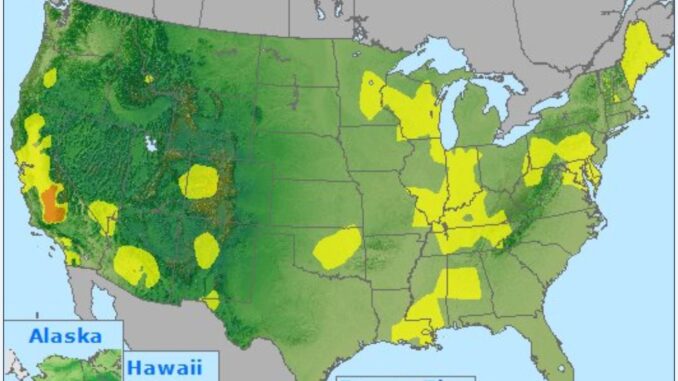
Ground-level ozone, a major contributor to smog, forms when nitrogen and volatile organic emissions from vehicles, industries, and power plants are exposed to sunlight. It affects people with respiratory diseases such as asthma and can lead to premature death. The current threshold of 75 parts per billion (ppb) was set in 2008.
On August 30, 2011, President Obama identified seven new government regulations that would cost the economy more than $1 billion each a year including four proposed Environmental Protection Agency (EPA) rules and three Department of Transportation (DOT) rules. The most expensive proposed EPA regulation was Ozone National Ambient Air Quality Standards estimated to cost $19-$90 billion. EPA’s analysis concluded that imposing a standard of 0.70 parts per million would have a net positive impact on the economy, as health benefits would outweigh the costs to industry.
September 2, 2011, President Obama withdrew the Ozone National Ambient Air Quality Standards. The same day then EPA Administrator Lisa P. Jackson issued a statement saying that the EPA would return to the regulation of ground-level ozone.
On November 25, 2014, the EPA proposed to strengthen the National Ambient Air Quality Standards (NAAQS) for ground-level ozone. EPA is proposing to update both the primary ozone standard, to protect public health, and the secondary standard, to protect the public welfare. Both standards would be 8-hour standards set within a range of 65 to 70 parts per billion (ppb). EPA is also seeking comment on levels for the health standard as low as 60 ppb. This regulation will have important implications for power plants, emitting industries, and vehicle emissions especially in the Midwest.
EPA estimates that meeting the standards will yield health benefits valued at $6.4 to $13 billion annually in 2025 for a standard of 70 ppb, and $19 to $38 billion annually in 2025 for a standard of 65 ppb. This would be for all of the U.S. excluding California. The primary health benefits include avoiding asthma attacks, heart attacks, missed school days and premature deaths. EPA analyzed the benefits and costs for California separately. The benefits from meeting the proposed standards in California add $1.1 to $2 billion annually after 2025 for a standard of 70 ppb and $2.2 to $4.1 billion for a standard of 65 ppb.
EPA will accept comments on the proposal for 90 days. A final decision will be issued by Oct. 1, 2015.

Be the first to comment