
Conservation voltage reduction (CVR) or volt-var is an approach to demand response (DR) and energy efficiency (EE) that can provide major benefits without significant alterations to the power distribution system, unlike other DR/EE approaches. Volt-var is used to reduce demand and energy consumption during peak load when electricity prices are inflated and demand may exceed the available energy while maintaining customer voltage power quality according to tolerances mandated by the regulator to protect consumer and utility devices. Peak demand can be reduced typically by 2 to 4 %. The business benefits are a greater percentage of energy delivered to paying customers, reduced investment in peaking generation plants or in buying power from generators at peak market prices, and a reduction in the environmental impact of energy delivery (reduced emissions).
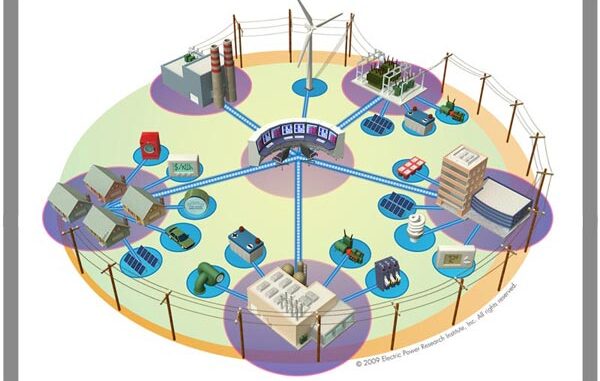
For the past seven years the Electric Power Research Institute (EPRI) has been leading a smart grid demonstration project initiative that includes regional demonstrations and supporting research focusing on smart grid activities related to integration of distributed energy resources (DER) including distributed generation, storage, renewables, and demand response technology. A number of well-known electric power utilities have participated in this program by developing and reporting on smart grid demonstration projects.
- AEP Smart Grid Demonstration
- Con Edison Smart Grid Demonstration
- Duke Energy Smart Grid Demonstration
- EDF Smart Grid Demonstration
- Ergon Energy EPRI Smart Grid Demonstration
- ESB Smart Grid Demonstration
- Exelon (ComEd/PECO) Smart Grid Demonstration
- Hawaiian Electric Company (HECO) Smart Grid Demonstration Project
- FirstEnergy Smart Grid Demonstration
- Hydro Quebec Smart Grid Demonstration
- KCP&L Smart Grid Demonstration
- PNM Smart Grid Demonstration
- Sacramento Municipal Utility District Smart Grid Demonstration
- Southern California Edison Smart Grid Demonstration
- Southern Company Smart Grid Demonstration
As an example, AEP’s smart grid demonstration project is based on a 10,000 customer pilot that includes smart meters, communications, end-use tariffs and controls, and distribution automation and volt/var control. It integrates other distributed and end-use technologies that are being evaluated by AEP including four MW scale sodium sulfur battery installations, two 70-kW roof-top photovoltaic systems, a new 5.7 kW concentrating solar technology, three 60 kW natural gas-fired reciprocating engines capable of combined heat and power generation, two plug-in hybrid electric vehicles, a large air conditioning system, two 10 kW wind turbines, and several 25 kW community energy storage systems (CES).
Currently a significant amount (about 10 %) of electric energy produced by power plants is lost during transmission and distribution to consumers. About 40 % of this total loss occurs on the distribution network.
In a recent blog, Jared Green, Project Manager for EPRI’s Smart Grid Demonstration Initiative reported a surprising finding from the Initiative. Through the Smart Grid Demonstration Initiative EPRI found that volt-var control was was one of the most effective technologies in reducing energy demand. EPRI reported that most of the utilities that ran demonstration projects had already deployed or were deploying volt-var technologies to optimize their distribution grids. Results from the demonstration projects showed that a significant reduction in energy demand could be achieved. EPRI’s analyses showed that for each 1 % reduction in voltage a corresponding 0.4-0.7 % reduction in energy demand was achieved.
For utilities that used volt-var control for targeted demand reduction, volt-var can reduce peak demand as well. Duke Energy, for example, reported reducing peak demand by about two hundred megawatts (MW) during the 2014 cold period in the Eastern U.S. It has been estimated that in the U.S. with every one percent reduction in peak demand there would be a reduced need to build a 7,900 MW power plant.
Even greater control and reduced risk can be achieved by Integrating volt-var with advanced metering infrastructure (AMI) and GIS. Volt-var/AMI/GIS provides greater precision in managing voltage reduction. At Distributech 2014, Tantalus reported using GIS is to produce voltage maps. Voltages reported by smart meters can be mapped geographically in real-time across the entire distribution network in the form of isovolt maps. This makes it possible to rapidly identify areas of low voltage and correct them in real time.

Be the first to comment