
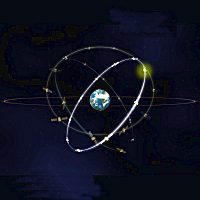
Galileo is the European civilian Global Navigation Satellite System (GNSS). Galileo has been developed as a collaboration between the European Union and the European Space Agency (ESA). Galileo is capable of positioning accuracy without earth stations down to the metre range. It is interoperable with the GPS (U.S.) and the Glonass (Russia) global satellite navigation systems.
On October 2nd the Russian space agency successfully launched the 24th satellite of the Glonass system, GLONASS-M, which is expected to enter service before November, restoring the GLONASS constellation to full operation capability.
A major differentiator with the GPS and Glonass sytems is that because it is able to immediately inform users of a satellite failure Galileo will have guaranteed availability of service, meaning it can be used for safety-critical applications
Two trial navigation satellites, GIOVE-A and B, were launched in 2005 and 2008. Today the first two of four operational satellites designed to validate the Galileo concept were launched from French Guiana. Two more will follow in 2012. Once the validation phase has been completed, the remaining ground and space infrastructure will be deployed. The first step will be an intermediate operational capability phase with 18 satellites in operation to be completed by 2015. The remaining satellites are scheduled to be in place by 2020. The fully deployed Galileo system will comprise 30 satellites, 23 000 km in altitude above the Earth.

Be the first to comment