
The European Commission (EC) has adopted the Communication “Energy Roadmap 2050“. which looks at different alternative scenarios reducing greenhouse gas emissions 80-95% below 1990 levels by 2050, which is a committment of the European Union (EU). In addition to reducing carbon emissions, the objective of the roadmap is ensuring security of energy supply and developing a competitive pan-European energy market.
The German Federal Minister of Economics and Technology said that the EC going in a similar direction to Germany’s perspective that a sustainable restructuring of the energy supply requires a solid economic foundation and one that ensures that EU industry continues to be competitive. In particular he identified the importance of the development of a pan-European network (grid).
The next step is for the the 2050 Energy Roadmap to be analysed in detail. The EU President plans to have the Council conclusions on the 2050 Energy Roadmap adopted by the Energy Ministerial Council in June 2012.
Energy policy for 2020 through 2050
In 2007 the European Council adopted the Energy 2020 policy, which commits the EU by 2020 to
- at least 20 % reduction in greenhouse gas emissions compared to 1990 (30% if international conditions are right),
- saving of 20 % of EU energy consumption compared to projections for 2020;
- 20 % share of renewable energies in EU energy consumption and 10% share in transport.
The measures taken to achieve the 2020 goals will reduce emissions by about 40% by 2050 and are insuffcient to achieve the EU’s 2050 carbon emissions goals. The objective of the Energy Roadmap 2050 is to explore alternative routes toward the 2050 carbon reduction objectives and to develop a long-term European technology-neutral framework in which national, regional, and local carbon reduction efforts can operate effectively.
Scenarios
Energy Roadmap 2050 looks at several different scenarios
- Reference – includes current trends and policies already in place, and assumes no new policy initiatives.
- Current Policy Initiatives (CPI) – adds new policy initiatives whihc are in the process of being adopted
- High Energy Efficiency – decrease in energy demand of 41% by 2050 through more stringent energy conservation measures
- Diversified supply technologies – competive energy market where all energy sources can
compete in the market basis including nuclear and Carbon Capture & Storage (CCS). - High Renewable energy (RES) – strong policy support for renewable energy with 97% of electric power coming from renewable energy by 2050
- Delayed CCS – like the Diversified supply technologies scenario but with delayed CCS, and accelerated nuclear
- Low nuclear – like the Diversified supply technologies scenario but with no new nuclear plants beyond what is currently under construction and accelerated CCS
 Conclusions
Based on these scenarios the report draws interesting conclusions.
- Decarbonisation is possible – Energy in a lower carbon economy can be less costly than current policies in the long-run.
- Higher capital expenditure and lower fuel costs – All decarbonisation scenarios show a transition from today’s system, with high fuel and operational costs, to an energy system based on higher capital expenditure and lower fuel costs.
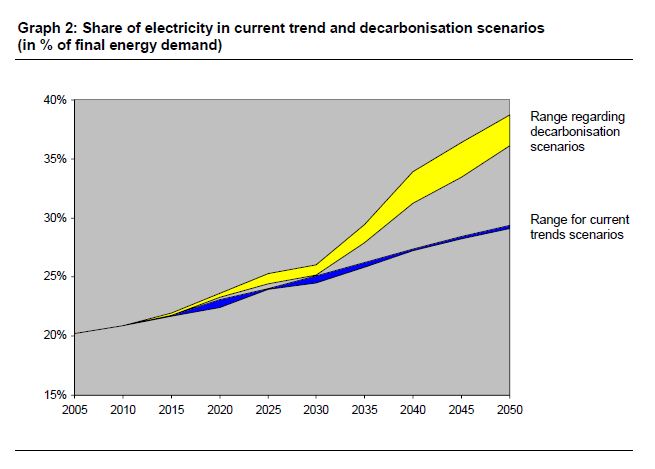
- Electricity plays an increasing role – All scenarios show electricity will have to play a much greater role than now (almost doubling its share in final energy demand to 36-39% in 2050) and will have to contribute to the decarbonisation of transport and heating/cooling.
- Electricity prices rise until 2030 and then decline – Most scenarios suggest that electricity prices will rise to 2030, but fall thereafter. The largest share of these increases is already happening in the reference scenario.
- Household expenditure will increase – In all scenarios including the Reference scenario expenditure on energy and energy-related products is likely to become a more important element in household
expenditure, rising to around 16% in 2030, and decreasing thereafter to above 15% in 2050. - Energy conservation is crucial
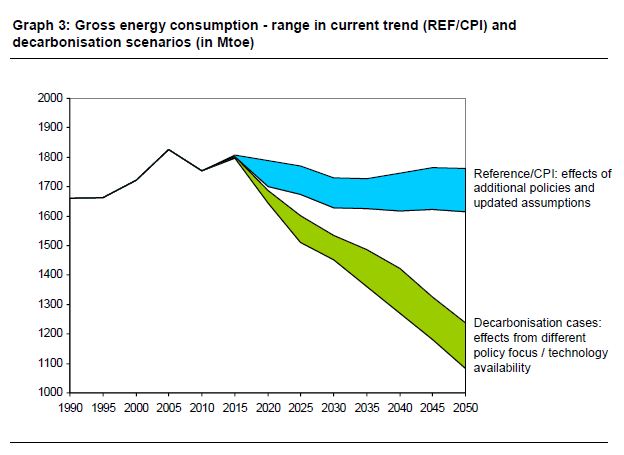
 – Very significant energy savings is needed in all decarbonisation scenarios. Primary energy demand need to drop by 32% to 41% by 2050 as compared to peaks in 2005-2006.
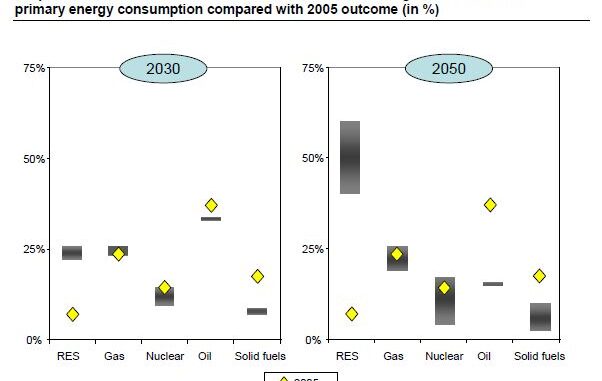
 - Renewables share rises substantially – The share of renewable energy rises substantially in all scenarios, reacjhing 55% in gross final energy consumption in 2050. The share of RES in electricity consumption reaches 64% to 97%.
- Carbon capture and storage is crucial – CCS will have to contribute significantly in most scenarios, implying that coal will likely continue to play an important role.
- Nuclear energy provides an important contribution – Nuclear energy need to provide a significant contribution in the energy because it remains a key source of low cost, low carbon electricity generation.
- Decentralization and centralized systems increasingly interact – Decentralization of the power system and increasing heat generation will result from more renewable generation, but intermittent renewable generation requires a centralized large-scale system to provide power when local renewable generation is inadequate to meet local demand.

Be the first to comment