

At the Second Annual Summit on Data Analytics for Utilities in Toronto, Lincoln Frost-Hunt, Director of Enterprise IT at Hydro One, gave a riveting presentation on how one utility has evolved from a company that in the past tended to use “gut feel” decision-making to a company that is increasingly relying on data-driven decision making,
Hydro One manages both transmission, almost 30 000 km or 96% of Ontario’s transmission network, and distribution, representing about 75% of Ontario, mostly rural but some urban as well. The total value of their assets is C$17 billion and they manage C$3 billion investment in their assets every year.
Data governance
Lincoln emphasized that a key prerequisite for a successful data-driven analytical approach is quality data. Bad data means bad decisions. They found that when they started to make investment decisions based on their analysis of their operational data, the deficiencies in their data sets immediately become apparent. For example, they found that only 76 % of their connectivity data was reliable, the remaining quarter was unusable. To ensure the necessary level of data quality and reliability data governance (processes that ensure that important data assets are formally managed) was a key underpinning of Hydro One’s analytics strategy. They implemented major projects to cleanup their connectivity and other data. Realizing that data quality is perishable, they also implemented a data governance policy and focused on improving business processes that produced bad data such as the processes for managing as-builts, which I have blogged about on multiple occasions, most recently here. In addition to ensure that their data quality level does not degrade overtime and that it is maintained at the required level of reliability, they have implemented a system of quarterly audits.
Data analytics
Lincoln described several areas where Hydro One’s data-driven approach has yielded value.
Customer billing
 Since this is Ontario, all of Hydro One’s customers have smart meters. Hydro One processes 65 000 bills per day. This is a key essential process because this is a major source of revenue. A certain proportion of these get kicked out because of problems. Since seven years ago when they first installed smart meters, tracking down the problems that caused these bills to be rejected was a slow manual process that used a lot of resources. In the last two years Hydro One has implemented an analytical tool set that allows them to resolve these problems and get the bills out to the customers much more rapidly. Since bills generates revenues, the value derived from the analytical approach was immediately apparent to managment and helped gain support for the data-driven approach to decision-making.
Asset management
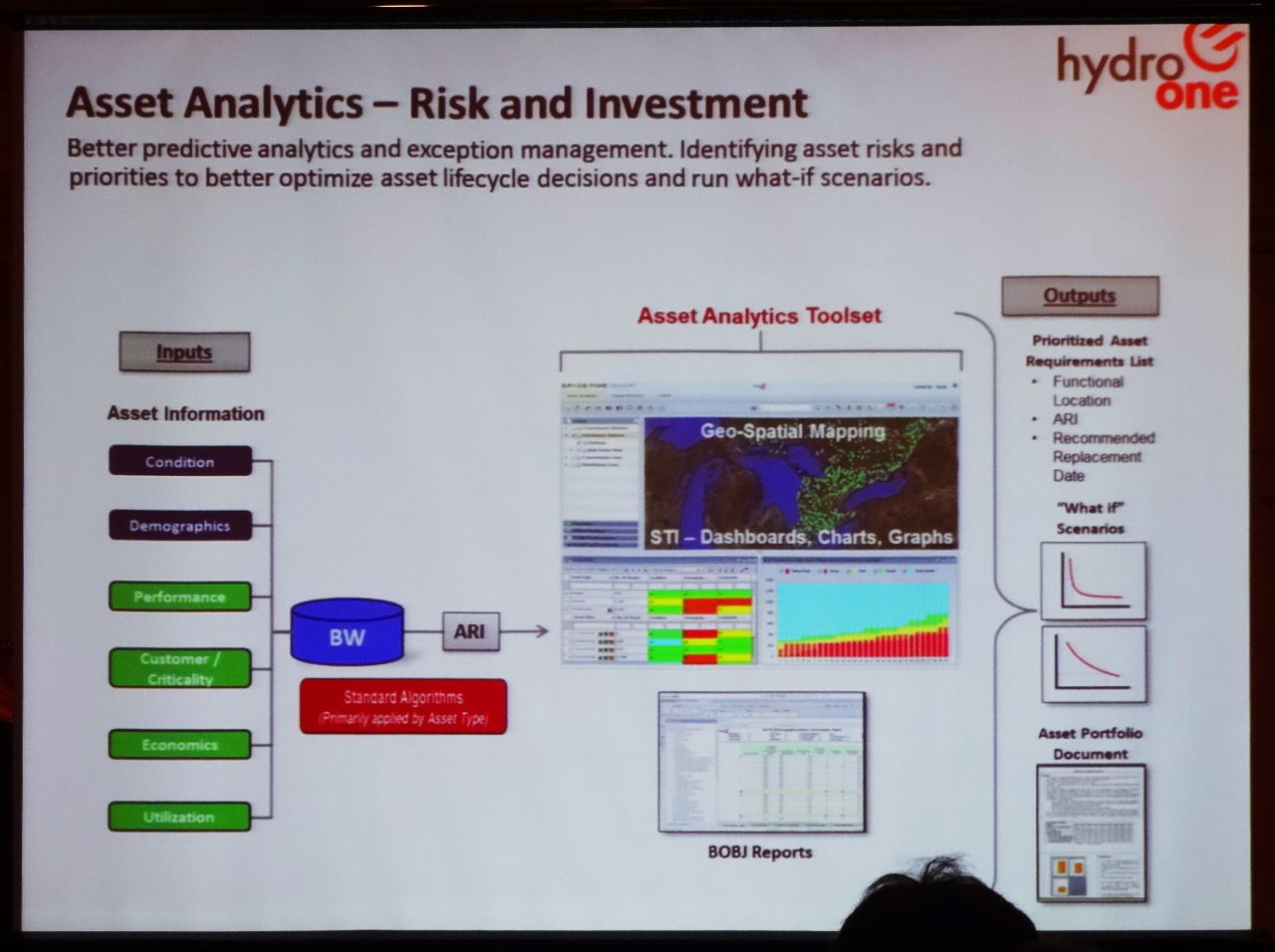
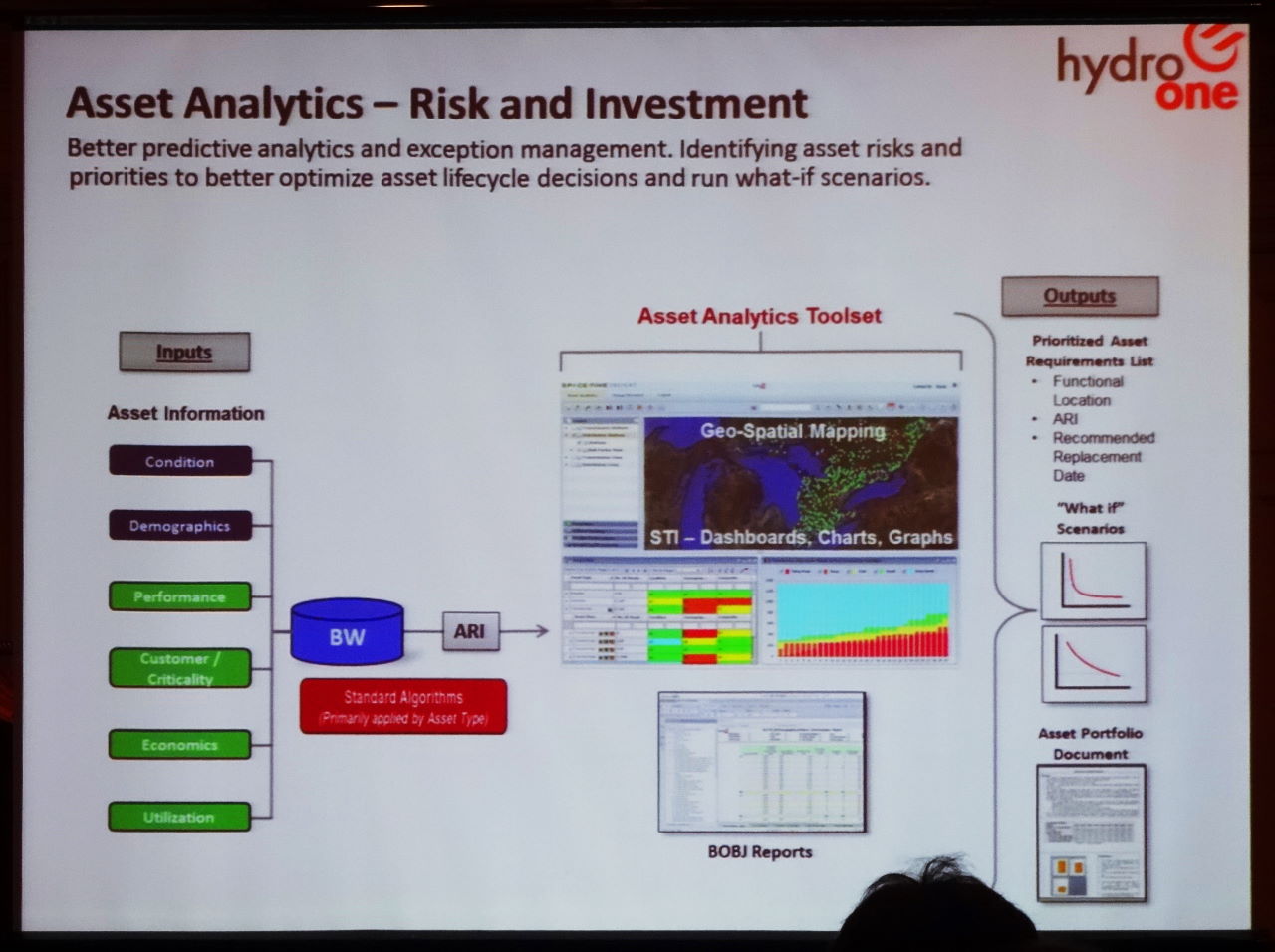 Improving utilization of assets is a key objective of the regulator, the Ontario Energy Board (OEB). Hydro One took an analytical approach based on modeling equipment failure so that they could estimate the probability of failure based on external conditions such as age and average load. This allowed them to generate risk curves which enables them to demonstrate to the OEB that their investment strategy had found the sweet spot between the cost of maintenance and reducing the risk of major failure. Geospatial technology was a key part of the asset analytics toolset that helped them optimize the lifecycles of their assets.
Workflow optimization
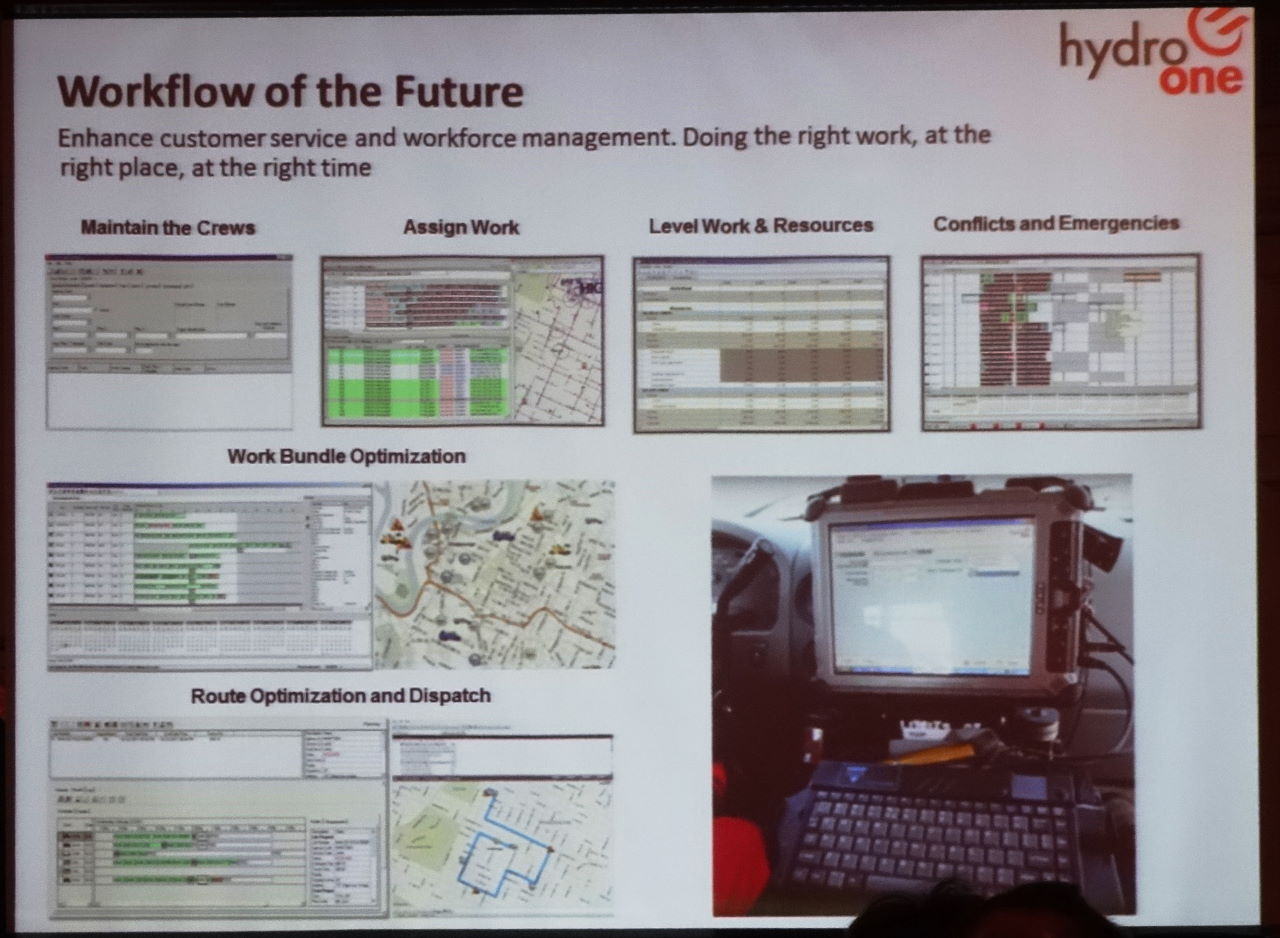 Like most utilities, Hydro One is facing the challenge of an aging workforce, so improving productivity is a key corporate objective. This is an especial challenge for Hydro One because of its largely rural service area. Sending a crew to resolve a problem or respond to a service request could require hours of driving to the site and back. Putting together “work bundles” comprising all the service requests and trouble calls in a geographic area reduces the time the crew spends on the road and maximizes their time actually resolving issues and servicing requests. To do this they installed GPS, communications and ruggedized tablets on every truck so they knew where every crew was and the crews had access to the information they needed. They also were able to show all trouble calls and service requests on a map for a three month period so they could easily assemble work bundles by geographic areas. Another major benefit they found was that when they received an emergency trouble call, they could determine immediately which crew was nearest, thus minimizing travel time. They also invested in route optimization so that the crew knew the most efficient route to follow. The bottom line is that crews spent significantly less time driving and more time resolving trouble calls and responding to service requests.
Enterprise architecture
Lincoln described Hydro One’s current enterprise architecture as comprised of three major enterprise systems with many heavily customized point solutions. I suspect that many utilities would find themselves with a similar architecture. Each point solution is a silo and the enterprise systems are big silos. Whatever interoperability there is has either been customized or acquired from a third party by Hydro One. Every time a vendor upgrades a point solution, Hydro One has to retest the links to other systems.
They evaluated three alternative architectures ranging from a best of breed approach with many point solutions focused on automating key business processes to a single enterprise system with bolt-ons or point solutions designed to run with the single enterprise system. They decided on a hybrid approach, a single enterprise system with minimal point solutions when justified by incremental value.
Basically Hydro One relies on SAP for key business functions like ERP, customer information management, and asset management. Their analytical tool set is Business Objects, another SAP module, integrated with a GIS designed to integrate with SAP.
As an example of a bolt-on, they use an advanced visualization tool (Space-Time Insight which is an SAP partner) as part of their analytics tool set. Lincoln said that visualization had really changed people’s view of analytics because it enabled them to visualize operational data in space and time in ways they had been able to do before. Visualizing based on geolocation, time and network topology has helped them gain insights about their operations that they would never have seen by looking at Excel spreadsheets. It also created a bit of a challenge for Hydro One’s IT folks, because it created an IT traffic jam – everyone wants to use the visualization tool and no one wants to look at Excel spreadsheets.
Smart zone
Hydro one has implemented what they call a “smart zone” around Barrie, north of Toronto, where all equipment are intelligent electronic devices (IEDs) including automated substations, basically a distribution smart grid. They intend to roll this out to the rest of their service territory.
Real-time big data
Hydro One realizes that the volume of data they need to manage is increasing astronomically, and with IEDs they need to be able to analyze and make decisions in real-time or at least near real-time. Lincoln said that their next major IT development focus is to be better able to manage “big data” in real-time. I have blogged on a couple of occasions (real-time monitoring smart devices for decision making and using social media streams to improve customer experience) about an example of technology that is designed to help do this.

Be the first to comment