
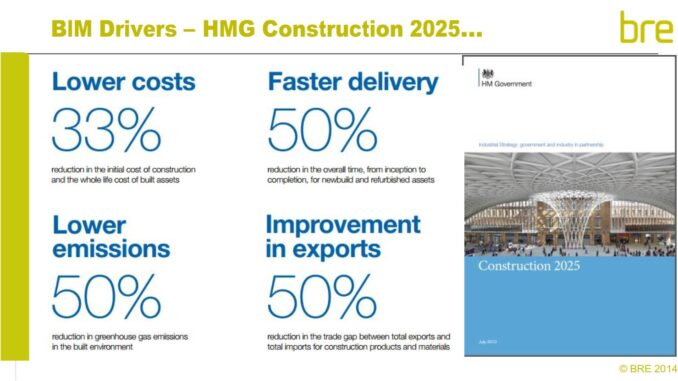
The UK Government’s goal for construction industry is to reduce the CAPEX for public construction (design and build) projects. To reach its goal for the construction industry the UK Government has undertaken several initiatives, one of which is a commitment to embrace Building Information Modelling (BIM) in Government projects. For public projects BIM has been mandated starting in 2016. The main motivation for this incredible effort to transform the UK public construction industry over a 5-year time frame is intended to reduce costs. When the current government took over the reins, the UK Government was broke and desperately needed to find a way to do more with less. Other goals include reducing the UK’s carbon intensity in line with its EU carbon commitments and making the UK a leader in the international BIM construction market.
The UK Government has explicitly targeted Level 2 BIM in the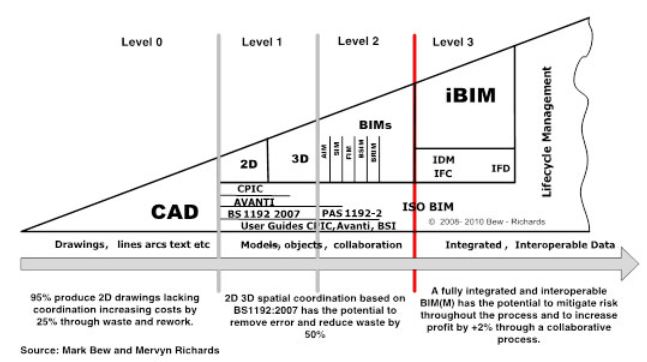 maturity ramp, defined as “file based collaboration and library management.” Level 2 BIM is a series of domain specific models (e.g. architectural, structural, services etc) where structured data can be shared based on COBie UK 2012. The mandate is quite far reaching. The projects that are covered are defined on the BIM Task Force’s site,
The Government Construction Strategy (GCS) requires that: Government will require fully collaborative 3D BIM (with all project and asset information, documentation and data being electronic) as a minimum by 2016. This refers to all centrally procured Government projects as outlined in the GCS including new build and retained estate, vertical and linear. The Government Construction Strategy and it’s BIM intervention is far reaching (there is no minimum value (£) on a BIM enabled project).
The initial focus is on the design/build part of the lifecycle, but the government has said that “the 20% saving refers to CapEx cost savings however we know that the largest prize for BIM lies in the operational stages of the project life-cycle”.
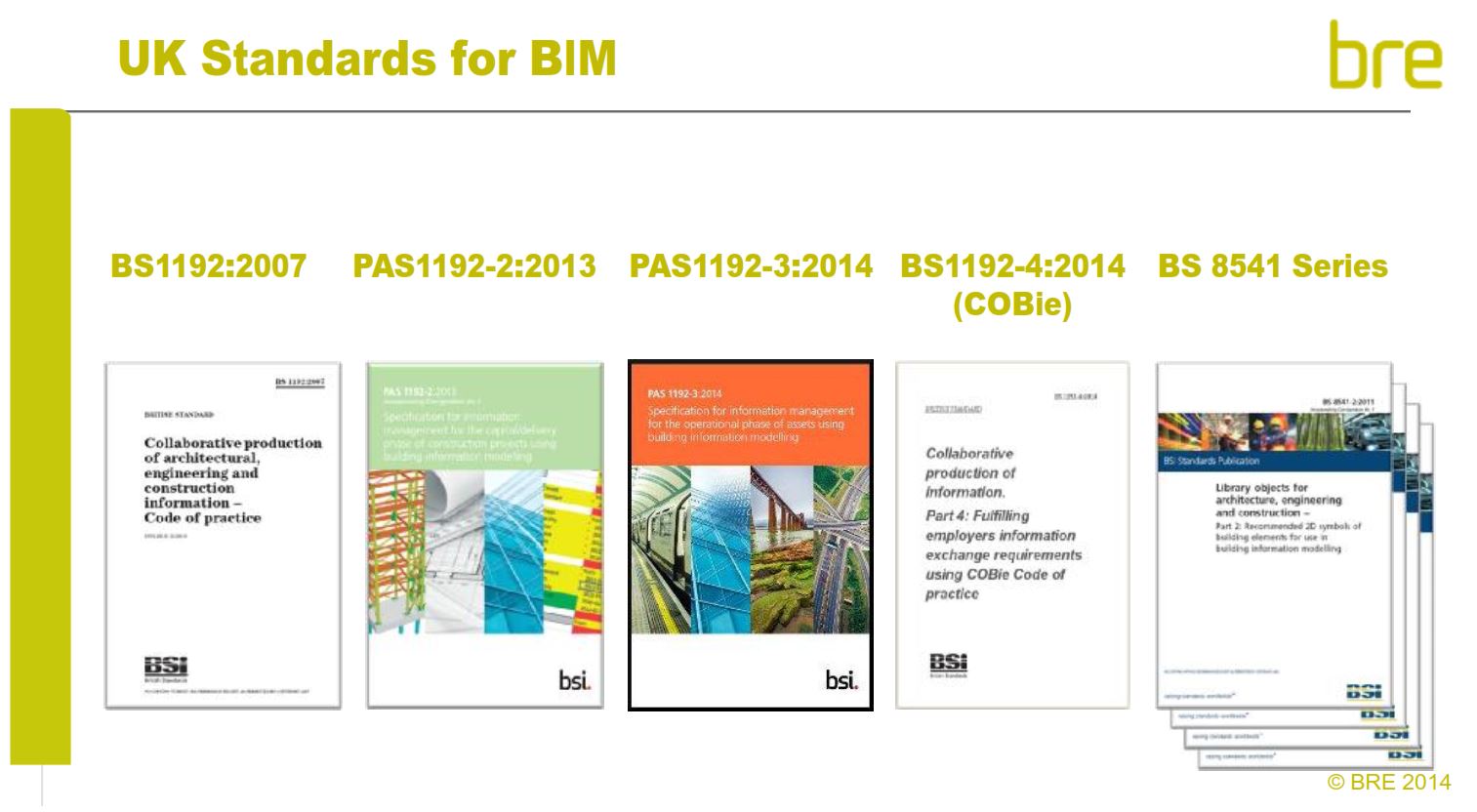
BIM Standards in the UK
 At the BIM Worldwide: Solutions for Canada conference in Toronto, Nick Tune Director at BRE and buildingSMART, outlined the next step for BIM in the UK which is BIM Level 3, an integrated BIM process characterized by a fully open process and data integration enabled by Industry Foundation Classes (IFC) and International Framework for Dictionaries (IFD). Whereas BIM Level 2 was essentially a homegrown UK-only effort that only now has begun to reach out to international standards organizations such as ISO to get British BIM standards adopted as ISO standards, BIM Level 3 will rely on collaboration with international standards organizations such as buildingSMART and ISO from the beginning.
Full lifecycle integrated BIM
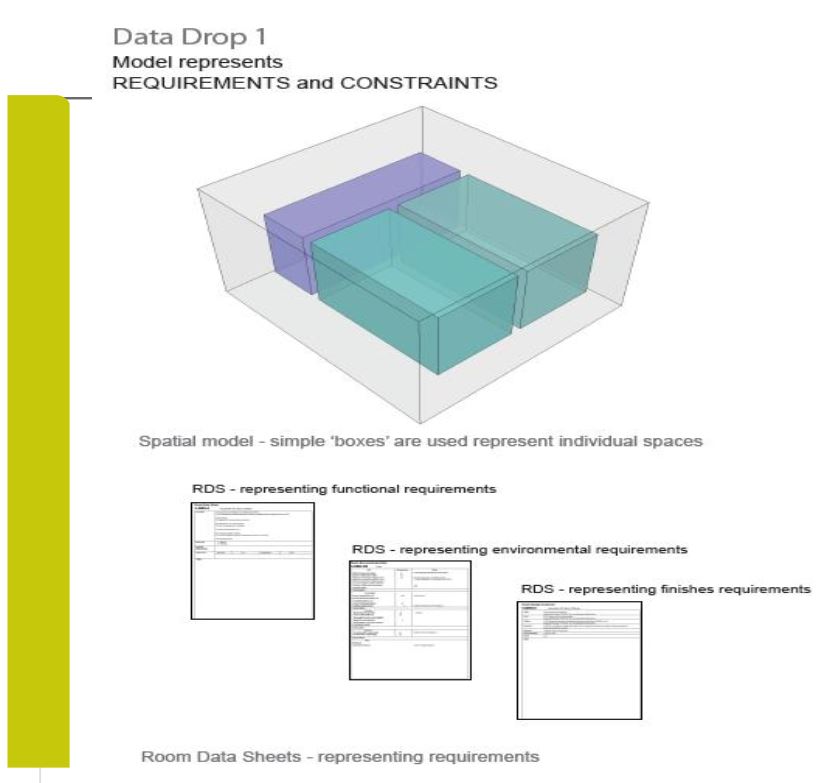 As an example of what is possible with BIM Level 3 Nick outlined a full lifecycle integrated BIM process that begins with requirements and constraints and ends with the delivery to the owner of a 3D model containing details of as-installed equipment, plant and furniture.
- Data Drop 1 – Model represents requirements and constraints including functional requirements, environmental and finishes requirements. 3D model is a simple space model with boxes representing rooms.
- Data drop 2 – Model represents outline solution. 3D model included generic mechanical, electrical and plumbing (MEP) and furniture, fixtures and equipment (FF&E) items such as sinks and desks.
- Data drop 3 – Model represents construction information. 3D model shows actual products, plant , equipment and furniture for MEP and FF&E items and includes local drawings.
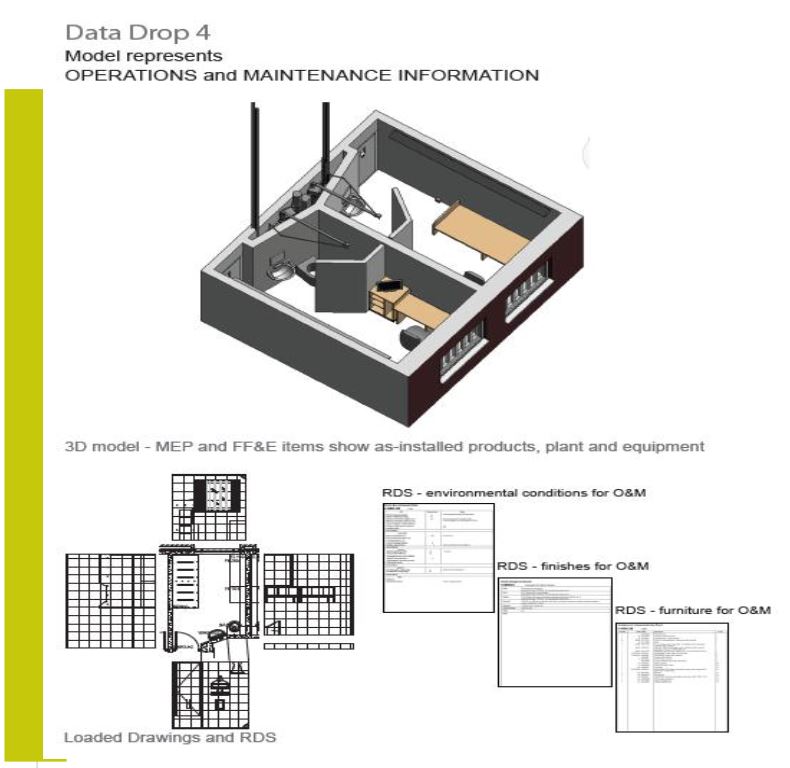
 Data drop 4 – Model represents operations and maintenance information. 3D model shows as-installed products, plant and equipment for MEP and FF&E items.
In response to a question about documented examples for the business benefits of a full lifecycle BIM process culminating in a BIM model for O&M, he said there is not yet information on the savings or ROI that can be expected with this process, but the government expects it to exceed the savings on design/build because its benefits extend over the 80-85% of a building’s total lifetime costs.

Be the first to comment