
The Energy Independence and Security Act of 2007 (EISA) designated development of a smart grid as a national policy goal and specifically said that the interoperability framework should be “flexible, uniform, and technology neutral” while at the same time encouraging new, innovative smart grid technologies.
According to EISA the Federal Energy Regulatory Commission (FERC) is responsible for rule making to set standards to insure smart-grid interoperability in interstate transmission of electric power, and regional and wholesale electricity markets and has supported the NIST effort to define standards for the smart grid. Once FERC is satisfied that the standards have evolved to the point of achieving a “consensus”, it can mandate them through its rule making mandate.
As I blogged about last year, the US National Institute of Standards and Technology (NIST) recognized that there is an urgent need to establish standards for the smart grid. NIST focussed on standards identified by the Federal Energy Regulatory Commission (FERC) plus additional areas identified by NIST. The priority action areas are
0 Meter Upgradeability Standard
1 Role of IP in the Smart Grid
2 Wireless Communications for the Smart Grid
3 Common Price Communication Model
4 Common Schedule Communication Mechanism
5 Standard Meter Data Profiles
6 Common Semantic Model for Meter Data Tables
7 Electric Storage Interconnection Guidelines
8 CIM for Distribution Grid Management
9 Standard DR and DER Signals
10 Standard Energy Usage Information
11 Common Object Models for Electric Transportation
12 Mapping IEEE 1815 (DNP3) to IEC 61850 Objects
13 Harmonization of IEEE C37.118 with IEC 61850 and Precision Time Synchronization
14 Transmission and Distribution Power Systems Model Mapping
15 Harmonize Power Line Carrier Standards for Appliance Communications in the Home
16 Wind Plant Communications
17 Facility Smart Grid Information Standard
18 Smart Energy (SEP) Profile 1.X to 2.0 Transition
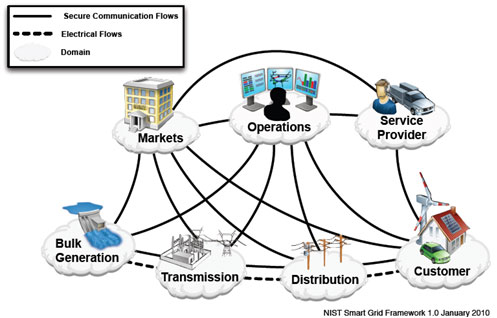 Early in 2010 NIST released a Framework and Roadmap for Smart Grid Interoperability Standards 1.0. The Framework is a conceptual reference model for the smart grid, identifies existing standards that are applicable to the development of the smart grid, identifies high-priority gaps for which new or revised standards are necessary, outlines action plans with timelines and standards organizations for addressing these gaps, and addresses smart grid cybersecurity.
In a letter to FERC in April 2011, NIST encouraged FERC to “endorse the use of the NIST interoprarbilioty framework as implementation guidance rather than mandating the use of inidividual standards.”
Earlier this week FERC announced (Smart Grid Interoperability Standards [Docket No. RM11-2-000] Issued July 19, 2011) its finding that that there is “insufficient consensus for the five families of standards under consideration and that it will not institute a rulemaking proceeding at this time with respect to these standards.” FERC says that it encourages stakeholders to actively participate in the NIST interoperability framework process to work on the development of interoperability standards and to refer to that process for guidance on smart grid standards.
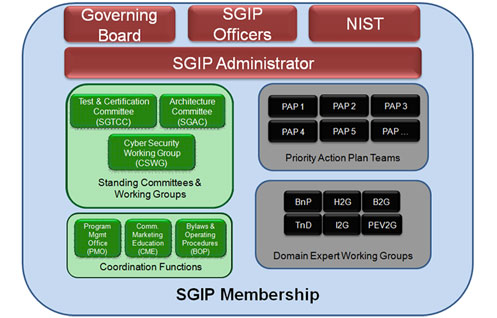 NIST has responded by saying that NIST supports FERC’s order and believes it is unnecesary for FERC to mandate interoperability standards. NIST said that it believes that “it can send appropriate signals to the marketplace by recommending use of the NIST Framework”. NIST further said that it believes that the Framework developed through the Smart Grid Interoperability Panel (SGIP) process is “comprehensive and represents the best vehicle for developing standards for the smart grid.”

Be the first to comment