
I have blogged on several occasions about the ASCE’s widely recognized Report Card for American Infrastructure which has highlighted the poor state of American infrastructure by not only assigning a grade but also attempting to estimate the total investment that is required to bring U.S. infrastructure up to an acceptable standard. The ASCE Report Card for 2009 includes Aviation (D), Bridges (C), Dams (D), Drinking Water (D-), Energy (D+), Hazardous Waste (D), Inland Waterways (D-), Levees (D-), Public Parks and Recreation (C-), Rail (C-), Roads (D-), Schools (D), Solid Waste (C+), Transit (D), and Wastewater (D-), for an overall GPA of D and an estimated five year investment requirement of $2.2 trillion.
Other countries have also attempted to do similar report cards for some of their infrastructure, including Japan, Australia, New Zealand, South Africa, and the United Kingdom. At least one city, Hamilton, Ontario has generated an infrastructure report card for its municipal infrastructure.
In 2007 the Federation of Canadian Municipalities (FCM) conducted a survey of municipal infrastructure and estimated that the municipal infrastructure deficit in Canada in
2007 was C$123 billion. The FCM broke this down by key infrastructure
categories,
- water and waste water systems – $31 billion
- transportation – $21.7 billion
- transit – $22.8 billion
- waste management – $7.7 billion
- community, recreational, cultural and social infrastructure – $40.2 billion
The first Canadian Infrastructure Report Card was released this month by the Canadian Society for Civil Engineering (CSCE), the Canadian Public Works Association (CPWA), the Canadian Construction Association (CCA) and the FCM.
The Report Card assesses the state of Canada’s municipal drinking water, wastewater, storm water and road systems at a national level based on survey results from 123 municipalities representing about two thirds of Canadians.
The Report Card estimates the total value of Canada’s municipal water, wastewater, storm water and road systems across the country at $538 billion. Of this
- $50.7 billion is assessed as being in poor or very poor condition.
- $121.1 billion is assessed as being in fair condition.
This is considerably higher for the comparable categories than the FCM estimated in 2007.
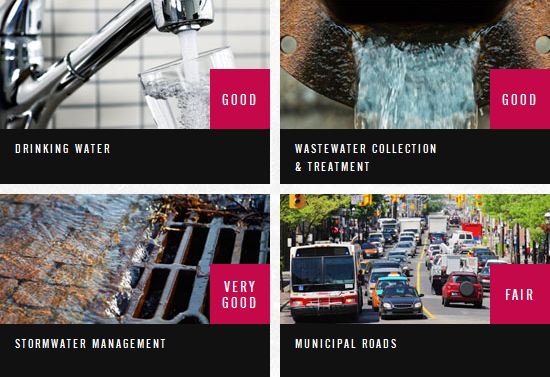
Municipal roads (Fair)
More than half the roads surveyed fall below a rating of “good”: 32% are in “fair” condition, and 20.6% are in “poor” to “very poor” condition, for a total of 52.6%. ( A grade of “Fair” means the infrastructure “shows general signs
of deterioration and requires attention, with some elements exhibiting
significant deficiencies.” ) The estimated replacement cost of the roads in fair to very poor condition is $91.1 billion, nationally.
Wastewater (Good)
40% of wastewater plants, pumping stations and storage tanks in “fair” to “very poor” condition, and 30.1% of pipes are assessed to be in “fair” to “very poor” condition. The replacement cost for the wastewater infrastructure in “fair” to “very poor” condition is $39 billion. In addition the Federal government has just introduced Canada’s first regulations covering wastewater treatment which will require an additional significant level of investment which the FCM has estimated could cost municipalities over $30 billion.
Drinking-water (Good)
15.4% of the systems were ranked “fair” to “very poor” for the condition of their pipes. 14.4% of plants, reservoirs and pumping stations were ranked “fair” to “very poor”. The replacement cost for the drinking-water infrastructure in “fair” to “very poor” condition is $25.9 billion.
Stormwater (Very good)
12.5% of stormwater installations surveyed fall below “good” condition. 23.4% of stormwater pipes are assessed to be “fair” or “poor”. The replacement cost for stormwater infrastructure in “fair” to “very poor” condition is $15.8 billion.
Be the first to comment