

In its 2017 Infrastructure Report Card, the American Society of Civil Engineers (ASCE) assigned an overall grade of D+ to U.S. infrastructure. Addressing the problem of bringing national infrastructure up to a standard where it becomes an enabler of economic expansion rather then a drag on the economy is hindered by a lack of systematic information readily available to decision makers on the nation’s inventory of infrastructure assets, their location, and condition. Geospatial data and technology are key to providing an accessible platform making it possible for decision makers to have a uniform view of the nation’s infrastructure. Access to this data is constrained by a variety of factors including the lack of interoperability across systems and proprietary rights. Also, data is often not comparable. Consequently, infrastructure challenges cannot be assessed in an integrated way or communicated effectively to the relevant decision-makers and constituencies.

 Initiative to create a national infrastructure map
To begin to address this challenge National Academy of Public Administration (NAPA), Arizona State University (ASU), the American Geographical Society (AGS), and the National Academy of Construction (NAC) partnered to put on an event to convene leaders in public administration, infrastructure development, geography, geospatial, and data integration/open data. Entitled “Building a Shared Map of the Nation’s Infrastructure to Enable Smart Investments” , the event was held at Arizona State University in Tempe, Arizona.
By way of background NAPA is a congressionally chartered, non-partisan organization with a mandate to make government work better. After the last presidential election NAPA decided to get out of Washington and talk to people in different levels of government across the country. NAPA talked to local government people in Sacramento, Austin, Syracuse, and in Virginia and came to the conclusion that there is a need for a national strategy for infrastructure. Infrastructure is local, but data with the granularity that is required is not available. Data is uneven, is not integrated and is basically not interoperable. The challenge is not technical, but one of leadership and effective public administration. The need for a national strategy was reinforced by the Trump administration’s infrastructure plan which appears to only provide federal support for state initiatives.
State of U.S. infrastructure
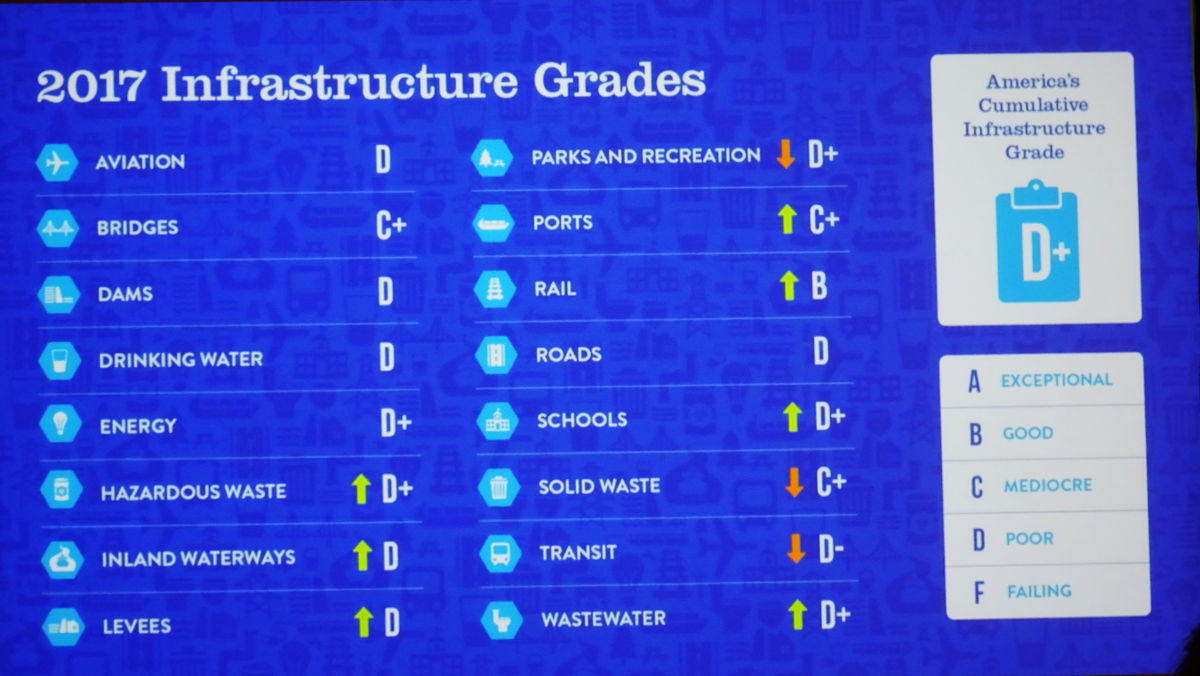 Introduced by Terry Gerton, President and CEO of NAPA and Jonathan Koppell, Dean, College of Public Programs, Arizona State University, the keynote was delivered by Greg DiLoreto, Former President, American Society of Civil Engineers, who provided an overview of the challenge from the perspective of the latest American Society of Civil Engineers report card.
- Aviation D : Two million passengers are served daily bu U.S. airports, but congestion is growing and it is expected that 24 of the top major airports may experience “Thanksgiving-peak traffic volume” at least one day a week.
- Bridges C+ : The U.S. has 614,387 bridges of which 9.1 % or 56,000 were structurally deficient in 2016.
- Dams D : 17% of U.S. dams or 15,498 have been identified as high-hazard potential dams. Nationwide, 73 dams failed between 2010 and 2015.
- Drinking water D : There are an estimated 240,000 water main breaks in the U.S. every year and 6 billion gallons of treated drinking water are lost every year.
- Energy D+ : There were 3,571 power outages in the U.S. in 2016. Most electric power infrastructure has exceeded its life-expectancy.
- Hazardous waste D+ : There are over 18,000 hazardous waste sites in the U.S. 53% of the American population live within three miles of a hazardous waste site.
- Inland waterways D : The U.S. has 25,000 miles of inland waterways. 49% of vessels experience delays across the waterway systems.
- Parks and recreation D+ : Seven of ten Americans use park facilities on a regular basis. About $11.9 billion in maintenance has been deferred by the National Park Service because of underfunding.
- Rail B : The U.S. rail industry invested $27.1 billion in infrastructure in 2015. Rail was one of the brighter spots on the report card.
- Roads D : America’s road are often congested resulting in Americans spending 6.9 billion hours, or 42 hours per person, stuck in traffic every year. The The Pacific Institute for Research and Evaluation (PIRE) estimates that over half of the deaths that occur on America’s roadways can be blamed on poor road conditions.
- Schools D+ : There are about 100,000 schools in the U.S., serving 50 million K-12 students every day. About a quarter of public schools are rated to be in fair or poor condition.
- Solid waste C+ : Americans generate 258 million tons of municipal solid waste every year of which 53% ends up in landfill.
- Transit D- : Transit in America is losing ridership in some regions, the result of chronic underfunding which has generated a $90 billion maintenance backlog.

Be the first to comment