
The final presenter that I introduced at the FOSS4G plenary session Thursday was Andy Pitman, Professor of Atmospheric Science and Co-director of the Climate Change Research Centre at the University of New South Wales and a lead author on the Intergovernmental Panel on Climate Change (IPCC).
CO2 in the Atmosphere
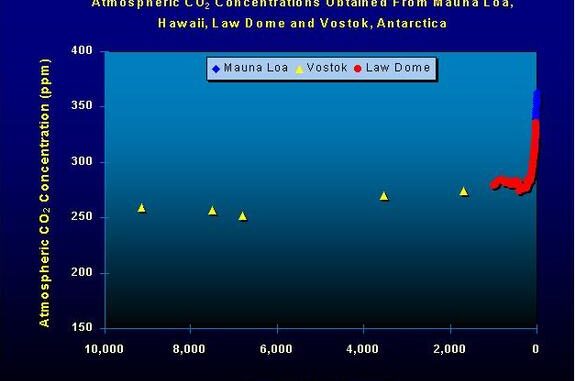
Profesor Pitman gave an an overview of some of the observed changes in the Earth’s climate including a ten thousand year perspective on CO2 concentrations in the Earth’s atmosphere. For ten thousand years CO2 concentrations were in the range 260-280 ppmv, but in the last one hundred years have reached 385 ppmv. He said categorically that the human species has become a dominant factor in determining Earth’s climate. He also said we are approaching a level of acidity in the Earth’s oceans at which calcium carbonate (CaCO3) would no longer precipitate, which will radically change sea life as we know it. (Image CO2 Science)
Climate Models
Professor Pitman then gave an overview of climate modeling, which is typically based on a grid comprised of 300km x 300km cells with 20 vertical layers in the atmosphere and 30 layers in the ocean. These are computationally intensive calculations, requiring massively parallel petaflop (1015 floating point operations per second) or in the future exaflop (1018) computers. (For a list of the world’s fastest computers see the TOP500 list. Currently the fastest computer is the IBM BladeCenter at Los Alamos National Lab which has 129 600 cores and has achieved 1.1 petaflops measured using the LINPACK benchmark suite.)
There are many climate models around the world, most of which are proprietary. The exceptions are the Community Climate System Model (CCSM) led by UCAR and Goddard Institute for Space Studies (GISS) atmospheric models (GISS ModelE, GISS AOM-GR, and GISS GCM-Model II) part of NASA in the US, which are open source.
Fortran
 Most if not all climate models are written in Fortran, either Fortran77, Fortran90, or Fortran95, which might have been a surprise to many in the audience who thought that programming began with C or Pascal. (After Professor Pitman’s talk I asked for a show of hands of those folks who had done Fortran programming and there were a significant number in the audience with Fortran experience including myself.) Professor Pitman said very unhappily that he knew of no universities with computer science courses in Fortran. (Image First Fortran Programmer’s Reference Manual for the IBM 704)
Open Source and Climate Models
Professor Pitman made an impassioned plea for more involvement by open source developers in climate models. The reasons he gave are that open source software has fewer bugs and software development processes for climate models lacks the rigourous error checking and testing of open source development.


Be the first to comment