
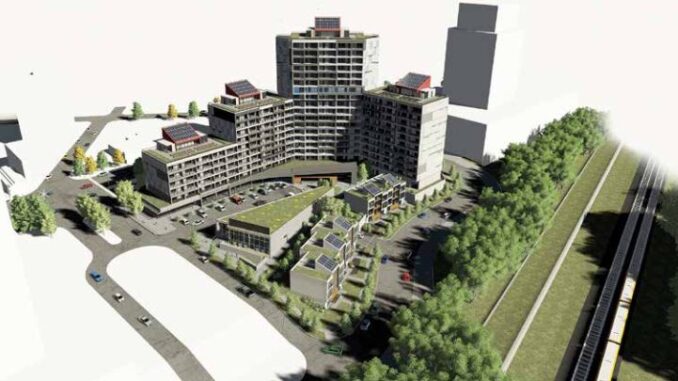
The Ottawa Chapter of the Canada Green Building Council last evening hosted a very informative presentation by Jamie Shipley and Thomas Green from the Canada Mortgage and Housing Corporation (CMHC) on lessons learned from CMHC’s EQuilibrium Communities Initiative and EQuilibrium Sustainable Housing Demonstration Initiative.
The EQuilibrium Communities Initiative are four sustainable community demonstration projects jointly funded by Canada Mortgage and Housing Corporation (CMHC) and Natural Resources Canada (NRCan). The initiative provided financial assistance to developers of the neighbourhood projects for research and technical activities to improve, monitor and showcase their performance in the six areas; energy, water and stormwater, protection of the natural environment, land use and housing, transportation and financial viability.
Jamie Shipley, a researcher with CMHC, gave an overview of the four EQuilibrium Communities projects: Station Pointe Greens in Edmonton, Alberta; Ampersand in Ottawa, Ontario; Ty-Histanis neighbourhood development 10 km from Tofino, British Columbia; and the Regent Park Revitalization in Toronto, Ontario, all of which are completed or near completion at this point. The achievements that Jamie described for these projects are quite remarkable and perhaps most remarkably because they have not increased costs significantly over what they would have cost if just built to meet the local building code.
Station Pointe Greens
Station Pointe Greens is a transit-oriented development 300 m from a light-rail transit station in a former industrial area northeast of downtown Edmonton. The Communitas Group Ltd. is building 219 co-operative homes, with mixed uses, in the form of mid- and high-rise construction, with some townhouses, all targeting Passive House criteria. (Passive House is a desing standard developed in Europe for reducing the energy consumption of houses. In Canada energy consumption can be reduced through PH by 80% or more). An ecological wastewater (“black” water) treatment facility has been installed in-site as part of the project.
The project has reduced energy requirements for heating and cooling by 90% compared to what would be required if the buildings had been built according to the Alberta Building Code. By installing green rooves, 50% of the site is classified as green. This also reduces storm water runoff. 100% of waste water is treated on site and reused as gray water. Perhaps the most remarkable aspect of this project is financial. The total cost was 1% above what it would have cost if built to code. This is quite a mremarkable achievment as buildung houses to the Passive House standard in Canada can require 10% more expenditure than building to code.
Ty-Histanis
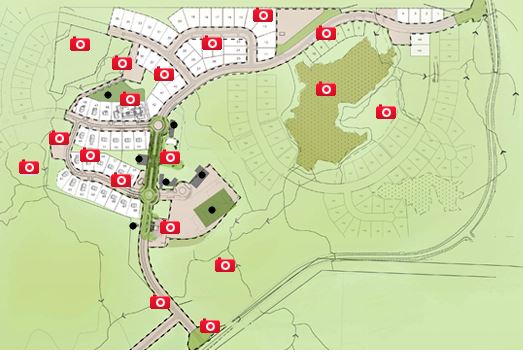 Tla-o-qui-aht First Nations (TFN) is developing a new community on 84 hectares of land near Tofino. The neighbourhood will 162 residential lots, up to 215 housing units, an elders’ complex, and a variety of community facilities located in the Community Core. By the end of 2012 all infrastructure is in place and 43 housing units had been built.
A key objective of the project is a 50 per cent reduction in greenhouse gases (GHGs) through energy reductions by using a district energy system using renewable energy sources and ground source heat pumps as well as building envelope improvements. At least 40 per cent of the development site has been maintained as undisturbed, natural habitat. Through the use of porous pavements only 14% of the total site surface area is classified as impermeable.
Ampersand
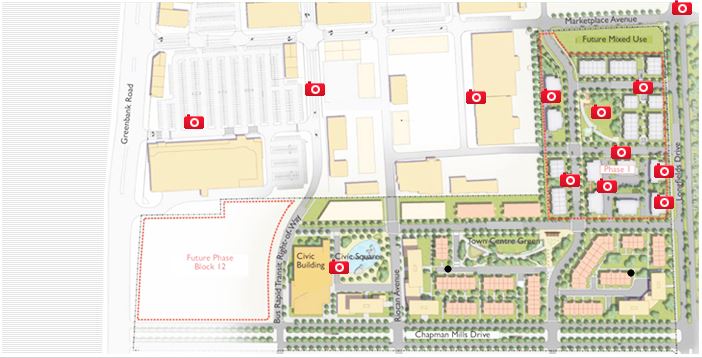 Ampersand is a transit-oriented development being developed by Minto. Phase 1 incudes 300 units in the form of stacked townhouses and 4-storey condominium apartments. One block of this development (14 units) is net-zero energy.
The project has a high level of pedestrian connectivity with access to high-quality community parks, commercial outlets, the existing OCTRANSPO bus transitway and Ottawa’s proposed Light Rail Transit. Remarkably, tree canopy coverage is 30 % of the site. A 30% reduction in energy usage compared to code has been achieved through a district heating system, solar PV on the rooves of the net zero energy buildings and improved building envelopes, appliances and mechanical systems.
Regent Park
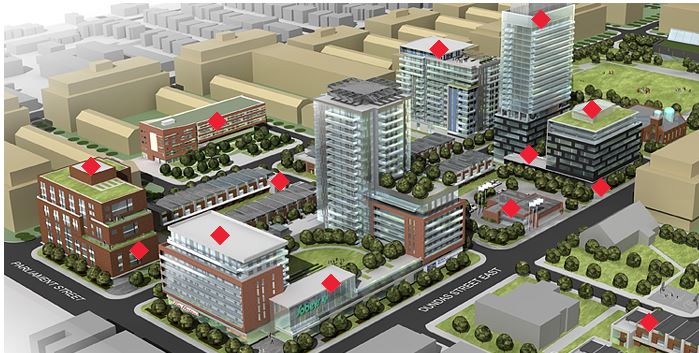 Revitalization of Regent Park is transforming Canada’s oldest and largest social housing community into a mixed-income community for 5,100 households. The EQuilibrium Communities initiative supported Phase 1, which includes over 1,000 townhouses, mid-rise and high-rise units, either market condominiums or affordable rental units for low to moderate income residents. This part of the project is fully occupied. Phase 1 also has 5,000 square meters of commercial, retail and community agency space.
One of the main objectives of the project is a high quality pedestrian environment with walking access to public transit, jobs, civic amenities and commercial outlets. This is a relatively high desnity development, but has been able to a achieve 30%-40% tree caopy coverage.
Energy consumption is 40 to 50 % lower than building to the Model National Energy Code for Buildings (MNECB) throgh energy-efficient building envelopes, lighting, appliances and mechanical
systems and a district heating system that uses commercial waste heat for residential heating.
The project uses 40-60% less potable water through low-flow fixtures, water-efficient
landscape design and tenant education. It also reduces runoff volume by 50 per cent through the use of green roofs and porous pavements.
Affordability is a key goal of this community development: 35 per cent of homes are market rental and all units have rents lower than the area average or are rent-geared-to-income.

Be the first to comment