

In June 2014, Sylvia Pinel, the Minister of Logement et de l’Égalité des territoires (Ministry of Housing), announced the intention to put in place a “French numerical strategy” with the possibility of making BIM mandatory in public procurement in 2017. At the first GeoBIM conference in Amsterdam Dr. Souheil Soubra, Deputy Director of IT at the Scientific and Technical Centre for Building (CSTB), gave an insightful presentation on the integration of BIM and geospatial information especially in the context of sustainable construction and urban development.
In this context he referred to the recent EU Procurement Directive (2014), which permits member states to mandate BIM.
“For public works contracts and design contests, Member States may require the use of specific electronic tools, such as building information electronic modelling tools or s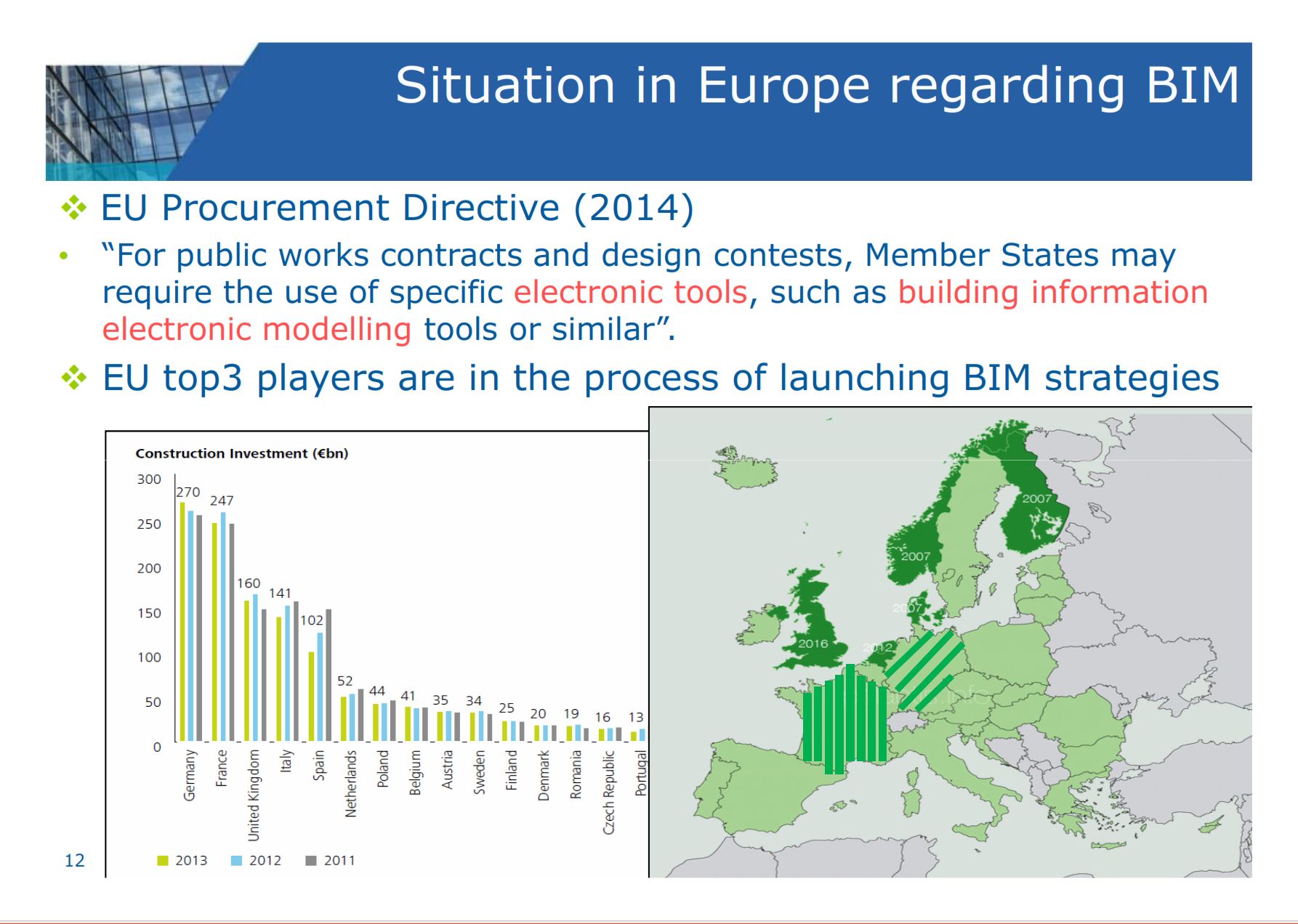 imilar”.
According to Dr Soubra, the top three economic players (Germany, France, and the UK) in Europe are in the process of launching BIM strategies. The UK has mandated BIM for national government procurement in 2016. It appears highly likely that France will mandate BIM for public procurement in 2017. The details of what is going to be included in that mandate are still being worked out. It also appears that Germany will implement a BIM strategy in a similar timeframe. Nordic countries including Norway (2007), Finland (2007), and Denmark (2007) and the Netherlands (2012) have already implemented BIM strategies for public procurement, but the combined economic weight of Germany, France, and the UK means that most public procurement in the EU will require BIM beginning in 2017.
Full lifecycle BIM: Construction, maintenance and building operations
Another fascinating aspect of BIM in France that Dr Soubra alluded to is a ten year project by the Conseil Regional de Bourgogne (Regional Council of Burgundy) to implement a full lifecycle BIM process including building operations, often referred to as facilities management (FM).
In 2004 the Conseil Regional de Bourgogne undertook a proactive approach to managing its property portfolio which consists primarily of high schools. It decided to implement a BIM-based building management strategy. The long-term vision of the Regional Council’s building management strategy is to optimize the technical operation of its buildings through the sharing of data based on the use of BIM in construction, renovation/maintenance and building operations. Ten years ago the Regional Council became the first community in France to deploy BIM models for managing building operations (facilities management or FM) when it implemented BIM-based building management at 135 sites representing 1.5 million m² of floor space.
The Regional Council developed its BIM-based building management capability in partnership with a private firm ACTIVe3D over the past ten years. At this point it works entirely within a BIM-based process for construction, maintenance and building operations. For example, its tenders include the requirement that the DOE (Dossiers d’Ouvrages Exécutés) must be handed over in digital form. The DOE are the official documents that are handed over to the client after completion of construction by the contractors. They represent the “as-built” information and other information that is required during the operate and maintain phase of the building lifecycle.
In the U.K. the national government’s strategy is based on the expectation that the biggest payoff from BIM adoption is over the full lifecycle of a building, 80-85% of which is O&M. It is interesting to speculate whether the French BIM mandate will include provisions supporting a full-lifecyle BIM process similar to that which the Conseil Regional de Bourgogne has implemented. Geospatial is expected to play a key role in full lifecyle BIM-based building management.

Be the first to comment