
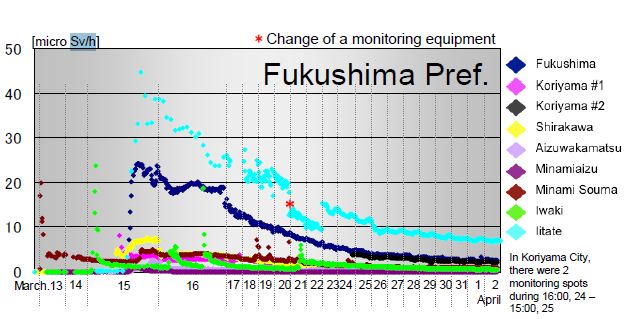
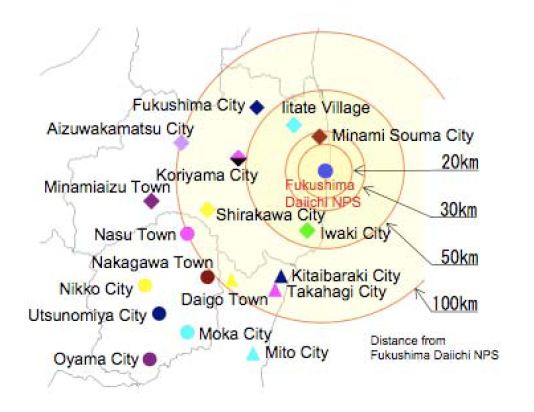
April 4 9:00 () JAIF has published graphical data showing trends in measured radiation dose rates in monitoring stations in Fukushima and neighboring prefectures between 20 and 100 km from the Fukushima Daiichi nuclear plant. Data is included for Iitate, where dangerously high rates were recently measured by the IAEA.
The first hydrogen explosion at Fukushima Daiichi Unit 1 occurred on March 12, and the same day TEPCO first reported high radiation readings outside of containment. According to the JAIF graphs, a spike in radiation of about 20 μSv/h was detected at Minami Souma, about 25 km northwest from the plant, late March 12 or early March 13.
March 13 venting was started at Unit 3. March 14 the second hydrogen explosion occurred, this time at Unit 3. At Iwaki, about 40 km southwest from the plant, early on March 15th a peak in radiation readings of about 25 μSv/h was recorded according to JAIF.
 March 14 it was reported that all cooling to the reactor core at Unit 2 was lost. The same day it was reported that the fuel rods at Unit 2 had been fully exposed for a period of time. At 8:30 pm JST JAIF reported that the integrity of the fuel rods in the Unit 2 reactor was unknown and that radioactivity readings in the environment, meaning outside of containment, were increasing. Shortly thereafter it was reported that it was believed that fuel rods had been damaged. The cause of the loss of coolant was reported to be a malfunctioning relief valve. Later TEPCO reported that vapour had been vented from the Unit 2 reactor. Early March 15 there were reports of an explosion at Unit 2, later confirmed by TEPCO to have happened between 6 and 6:15 a.m. JST, March 15. According to the JAIF data spikes in radiation readings occurred at both Iitate [ 45 μSv/h ], about 40 km northwest of the plant, and Fukushima City [ 25 μSv/h ], about 60 km northwest of the plant. A government spokesman reported apparent damage to part of the container shielding the Unit 2 reactor, specifically the suppression pool of the nuclear reactor appeared to have been damaged. March 16 a radiation dose measurement of 330 μSv/h was reported 20 km northwest of the plant. March 18 a reading of 150 μSv/h was reported 30 km northwest of the plant.
March 17, the radiation level 300 meters above the plant was reported to be 4,130 μSv/h. At an elevation of 90 meters above the plant it was 87,700 μSv/h.
March 22 high levels of contamination in sea water were reported.
March 27 it was reported that highly radioactive water had been found in the turbine room of Unit 2. March 28 it was reported that highly radioactive water had been found in a trench outside the turbine room of Unit 2. March 29 it was reported that the highly radioactive water found unexpectedly in the Unit 2 turbine room had probably been in contact with molten fuel rods in the Unit 2 reactor.

Be the first to comment