
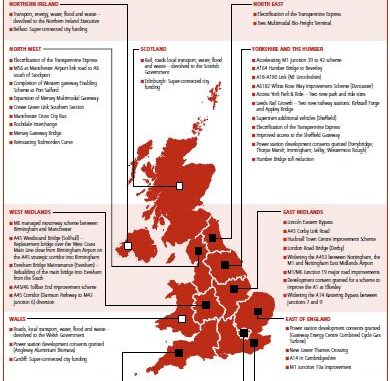
At the Global Infrastructure Leadership Forum, Geoffrey Spence, who heads up Infrastructure UK, the Treasury body that oversees the UK’s infrastructure plan, gave an overview of the National Infrastructure Plan of the UK. The fact that Geofffrey Spence was a personal economic adviser to Chancellor Alistair Darling during the last banking crisis, gives some indication of how seiously the UK Government is treating infrastructure.
In 2011 the Government released its National Infrastructure Plan, which outlines a plan to invest about £250 billion in the next five yrs and £ 400 billion in the 10 yrs on infrastructure including high speed rail, energy (especially nuclear and wind), aviation, water and wastewater, roads and highways, and high speed broadband. This is a considerably higher spend than in the past and signals a change in focus from social infrastructure such as hospitals and government facilities to economic infrastructure. Perhaps the most revolutionary aspect of this plan is the intention that 70% of the funding will come from the private sector.
The Institution of Civil Engineers (ICE) has said that it supports the vision as expressed in the Plan and that it believes that it would enable the UK to compete in the global economy. It specifically recommended that HM Government assign a senior minister with responsibility for monitoring performance against Plan, create a simple set of performance measures for infrastructure that are independently assessed, and develop a two year pipeline of infrastructure projects to help the private sector to improve efficiency. The ICE also suggested ways to asist the Government to attract private investment.
Geoffrey Spense said that the Government wants full transparency for the infrastructure effort, so that business will know where they should focus its efforts over the next ten years. It intends to maintain an open pipeline of projects for the next several years so that, for example, companies specializing in tunneling will be able to see for all tunneling projects in one place, whether they are for rail, sewers, or nuclear power plants. He said that there is a multi-ministry subcommittee that meets regularly to identify where blockages are occurring between ministries and to work colaboratively to streamline infrastructure projects where multiple ministries are involved.
The critical challenge in realizing the Plan is reducing the financial burden on government. The UK Government recognizes that traditional funding mechanisms such as bonds, traditional public-private partnerships (PPP), and long term loans from banks are not longer viable. As a first step the Government is planning to reform PPP policy, and has just completed a public consultation on this.
The second problem is that banks are charging unprecedented rates, 3-4% over Treasury rates, and it is hard to find long term loans longer than seven years. The Government is looking at how best attract the banks and at ways of encouraging banks to take on some of the risk in the early stages of projects. The Government is also looking at different models for low cost, long term financing. For example, in Canada pension funds have been a source of long term infrastructure funding. Another option is off-shore investors such as China.

Be the first to comment