
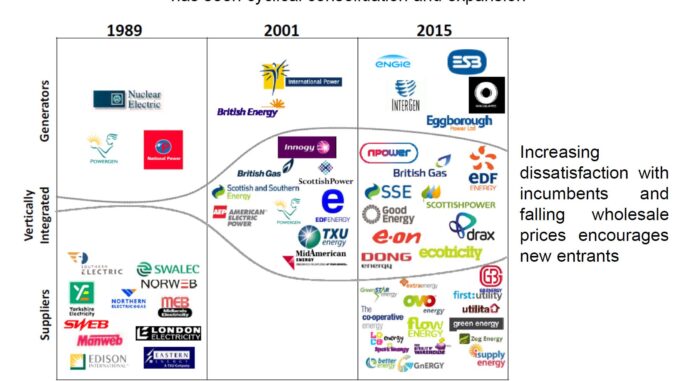
The U.K. electricity industry has been through privatization and changing regulation. From privatization to consolidation to expansion the market has seen cyclical consolidation and expansion. The structure of the industry that has evolved has become a model for many others including North American regulators and utilities.
There are many companies in the electricity generation sector, from large multinationals to small, family-owned businesses running a single site. Transmission in the U.K. is operated by three regulated monopolies. Fourteen distribution companies are responsible for the distribution infrastructure. There are 39 energy suppliers who compete with each other to supply energy to customers. Full competition was introduced into Britain’s retail energy markets for large customers in 1990, in 1994 for medium sized entities and in 1998 for domestic customers.
At the Future of Canada’s Utilities Summit in Toronto, Lawrence Slade, CEO of Energy UK, gave a fascinating overview of the evolution of the U.K. energy retail market from a market that was perceived as broken, noncompetitive and inefficient, to its present disruptive (to incumbents) state with new entrants into the market almost every week.
Energy UK is the trade association for the UK energy industry representing over 80 suppliers and generators of electricity and gas for domestic and business consumers.
The energy regulator in the U.K. is Ofgem. In 2002 Ofgem abolished price caps across the market based on the concept that “competition could deliver more benefits for customers than regulation.” But there was a widespread perception that the market was not competitive. In 2008 Ofgem announces a probe into energy supply markets. In 2014 Ofgem referred the energy market to the Competition and Markets Authority.
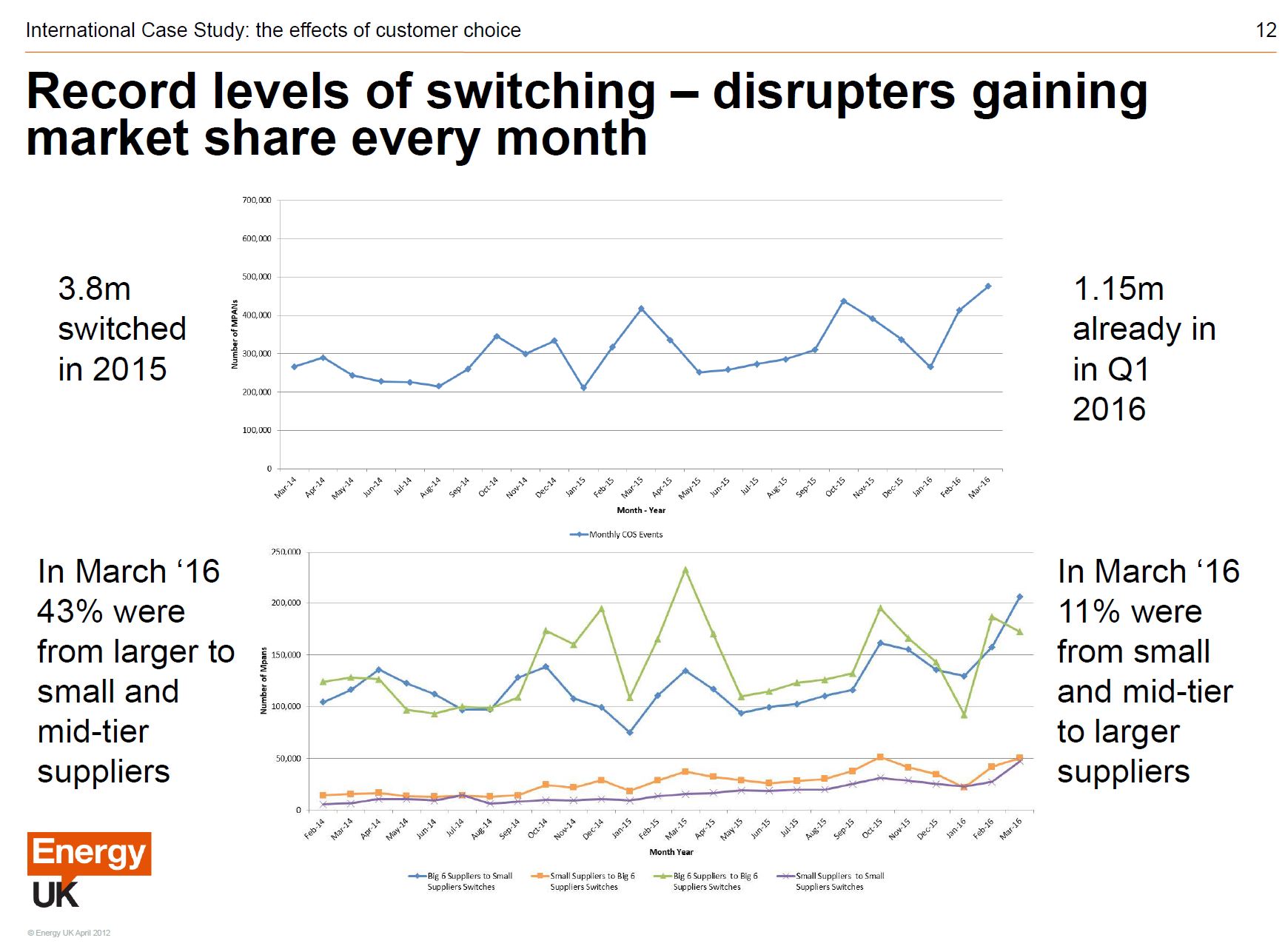 However, in the last few years, the number of customers switching their energy supplier has increased dramatically. The number of new energy suppliers has gone up dramatically and the public has shown with its feet that it prefers the new entrants to the incumbents. More than a million customers are leaving the incumbents for the new entrants every year. The market share the new entrants has achieved is remarkable, 15% in a couple of years and it continues to rise.
There are price comparison web sites. Collective switching where customers join together to get a better price from a supplier is commonplace. This together with government ads has achieved a record level of customers switching, 4 million in 2015 and over 1.1 million in the first quarter of 2016.
The biggest hurdle that had to be overcome and continues to be a challenge is engaging with customers. When the market was first opened up, many customers didn’t understand how the market functions. Many assumed that all energy companies are the same and it wouldn’t be worth switching. The reality is that customers can save hundreds of pounds a year by switching. An Ofgem survey in 2014 found that the amount of money that the average customer would have to save to encourage them to switch was £94. It turns out this is just about the amount that customers save per annum by switching.
But it is not just about price. The new entrants have done a better job of engaging with the customer, by providing green energy, better customer service, a free heater or broadband and energy packages. The incumbents have realized that they are rapidly losing a major part of their customer base and are starting to fight back.
The future
In the future it is expected that customers will be able to switch in 24 hours rather than the current two weeks. There will be additional trials to try to engage with late adopters, the customers who still have not seen the value of switching in a competitive market. The rollout of smart meters will make it easier for innovators to use customer power usage patterns to demonstrate the advantage of smart devices, batteries and load shifting. It is expected that energy suppliers will get more involved in managing devices on the other side of the meter.
There is the threat of intermediaries coming between the customer and the energy supplier leading to disconnect of the relationship between a supplier and their customers. The continued drop in cost and efficiency improvements from solar PV and batteries may lead to customers going off the grid. This creates a regulatory headache of how to recover costs for stranded network assets that may only carry a small proportion of their design capacity. On the plus side electric vehicles and the possible decarbonization of heat could potentially reverse the demand decline.

Be the first to comment