
One of the most interesting talks I went to at Oracle Open World last week was a talk by Noel Yuhanna of Forrester on The Future of Database Technology: An Analyst’s View.
Features and Technologies
First of all the features and technologies that he expects to become the focus of database vendors in
the immediate future are open source, consolidation, in-memory databases (caches), very large databases (apparently the largest one at the present is 50 TB), grid architecture, unstructured data, higher performance, increased availability, database security, and archiving and retention.
DBAs
An interesting fact is that apparently there are 265,000 DBA’s around the world. An even more interesting statistic is that each DBA manages on average a terabyte of data. I validated this statistic myself chatting to a couple of folks who turned out to be DBAs. For example, I chatted with a very interesting person from the Liquor Licensing Board (LLB) of British Columbia, and he said that the LLB managed about 2.5 TB of data, and employed two senior DBAs and a junior consultant DBA. This is pretty close to the 2.5 DBAs you would expect for 2.5 TBs of data.
Over the next few years Noel expects that DBA’s will spend a decreasing amount of time on tuning and performance, availability and disaster recovery, because these areas are being increasingly automated. RDBMSs are becoming increasingly adaptive, so they they can diagnose and solve their own problems and tune themselves. This means that instead of spending their time on administration and tuning they will spend an increasing proportion of their time on security, performance, and functionality.
By 2012 DBAs will be spending a lot of their time on architecture and implementation to support database virtualization.
Database Virtualization
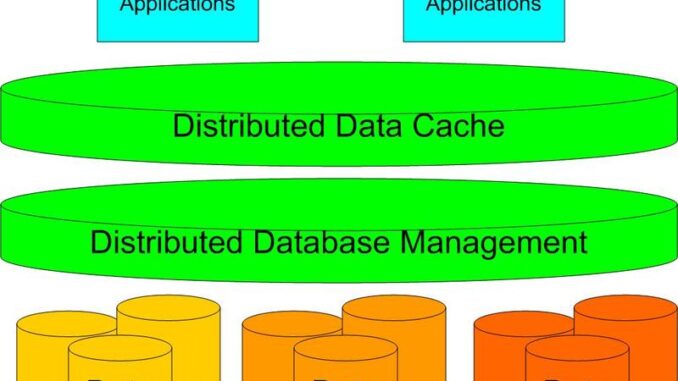
Noel outlined a very general architecture for database virtualization that includes a cache layer (for
performance), a database management layer (for backup/recovery, transaction management, and other administration tasks), and the data layer itself. To me this is a very general data management architecture that has been proven over and over again for OLTP (online transaction processing) applications and it appears to be evolving into the de facto architecture for database virtualization.

Be the first to comment