
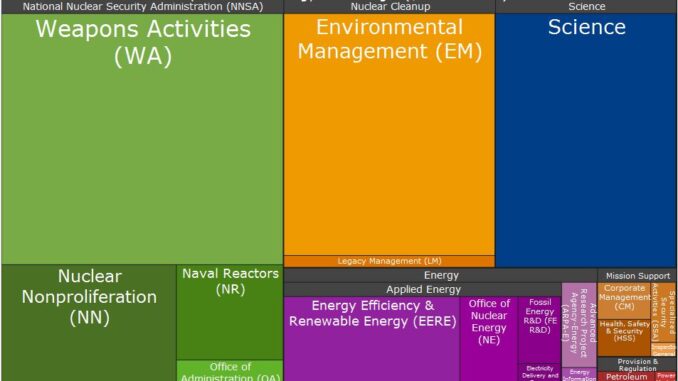
A few days ago the U.S. Department of Energy (DoE) released the details of its FY 2013 budget request to Congress for $27.2 billion. To put this in context, last year DoE requested $29.5 billion, so there have been some cuts. One of the largest cuts is is $4 billion in fossil fuel subsidies. Some 35 ARPA-E, EERE and FE projects were eliminated as well.
For historical reasons a significant proportion (42.5%) of DoE’s budget goes to nuclear weapons related activities including non-proliferation. Another 21.5% goes toward cleaning up the nuclear material legacy of the Cold War. The DoE supports the Administration’s objective of securing all nuclear weapons-grade materials around the world over the next four years.
Energy-ralted activities
That leaves 36% of the budget for domestic energy-related activities. Major themes that DoE’s budget is aimed at furthering are
- An overall energy independence objective of reducing U.S. dependence on oil by one-third by 2025.
- Reversing the negative balance of trade in high technology goods. Since 2001 the U.S. has imported more high technology goods than it has exported.
- Investing in reducing the cost of clean energy including on-shore wind, solar and off-shore wind. A specific goal is reducing the cost of solar energy by 75 percent and making it cost competitive without subsidies by 2020.
- More energy efficient buildings, specifically the Better Building Initiative to make commercial and industrial buildings 20% more energy efficient by 2020
Specific budget allocations include
- $310 million to promote energy conservation, specifically improving the energy efficiency of commecial and residential buildings
- $155 million for R&D in low emissions fossil fuel technologies including carbon capture and sequestration (CCS) and carbon capture utilization and sequestration (CCUS)
- $770 million for nuclear energy including small, modular reactors
- $143 million for smart grid, grid modernization and electricity storage
- $290 million for advanced manufacturing technology
- $95 million for reducing the cost of wind turbines and $330 million for reducing the cost of solar PV
The National Institute of Standards and Technology (NIST), while part of the Department of Commerce, works very closely with DoE on standards relating to equipment such as intelligent devices for smart grid. The $860 million requested for NIST in 2013 is a significant ($100 million) increase on the $761 million request in 2012.
$140 million has been allocated for Energy Innovation Hubs, a program intended to replicate the success of the Manhattan Project and Bell Labs. Hubs are multidisciplinary, multi-investigator, and multi-institutional integrated research centers. Currently there are five hubs and a new one has just been added.
- Fuels from sunlight
- Modeling and simulation for nuclear reactors
- Energy efficient buildings
- Batteries and energy storage
- Critical materials
- Electricity systems (new)

Be the first to comment