
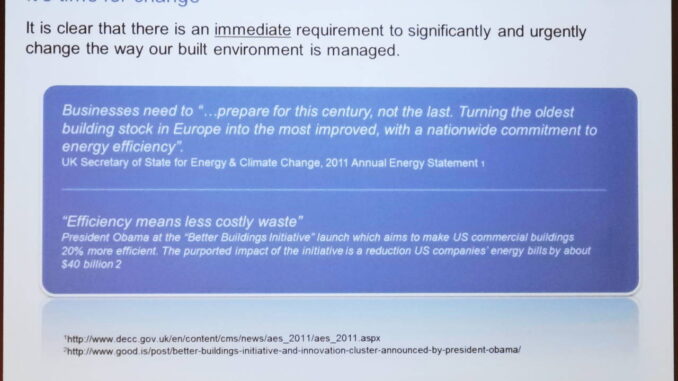
David Bartlett, who leads IBM’s Smarter Planet initiative, believes there is an ”
immediate requirement to significantly and urgently change the way our
built environment is managed.” And he is very sanquine about the capacity of our evolving technology to do this. The Internet of Things is approaching a trillion objects. Moore’s law conrtinues to operate so we have incredible processing power. The cloud is enablng us to make this processing power available to just about anybody with any type of device any where. Big data technology is enablng analytics in real-time. We are rapidly approaching havng enough computing capacity to capture digitally, visualize and model our entire built environment. IBM’s Smarter Planet initiative is aimed at helping to make this happen. According to David 42% of the world’s energy goes to buildings so improving the efficiency of buildings is a primary focus of the Smarter Planet intiiative.
In October 2009 President Obama signed a directive calling for a more sustainable operations strategy across the federal government. Commercial buildings use roughly
40 percent of the energy in the United States and the federal
government owns approximately 182 million square feet of office space
nationwide. The U.S. General Services Administration (GSA) has a goal
of reducing energy usage across federal buildings at least 30 % by 2015.
The GSA has contracted IBM to create a cloud-based centralized system that will monitor building performance and feed information into a central building management dashboard. It is expected that better analytics will help the government automate building controls to help property managers take more active control over building performance.
The initial focus during the first year of the smart building initiative will be 50 buildings (including the White House) that have already been identified as energy inefficient. It is estimated that the project could save approximately $15 million in operational costs annually.
 Where do we start ?
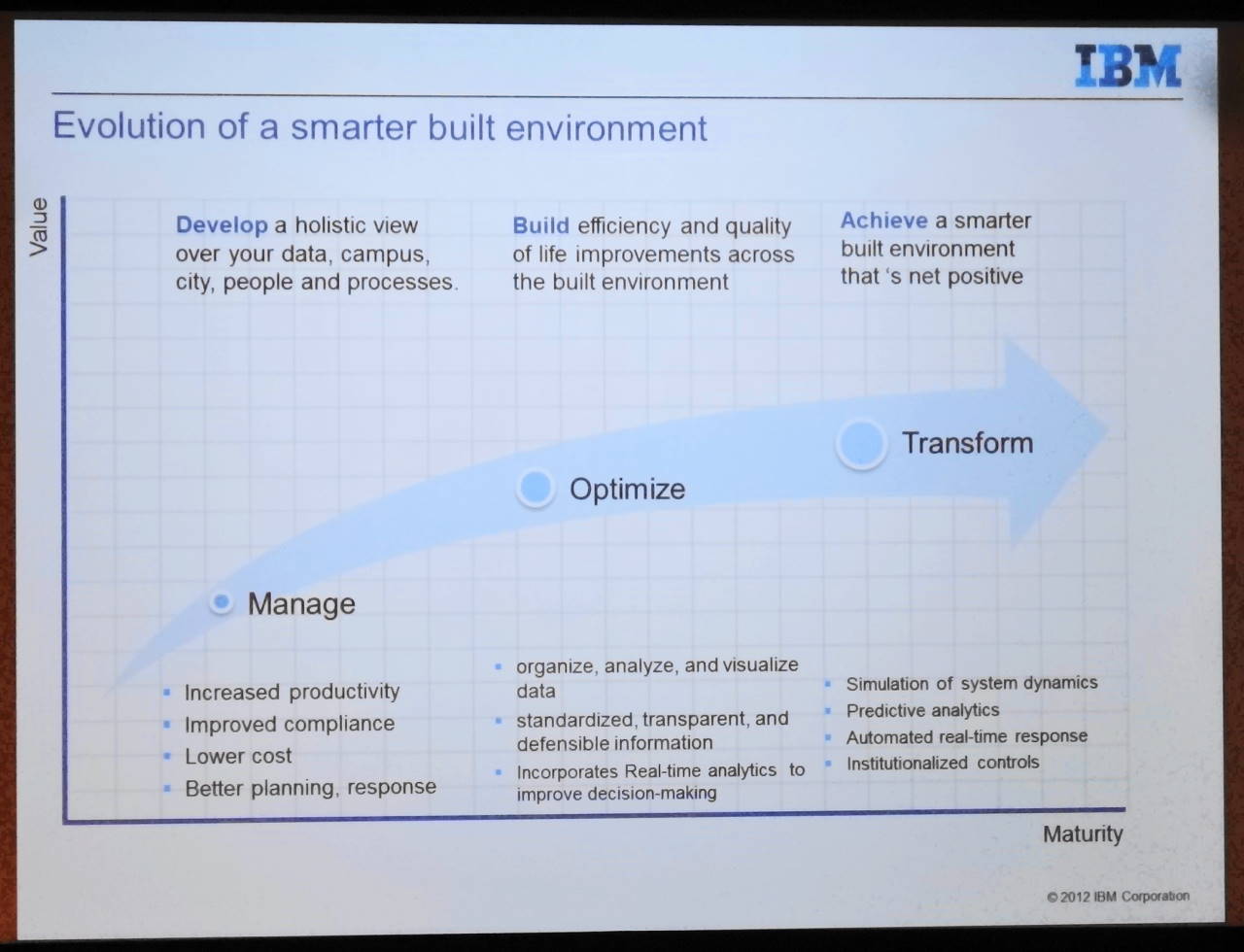
A frequent question that David often gets after an organization buys into the smarter planet vision is where do we start. IBM
has developed a capability maturity model that offers
a roadmap for organizations to use to assess their current situation to determine at
what stage they are and then provides guidance to what they should
prioritize to get to the next stage.
Motivating change
One
of the most important tools in motivating change is transparency. The internet faciliates
transparency. President Obama’s administration has made government transparency using the internet a top priority. David has found that transparency and gamification is
extremely powerful in motivating change and in overcoming institutionalized inefficiencies (“but we have always done it this way”).
Crowdsourcing green at the Los Angeles Unified School District
 IBM has found that educational institutions and defense departments are the most receptive to the Smarter Planet vision.
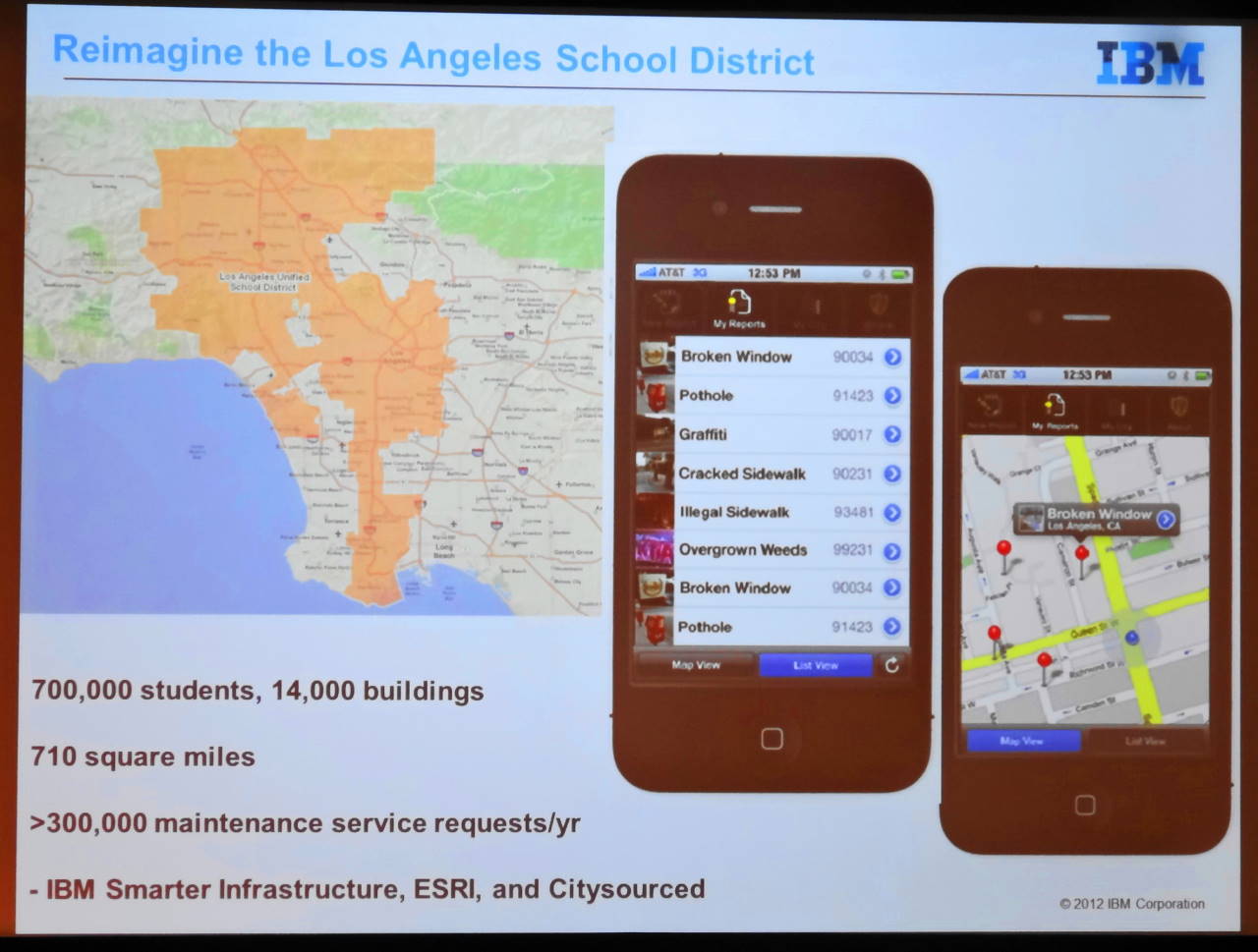
The Los Angeles Unified School District (LAUSD) is an interesting example. LAUSD, which is the second largest school district in the country, decided it wanted to be the nation’s greenest school district.. LAUSD has 700,000 students and more than 14,000 buildings spread out over 710 square miles. But they had no budget for doing the green initative. What they did have was an IBM asset management system and a lot of students with mobile phones.
Students, teachers and staff became part of the solution. A mobile app developed by an IBM partenr was installed on students and others’ mobile phones that made them all green monitors and reporters identifying maintenance
issues such as leaky faucets and broken air conditioning units by
sending text messages and photos through their mobile phones. The mobile app sends
the photos and texts for analysis to the server where a GIS
shows staff where the problem is located and records the problem in the asset management system. Gamification was used to encourage compeitition, for example, for who is the best green reporter. Within the first eight months of implementing the program LAUSD responded to more than 750 maintenance requests. Things are getting fixed and students and others feel like active participants in the program to make the schools greener.
IBM plans to announce the next three school districts to participate in the Smarter Planet program.

Be the first to comment