
A number of return on investment (ROI) studies have identified the significant benefits of knowing where underground utilities are located. For example, a Pennsylvania State University study commissioned by the Pennsylvania DoT found a return on investment of US$21.00 saved for every US$1.00 spent for SUE when elevating the quality level of subsurface utility information using SUE. A study in Lombardy, Italy found a return on investment of €16 for every € invested
The most interesting and differentiating technology at this year’s Geo Business 2016 event in London was ground penetrating radar (GPR). There were at least five or six presentations on GPR technology from different companies at the conference.
The technology that attracted the most attention is a new radar array from IDS (Ingegneria dei Sistemi) in Italy. (I’ve blogged previously about subsurface mapping of utility infrastructure in Italy.) It’s called the IDS Stream EM. It’s a modular device with a massive array of high sensitivity radar antennas capable of detecting objects as small as 5 cm down to 5 meters (depending on the soil type). There are about 25 of these devices worldwide including in North America – it is FCC certified. Hexagon AB has reached on an agreement to acquire the GeoRadar division of IDS. At the conference two companies, Technics Group and GPR Pro talked about the technology and how they use it to geolocate underground utilities.
Kevin Bank of GPR Pro described the relative advantages of GPR and electromagnetic locators (EML). There are two situations where GPR is decidely better; when you are looking for non-metallic objects and when you don’t have access to a manhole. GPR Pro offers a dedicated PAS128 compliant GPR data post processing and interpretation service that allows multiple scans to be analyzed at the same time.
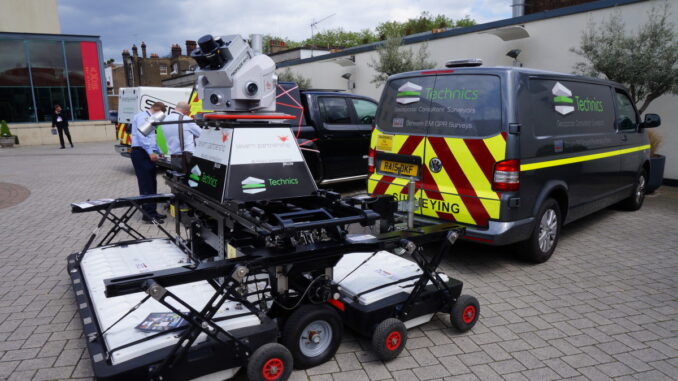
Technics demonstrated a towable Pegasus: Stream array that combines above and below surface multi-sensor scanning. It includes a Leica Pegasus: Two scanner for above ground features and a Stream EM array for below ground objects. Technics told me that the combined multi-sensor scanner can be towed at up to 12.5 miles an hour (about 15 km/hour), though 5-10 miles an hour is more typical. Technics was a major supporter of the development of the PAS128 standard and offers a PAS128 interpretation service.
According to Technics, GPR has more uses than just mapping utilities. It can be used for pavement/bridge/roadway inspection, void detection, concrete slab analysis, rebar mapping, verifying as-built information of concrete walls and floors. In general GPR is a superior tool for mapping underground features because unlike traditional EML it can pick up non-metallic objects and can detect utilities without access to a manhole. This makes the use of GPR almost mandatory in an industry that is increasing its use of plastic piping. Kevin Bank pointed out that GPR is not particularly good at detecting the plastic pipe itself – it detects the contents of the pipe such as water. However, GPR does have drawbacks. It requires a trained surveyor to interpret the scans. It is unable to accurately identify utility type and in some soil types such as aggregate and clay it does not perform well. Therefore, Technics combines GPR, EML, visual inspection and records to produce its subsurface mapping information.

Be the first to comment