
The EU has set three goals for reducing greenhouse gas emissions under the catch phrase 20-20-20 by 2020, reduce greenhouse gas emissions by 20% from 1990
levels, increase the share of renewable energy sources in energy
consumption to 20%, and increase energy efficiency by 20%.
The European Commission (EC) believes that it is on track for meeting the first two of these goals. But for the third current projections indicate that the EU is tracking toward  only a 10% reduction in energy consumption, half the target of 20%.
To get the EU back on track for the 20-20-20 energy efficiency goal, the European Commission (EC) has proposed
a new Energy Efficiency Directive (EED).
Geo-clusters
A business cluster is a geographic concentration of interconnected
businesses, suppliers, and associated institutions in a particular
field. The term was introduced by Michael Porter in The Competitive Advantage of Nations (1990).
“Geo-clusters” are virtual trans-national areas where strong similarities are found (i.e. climate, culture and behaviour, construction typologies, economy, energy price and policies and gross domestic product, to name a few).
The goal is to locate similarities relating to energy efficient buildings across the EU by combining parameters and indicators organized in homogeneous layers. For example, a technological layer (i.e. building typologies, technologies, ..), a context layer (i.e. climatic conditions, …), a socio-economic layer (i.e. macroeconomic indicators, behavioural aspects,…), and a political-strategic layer (i.e. standards and regulations, energy policies, ..). According to Michael Porter clusters have the potential to affect competition in three ways
- Increasing the productivity of the companies in the cluster
- Driving innovation in the field
- Stimulating new businesses in the field
The firms and institutions in a cluster must share four critical characteristics:
- Proximity; they need to be close in space to allow positive spill-overs and the sharing of common resources
- Linkages; their activities need to share a common goal
- Interactions; for positive cluster effects active interaction has to be present
- Critical mass; there needs to be sufficient number of participants present for the interactions to have a meaningful impact on companies’ performance.
The Cluster Observatory provides a single access point to information and analysis of clusters and cluster policy in Europe. The Cluster Observatory also produces analysis and reports on regional competitiveness conditions, transnational cluster networks, clusters in emerging industries, and studies on better practices in cluster organisations.
Geo-clusters for energy efficient buildings in the European Union
The Energy Efficient Buildings Association (E2BA) is a Europe wide industry driven research and demonstration program for energy efficient buildings. It developed a research and innovation roadmap “Towards the creation of a high-tech building industry. Turning energy efficiency into a sustainable business”, which sets the priorities in the built environment for the period 2014-2020. It is understood that innovation will be the key for sustainable
development and competitiveness of the regions and amplifying the
productivity of local resources.
It introduced the concept of geo-clusters which are virtual trans-national areas where strong similarities are found in terms of climate, culture and behaviour, construction typologies, economy, energy price and policies, and gross domestic product.
 The GE2O project was formed to apply geo-clustering to the development of energy efficient buildings across Europe. The GE2O Project will develop a proof-of-concept of a geo-cluster approach by means of a multidimensional mapping tool. The geo-cluster mapping tool will provide, based on similarities across Europe, relevant information about where and how a program or service can be implemented, which program or service can be used in a specific situation, and where opportunities exist to develop a new program or service.
The information identified for geoclustering identification for energy efficient buildings includes
- Characterization of energy use in buildings
- Characterization of buildings
- Characterization of the construction sector – employment aspects
- Characterization of the construction sector – dynamic aspects
- Regulation
- Climate
- Environmental and social consideration layer
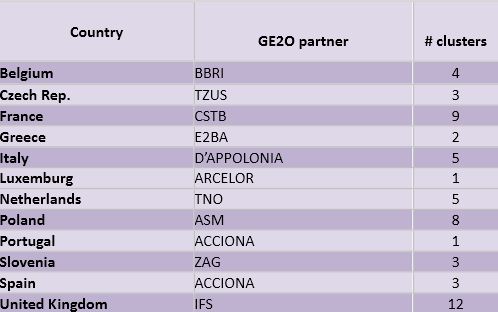 Based on these data layers, the objective is to gather information on the existing stock of clusters spread over Europe related to energy efficient buildings. In this context a cluster is a joint initiative for enenrgy efficient buildings in a geographic area that brings together companies, research centres, educational institutions in order to develop synergies and cooperative efforts. Membership must be on a voluntary basis. The goal is to stimulate businesses, increase productivity and drive innovation.
Between April and June 2012, 68 datasheets were collected for a number of countries. Among them, 56 were considered to meet the definition of a cluster for energy efficient buildings.
Thanks to Gene Roe for pointing me to this.

Be the first to comment