
Reality modeling
In the future, the deliverables at the end of a construction project will not only include the completed building itself, but also a digital “reality model” of the structure. The digital model will include digital as-builts comprised of georeferenced point clouds captured by laser-scanning or meshes generated from images captured with a digital camera on a smartphone. That was the prediction of Bhupinder Singh of Bentley at the GeoBuiz 2016 Summit in Bethesda. This is a vision that is shared by other professionals in the construction industry including Ron Singh, Chief Surveyor at the Oregon Department of Transportation, who sees it as dramatically changing the construction process from surveying through design and construction to operations and maintenance.
Consumer devices and professionals
Consumer mobile devices will increasingly be the platform for many professional activities which currently require specialized devices and a PC computing platform. Bryn Fosburgh of Trimble pointed out that while currently the location accuracy of GPS equipped smartphones is 10 meters, centimeter precision is surely coming because all that is required is a relatively simple antenna redesign. Bryn sees a continuum in these devices between consumer and professional applications. But while consumers tend to blindly accept whatever is available on their smartphones, professionals using these devices will have to be aware of the limits of the hardware, what it can be used for and what not. For example, while smartphones in the future will be capable of centimeter accuracy in ideal locations, the accuracy will be less where there is a lot of scatter in the RF signals from the GPS satellites. To ensure reliable results a professional surveyor relies on multiple sources including GPS linked to an earth station and traditional total station measurements. Increasingly we will require other professionals to be involved. Bryn reported a rising demand for photogrammetrists, as a result of the growing volume and availability of high resolution imagery which needs professional to help interpret.
Platform as a service
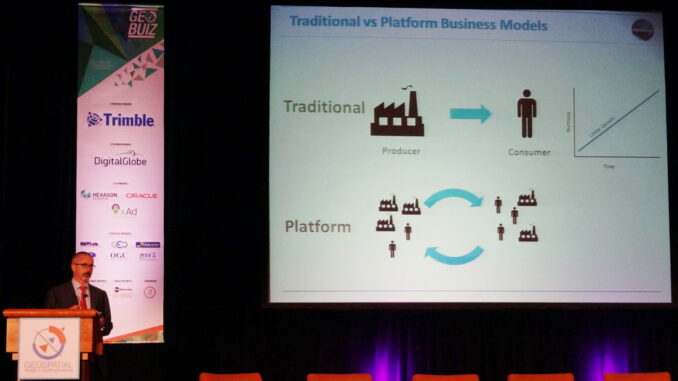
For virtually all of the world’s big IT companies including IBM, Oracle, SAP, and Microsoft and the world’s big content companies such as Digital Globe, the cloud is central to their vision of the future. Together with others in the IT industry Xavier Lopez of Oracle sees the future in platform as a services (PaaS), but there are challenges. A major challenge is integrating data in different databases including traditional SQL databases from Oracle and Microsoft and nonSQL databases such as Hadoop. Another challenge is semantics. Frequently different disciplines use different terms for the same thing. I have blogged about the CB-NL project in the Netherlands aimed at solving the semantics problem in the construction industry. Another big issue that Xavier identified is data fusion without co-location – how do you enable efficient processing of a logically federated database when the data resides in different locations ?
Monetizing the cloud
But perhaps the biggest challenge is finding an appropriate business model. It is not completely transparent how the cloud is going to be successfully monetized, though the trend is toward some form of subscription or pay-per-use. An interesting model of the successful application of the cloud in the construction industry is Textura, just acquired by Oracle. Textura’s cloud serves as a place in which all of the participants in a project from the funding, through design, to construction can come together and access the shared assets necessary to complete the project. Textura’s network includes about 85,000 general and subcontractors who using Textura to collaborate on construction projects. Textura handles on average about 6,000 projects each month. The company’s shared database, which hosts project budgets, contractors, invoices, payments, change orders and compliance documents, resides in the cloud and is accessible to contract administrators, contractors, developers, subcontractors, consultants, title companies, and banks.
Big data and analytics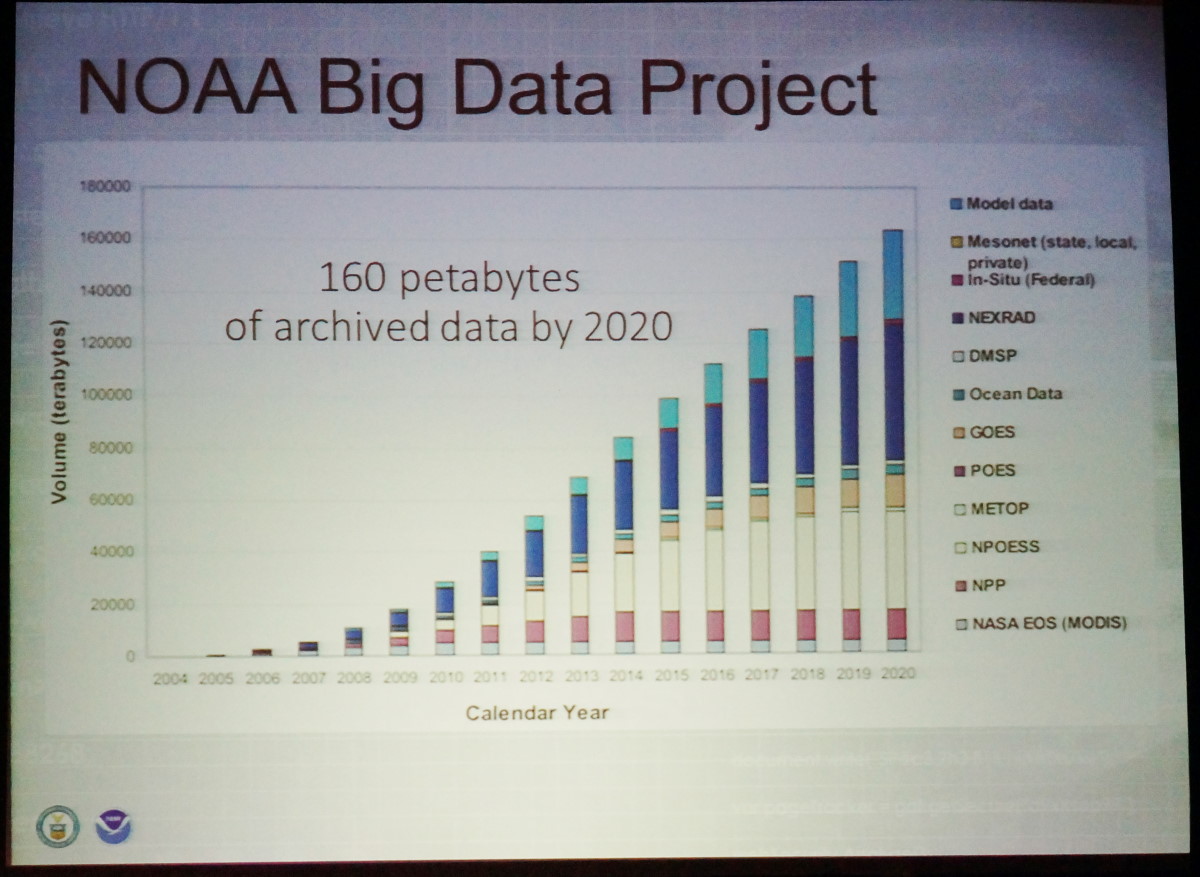
One of big drivers for the cloud is enabling the extraction of information from the huge volumes of data (most of which includes location) which are now available. I have blogged about the nearly 100 petabytes of earth observation imagery available from Digital Globe. According to Dr Richard W. Spinrad, Chief Scientist at the National Oceanic and Atmospheric Administration (NOAA) , NOAA is expecting to have 160 petabytes of archived geospatial data by 2020.
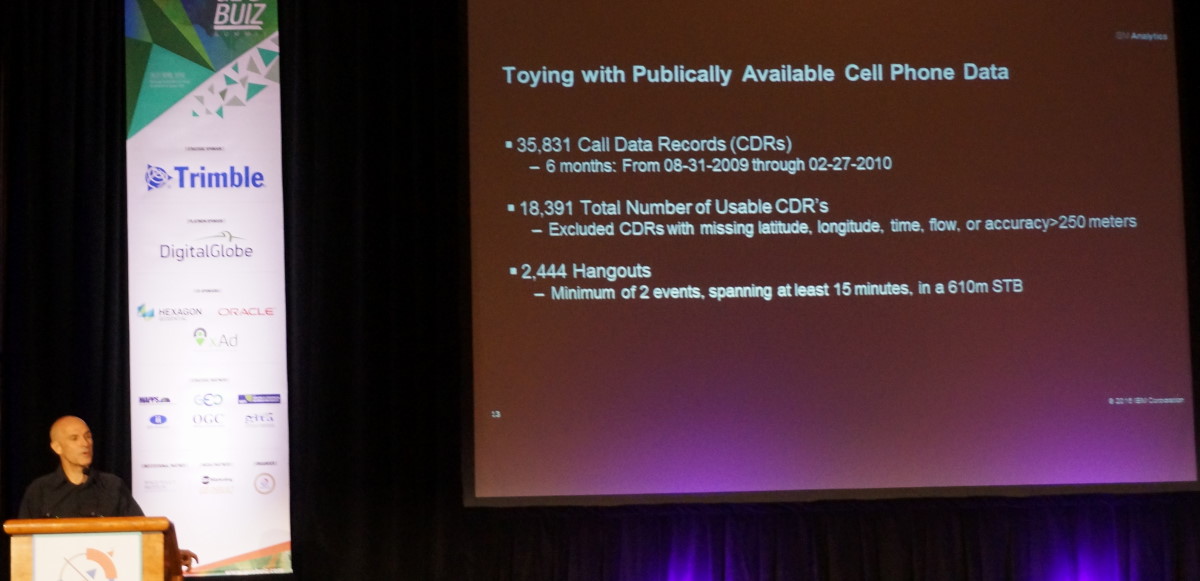 As another example, Jeff Jonas of IBM described a publicly available database which includes 600 billion transactions per day collected by telephone companies. This data, which includes location, can be mined (after being anonymized) for very interesting and commercially valuable information. Jeff Jonas described some examples – using it to analyze where people spend most of their time (their “pattern of life“), how many people go into a store, and how long they remain in a store.
Dipanshu Sharma, Founder & CEO, xAd illustrated live some of the things his company, which is in the location-based marketing business, does with this type of data. xAd can customize ads to target people who are inside a store (“There’s a great deal on aisle 5”), just outside one (“Come on in, we have great deals on umbrellas”) or close to a competitor’s store (“Checkout XXXX, our prices are lower than YYYY”) – the words are mine.
In all of these example, geospatial data and technology are key to the applications. Jeff Jonas foresees that the apps of the future on your smartphone will require geolocation and will be so compelling that just about everyone will enable GPS location on their smartphones.
Be the first to comment