
Last night Carl Steinitz, Professor of Landscape Architecture and Planning at the Graduate School of Design at Harvard, gave two presentations. The first addressed the queston of how to organize education in geosdesign and was the result of Carl being invited to advise a specific university (which remained nameless).
Last night’s talk was the actual presentation he gave at the university at the culmination of a week’s visit to the university. The second was a personal history of the early days in the development of geodesign, primarily in the 60s.
Organizing education in geodesign
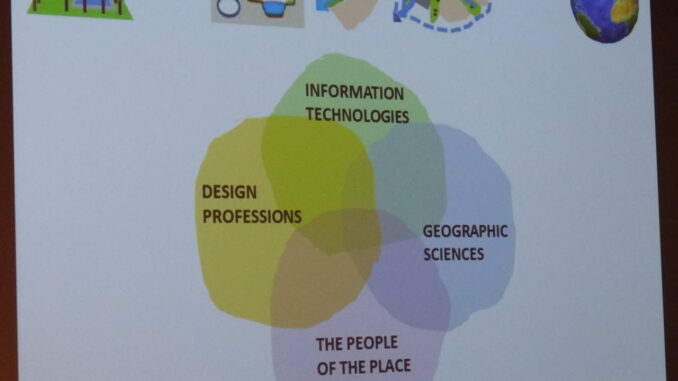
Geodesign involves bringing together the design professions (architecture and engineering), technology, the geographic sciences, and wha Carl calls the people of the place, the folks that are going to live in the result of a “geodesigned” environment. A major challenge arises from scale. Scientists approaach things from the universal anf global, designers from the local, even at the level of one building or one parcel.
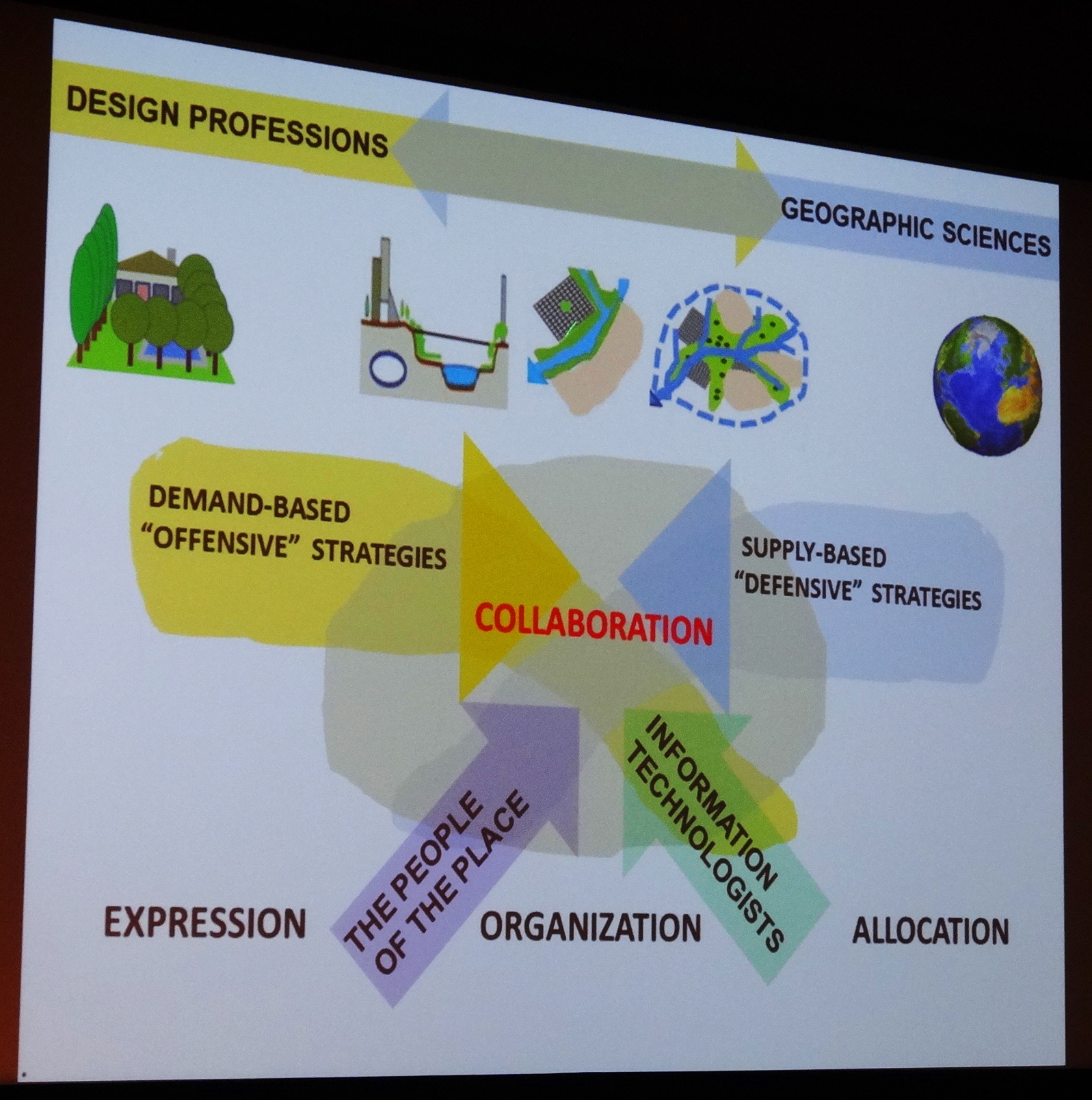 Carl made the case that the most important thing that all students of geodesign, regardless of their background, need to learn is how to collaborate in a multi-disciplinary project environment involving architects, engineers, IT folks, and folks from geographically-oriented sciences. He made specific recommendations on how to do this, not generally applicable to all unversities but tailored to the specific unnamed univesity he had been asked to advise.
Early days of geodesign
There is a fascinating book by Nick Chrisman called How computer mapping at Harvard became GIS that describes the early days in the development of geospatial technology and science.
 Carl Steinitz was part of these early developments. Last night he gave a personal perspective on the early days of geodesign.
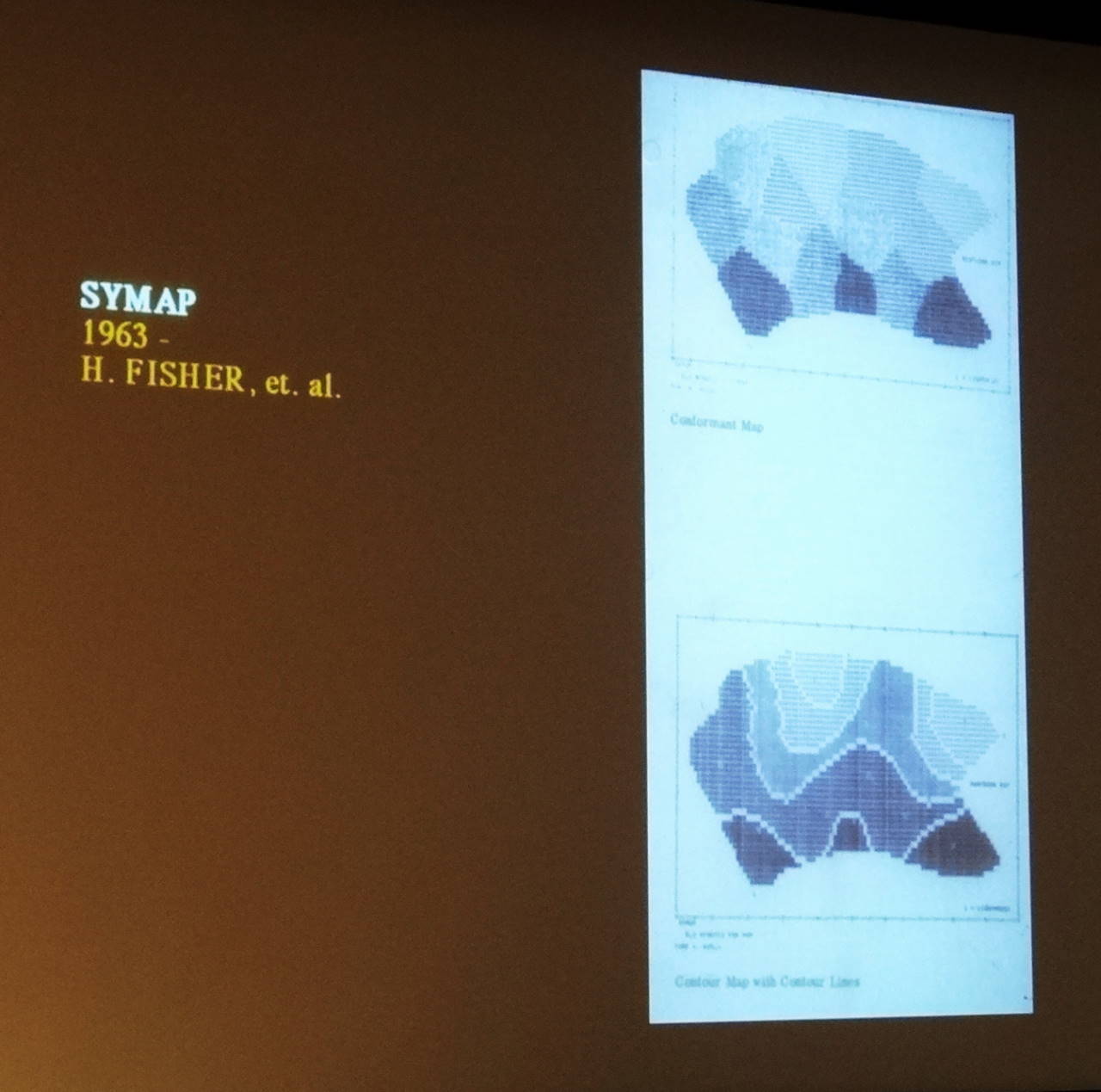
From a technical perspective the developments I found most fascinating were the first computer geographic computer graphics that was created by hooking an IBM Selectric typewriter to a computer and using overprinting to create an approximation of grey scale thematic maps. The program to do this, SYMAP, was developed by Howard Fisher in 1963. When the Harvard Lab for Computer Graphics was founded in 1966, Howard Fisher was its first director. Carl also described some of the ways colour printing was simulated in these early days, and early 3D imagery.
An interesting recollection in this fascinating talk was that computing was introduced into the design course via tutorials as and when needed, not as a separate course.
Carl described the development of geodesign methodogies such as moving from traditional programming languages in the direction of what became map algebra, spatial analysis, automating aspects of design and using linear programming to optimize design. As Carl said they did it all, though some of it was too expensive at that time to be of practical use.

Be the first to comment