
In a recent report, Imagining construction’s digital future, McKinsey & Company suggests that the construction industry is ripe for disruption and two of the technologies that it believes will be key in that anticipated transformation are goespatial and BIM.
The McKinsey report presents data that shows that large construction projects typically take 20 percent longer to finish than scheduled and are up to 80 percent over budget. Construction productivity has actually declined in some markets since the 1990s and financial returns for contractors are relatively low and volatile.
The report finds that construction has been slow to adopt process and technological innovations. R&D spending in construction lags other industries. Construction R&D is less than 1% of total industry revenue compared to 3.5-4.5 % in the auto and aerospace sectors. And construction spending on IT is low compared to other industries.
The McKinsey Global Institute estimates that the world will need to spend $57 trillion on infrastructure through 2030 to keep up with global GDP growth. This is a massive incentive for the construction industry to transform productivity and project delivery through new technologies and improved practices.
McKinsey has identified five technologies that it believes will be transformative in the construction industry. Th first two are geospatial technologies and BIM.
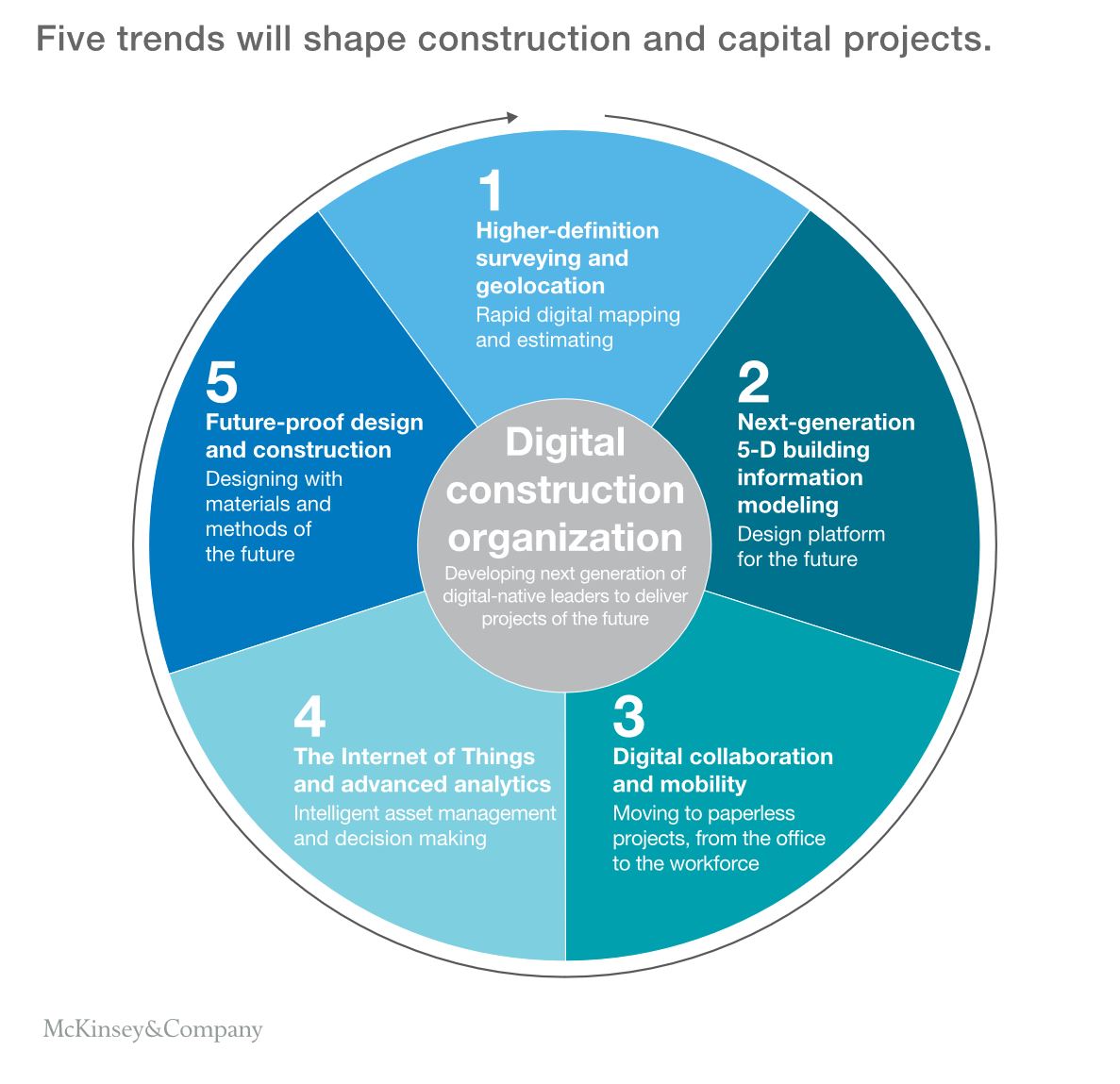
 Disruptive technologies: Geospatial and BIM
Geospatial
About 4 million excavations are carried out on the UK road network each year to install or repair buried utility pipes and cables. Not knowing the location of buried assets causes practical problems that increase costs and delay projects, but more importantly, it increases the risk of injury for utility owners, contractors and road users. The problems associated with inaccurate location of buried pipes and cables are serious and are rapidly worsening due to the increasing density of underground infrastructure in major urban areas. In the U.S. it is estimated that an underground utility is hit every minute. Underground utility conflicts and relocations are the number one cause of project delays during road construction.
These type of unforeseen problems are a major reason that projects are delayed and go over budget. Discrepancies between ground conditions and early survey estimates can require costly last-minute changes to project scope and design. New techniques that integrate high-definition photography, 3-D laser scanning, ground penetrating radar in conjunction with other technologies and geographic information systems make it possible to reduce the risk of hitting underground utilities.
Reality modeling using phodar and LiDAR technologies provides high-quality 3-D images and point clouds that can be integrated with building information modeling (BIM). Used in conjunction with ground-penetrating radar, magnetometers, and other equipment, LiDAR can generate above-ground and underground 3-D images of project sites. A vendor has recently offered an above ground LiDAR scanner combined with a ground penetrating radar array that can scan above and below ground at up to 15 km per hour. This is particularly important in congested urban or environmentally sensitive sites where disturbance needs to be minimized.
These advanced survey techniques are complemented by geographic information systems that allow maps, images, distance measurements, and GPS positions to be overlaid. This information can then be uploaded to other analytical and visualization systems for use in project planning and construction.
Modern survey technology is more accessible than ever because costs have come down substantially. An light-weight imaging laser scanner with software that runs on an iPad has been introduced at a breakthrough price if $16,000. Light-weight and low cost high-resolution cameras and laser scanners can be mounted on standard industrial drones. Specialized technology providers offer cost-efficient survey packages, including drone and UAV equipment, data uploading, and processing services, as well as software to manage drone flights, data capture, and dashboards to visualize information.
BIM
The construction industry has yet to adopt an integrated platform that spans project planning, design, construction, operations, and maintenance. The industry still relies on bespoke point solutions. Designers, contractors, and operators use different software that do not sync with one another. There is no single source that provides an integrated, real-time, full-lifecycle view of project design, cost, and schedule.
McKinsey reports a study found that 75 % of those that adopted BIM reported a positive return on their investment. They also reported shorter project life cycles and savings on paperwork and material costs. A number of governments, including those in Britain, Finland, and Singapore, and in the future probably France and Russia mandate the use of BIM for public infrastructure projects.
McKinsey believes the future lies in 5-D BIM, which is a five-dimensional representation that includes a project’s cost and schedule in addition to the spatial design in 3-D. It also includes such details such as geometry, specifications, aesthetics, thermal, and acoustic properties. A 5-D BIM platform allows designers, owners and contractors to collaborate on a project. The visual and intuitive nature of 5-D BIM gives contractors a better chance to identify risks earlier and thus to make better decisions. McKinsey argues that to get the full benefit of BIM technology, project owners and contractors need to incorporate its use right from the design stage, and all stakeholders need to adopt standardized design and data-reporting formats compatible with BIM. In addition, owners and contractors need to dedicate resources for BIM implementation and invest in capability building. When combined with reality modeling and geolocation, 5-D BIM technology offers a way of providing the full-lifecycle BIM modeling that the British government expects will contribute to reducing public infrastructure costs over the lifetime of a facility by 40% or more.

Be the first to comment