
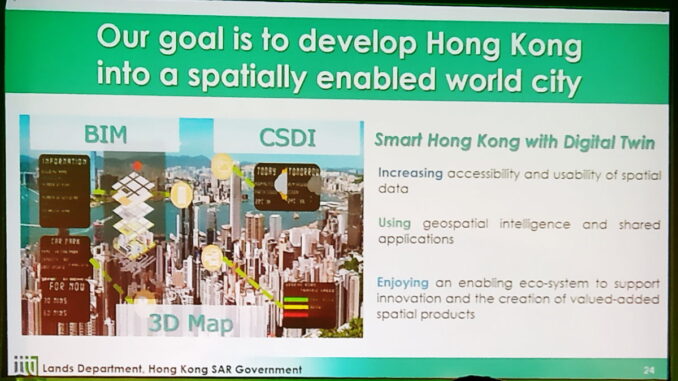
Integrated geospatial and BIM is increasingly being recognized as essential for full lifecycle construction and for enabling urban digital twins. At this year’s Geo Business in London the importance of integrating these technologies was asserted by several speakers. From the perspective of developing smart cities, Hong Kong has made integrating these technologies a policy priority for its goal of becoming a smart city.
In an award winning paper at a 2011 conference organized by Britain’s Association for Geographic Information (AGI), Ann Kemp, then head of GIS at Atkins Global, the design and engineering firm, asked the question ‘BIM isn’t geospatial — or is it?’ and then argued that integration of geospatial and BIM was essential to address the challenges of the 21st century. At that time within the UK construction company this was a radical suggestion, but since then the need to integrate geospatial and BIM has been gaining traction in the construction industry. Among the construction vendor community it was adopted by Bentley, Hexagon, and Trimble a number of years ago and in 2017 Autodesk also jumped on board, forming an alliance with ESRI. At this year’s Geo Business event in London the importance of an integrated geospatial and BIM approach in construction was recognized by several speakers. For example, Marek Suchocki, Autodesk argued that GIS and BIM are not separate, quite a change for Autodesk compared to a couple of years ago.
Hong Kong has the highest population density (26,100 per km2) in the world. In Hong Kong 50% of the construction industry is government providing government with a key role in moving the entire construction industry, both public and private, forward. The city is quite advanced in adopting BIM. BIM is mandatory for projects over HK$30 million. The city has developed a BIM Data Repository prototype to allow BIM models of public structures to be shared among government departments and with the public. BIM has been accepted for General Building Plan submission (permitting) and all of this has been done in collaboration with the Construction Industry Council (CIC). Finally a study of BIM/GIS integration has been completed.
In his inspiring talk at Geo Business Thomas Chan, Director of Lands, Hong Kong SAR Government, asserted geospatial has to go hand in hand with BIM in creating the common spatial data infrastructure (CSDI) that will underpin Hong Kong as a smart city. As a basis for moving toward a smart city Hong Kong has adopted common spatial data infrastructure, 3D GIS city model, and open data as public policies. The city has already initiated a pilot open CSDI data portal with over 70 data types available. But the BIM-GIS integration study found that it is currently difficult to bring BIM models into GIS. Thomas Chan mentioned the OGC standards CityGML and IndoorGML as essential smart city standards. Research has shown these standards have some incompatibilities with buildingSmart BIM standards. He is strongly encouraging the geospatial and BIM communities to collaborate to ensure that BIM models submitted to the city can be easily brought into the city’s CSDI.
I would suggest that the most important takeaway from this is that in addition to the now widely recognized benefits of geospatial+BIM integration for the construction industry, it is also essential for creating a common spatial data basis for smart cities. If we cannot resolve AEC+geospatial interoperability now through collaborative work between the two communities, we will continue to be plagued by this issue for decades to come much as we have been by CAD/GIS incompatibility for the past 25 years.

Be the first to comment