

Geopatial Media is publishing a special annual edition of Geospatial World magazine in January. They have invited geospatial leaders representing the stakeholders communities of the geospatial industry globally to share their views and perspectives on different aspects of the geospatial eco-system.
I was invited to share my perspective on geospatial technology for the energy industry. I was quite amazed at the number of areas where geospatial technology plays an important, often critical role in the energy sector. I am including a few highlights here. The full article can be found in the January 2013 edition of Geospatial World Magazine.
Geospatial technology for the energy industry
Energy demand will increase by over one‐third between now and 2035. A massive investment of some $37 trillion in the world’s energy supply system is needed during 2012‐2035. Environmental issues have become a major concern in the energy industry. It is projected that energy‐related CO2 emissions will rise from an estimated 31.2 Gt in 2011 to 37.0 Gt in 2035, leading to a long‐term average temperature increase at the Earth’s surface of 3.6 °C. Just to reduce the estimated long‐term average temperature increase to 3 °C requires a significant investment in energy efficiency leading to energy intensity improvements 2.6 times the rate of the last 25 years.
Some examples where geospatial technology plays an important role in the energy sector ithat I discuss in the article nclude transmission line route routing; energy
density analysis to target buildings with high energy footprints; energy
performance optimization of buildings; vegetation management for
transmission lines; estimating solar potential and optimizing PV panel
positioning; reducing utility truck rolls by “bringing the field into the
office”, disaster management; and increasing the value of enterprise
systems such as outage management, asset management, and work crew
dispatch by integrating geospatial technology..
Energy efficiency of buildings
Residential, commercial, and public buildings account for one-third of the globe’s total final energy consumption, but 80% of the energy efficiency potential of buildings remains untapped. As a result improving the energy efficiency of buildings, both existing
and new structures, has become a global priority for governments and
power utilities.
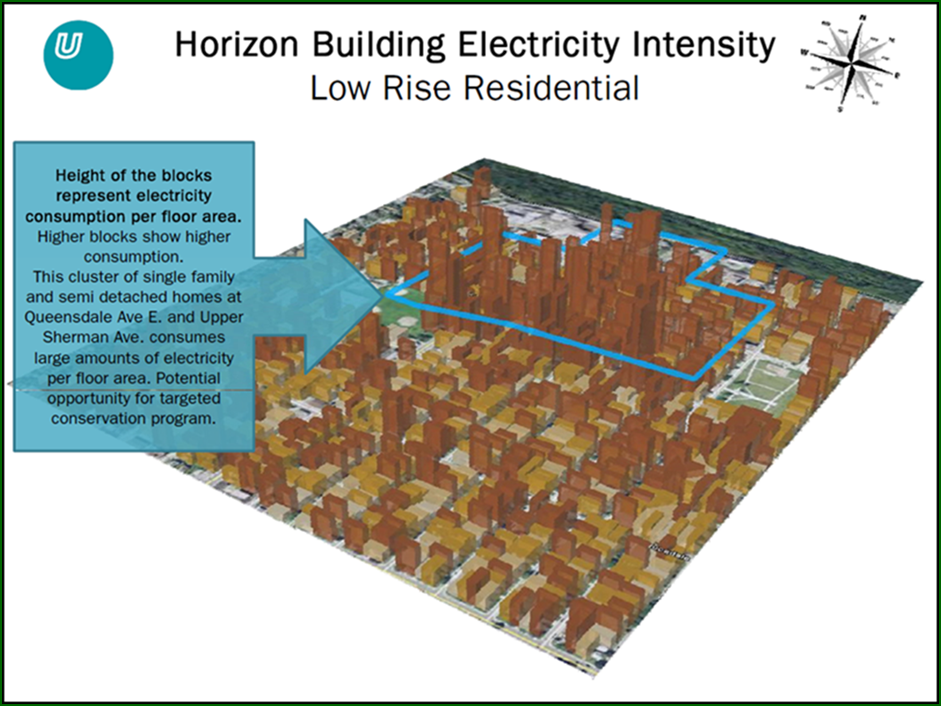 A classic example of the application of geospatial techology in the energy sector is energy density analysis and mapping that helps utilities target energy conservation and demand response programs to high energy footprint buildings. [Image courtesy of Horiizon Utilities]
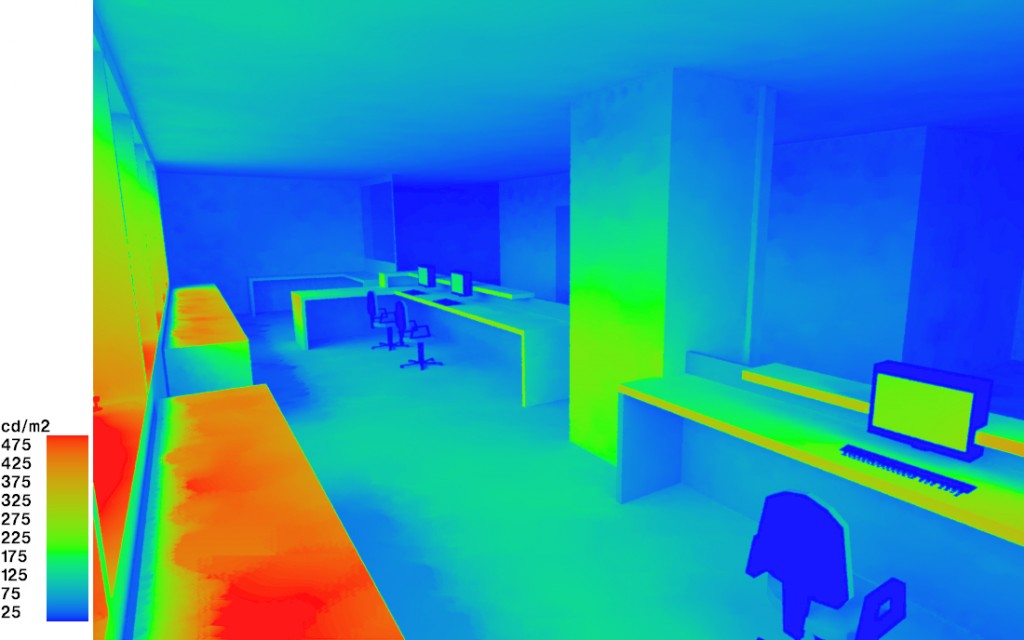 Energy performance analysis helps architects and engineers to optimize energy usage of new buildings, often motivated by programs such as LEED certification and energy conservation programs sponsored by electricity distribution companies. Combining detailed information about a building in the form of a building information models (BIM) together with geopatial information enables energy performance analyses of alternative design options that can reduce annual energy consumption and power bills by 40%. In some jurisdictions, programs supported by the local electric power utility means that reducing the expected electric power usage of a new building can generate an immediate financial benefit. [Image courtesy of 3D Energy Ltd].
Smart grid management system for operations and analytics
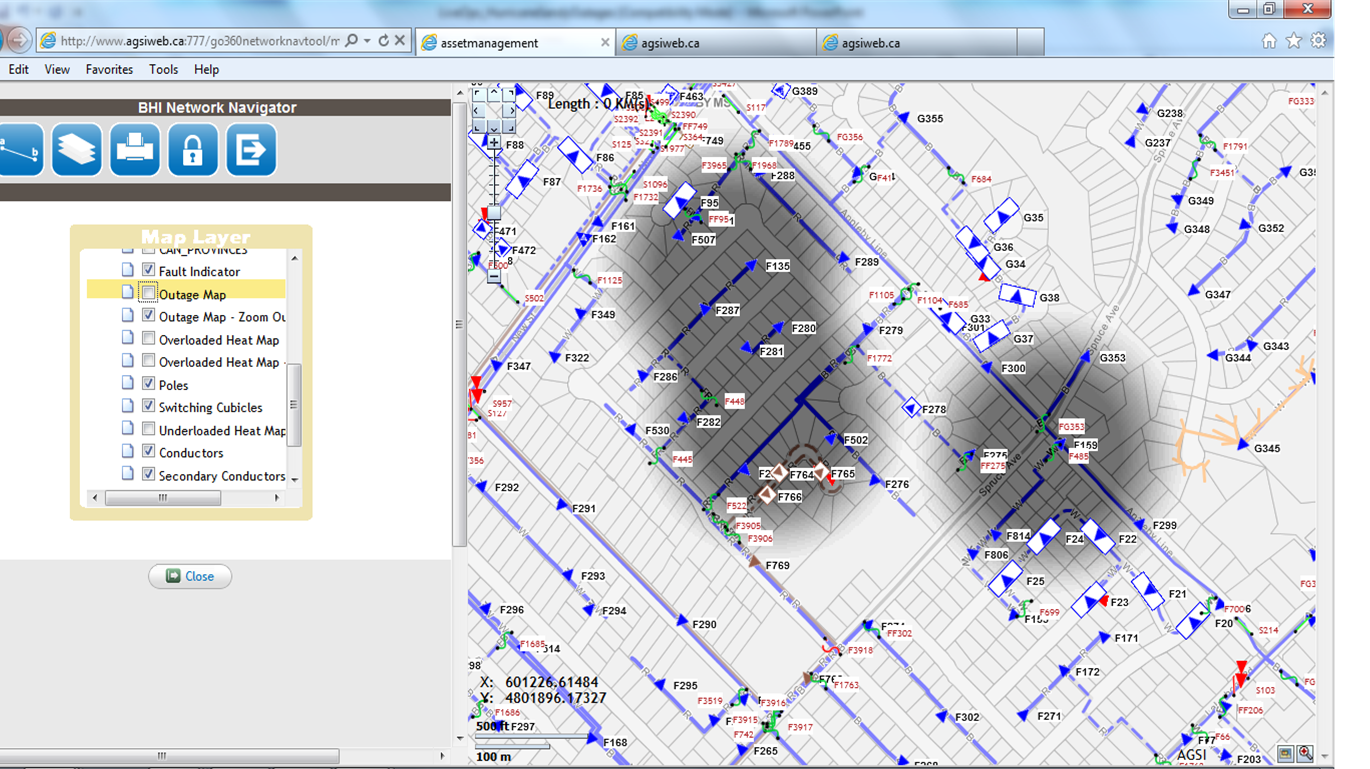 The volume of data generated by smart grid networks has been estimated to be 10,000 times greater than for our existing electrical networks, and much of the data is real-time. Managing large volumes of real-time data from sensors is simplified by integration with with geospatial technology that allows real-time monitoring and decision making. For example, it can provide useful outage information to the public in a way that protects the privacy of individual consumers as in this example when Hurricane Sandy caused outages in Toronto. [Image courtesy of Burlington Hydro]

Be the first to comment