
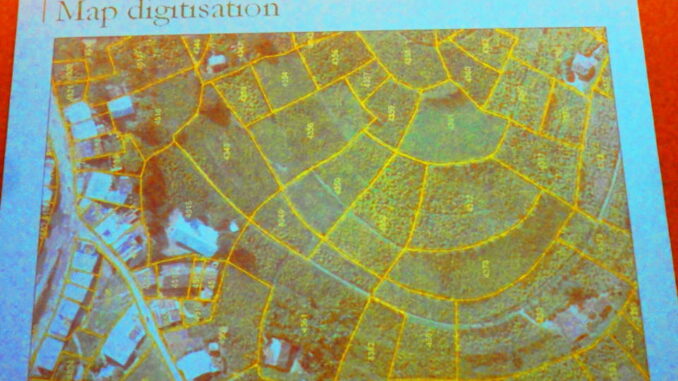
At the Geospatial World Forum in Amsterdam today Didier Sagashya, Deputy Director General of Lands and Mapping Department in the government of Rwanda gave a fascinating presentation about creating a land adminstration system in Rwanda.
The Organic Law of 2005 defined a new land tenure system based on security of tenure and that land administration is mandatory. There are an estimated 10 million parcels in Rwanda which has one of the highest national population densities in the world, about 400 people per km2.
Starting in 2009 Rwanda set out to create a land registry. One of the most interesting aspects of the Rwandan approach is that it is not based on a traditionally-surveyed cadastre. Instead it relies on nation-wide high resolution (25 cm) photo imagery and a process that involves consulting with local people and drawing boundaries on the high resolution imagery. At this point about 2.7 million parcels have been defined and adjudicated and land registry titles printed. It is expected that registration of all of the 10 million parcels will be completed by 2013, which is a remarkable achievement, especially in less than five years.
The major benefit of a national land registry system is that it enables land to participate in the national economy. For example, land can be used as collateral in applying for bank loans. One of the interesting statistics that Didier mentioned was that last year the number of bank loan applications involving land as a collateral was about 10,000 for the entire year. In the first quarter of 1012, the number of bank loan applications is already 6000, which suggest people are already beginning to take advantage of the new land registry system.
The other major impact that Didier mentioned that a national land registry system can have is that it can lead to sustainable land management, less erosion, for example, because presumeably if you own something you take better care of it. This effect tends to be long-term, and Didier did not have statistics to show that this is happening, but this is one of the outcomes they are monitoring, in addition to bank loans.

Be the first to comment