
At the Geospatial World Forum in Amsterdam, Radu Negoita, GIS Manager at GDF Suez Energy Romania, gave a fascinating overview of how GDF Suez has built a location aware asset management system in 10 months. Natural gas is a rapidly growing source of energy that is cleaner from an emissions perspective than traditional energy sources such as coal.
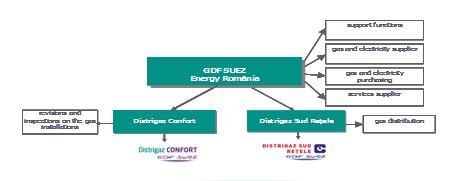 GDF SUEZ Energy România has over 1.3 million customers and is a leader in the gas distribution and delivery market. Its main buiness is the distribution of gas to consumers. The total gas distribution network managed by GDF Suez is 16,000 km. Natural gas distribution is a regulated activity to ensure the safe operation of the network which is comprised of pipes, residential connections, regulator stations, sensors/measurement systems, and other types of assets.
Data acquisition
In 2007 GDF Suez initiated a data acquisition project to capture information including location about all their network assets. It is an ongoing effort using using internal resources. GDF Suez relies on GPS and total stations to capture accurate locations for their assets.
Asset management system
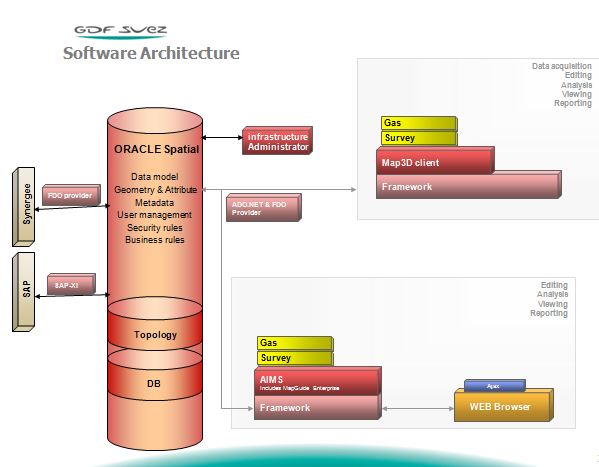 The objective of the asset management system is to improve the productivity of gas distribution operations by automating manual asset management processes. The core is an asset management system that manages the assets in a centralized database (Oracle Spatial) and provides desktop (AutoCAD Map 3D) and web based tools (Autodesk Infrastructure Map Server) for optimizing data quality and providing secure access to the information across the organization. The core database relies on data versioning (long transactions) to manage asset updates safely in a production environment. It relies on an open architecture to enable integration with SAP plant maintenance, SynerGEE network analysis, and other enterprise systems. It supports design sketches and redlining of design drawings and provides multi-criteria analysis for investment planning.
Project development
The project lifetime was ten months which, based on my experience with similar asset management systems in a range of utilities, I find quite remarkable in terms of how fast the production system was delivered. This involved a full project lifecycle including business requirements analysis, development of the hardware and software architecture, installation of Oracle Spatial database and configuring the gas network model, configuration and installation of the application, data migration and testing and training. The solution was deployed and in production in 2010 and currently supports 600 active users.
The system provides automated data capture from field measurement systems, multi-user editing of asset location and properties, creation and editing of network topology, generation of job estimates, tabular and graphical reporting, and provides an operations dashboard for monitoring progress and the status of the network.
The desktop client is used for field data acquisition, creation of the new assets; geometry, attribute and topology editing and network state analysis.
The web client, which is used by the majority of the users, provides a viewer for attributes and geometry of the network; navigation and searching of maps, and report generation.
Plant maintenance
Plant maintenance is based on a maintenance plan for all assets of the network including pipes, residential connections, valves, regulator stations, and so on. The master system which manages the assets is the geospatial asset management system. SAP- PM manages maintenance network assets in terms of preventive and corrective maintenance. It also handles exceptions and other operations events on the network.
Future developoment
GDF Suez’ future development plans include integration of the asset management system with the SCADA, SAP asset accounting, and workforce management enterprise systems. They also intend to develop a crew routing and dispatch module and a mobile client for field staff.

Be the first to comment