

Airports are like cities. They have all the infrastructure that cities have plus some. Heathrow is the busiest airport in Europe with on average 181,000 passengers passing through it each day. Heathrow has 13 different types of infrastructure, some of which are unique to the airport environment. To provide some idea of the magnitude of the infrastructure at Heathrow, there are more than 45 000 man holes, 72 miles of high pressure fire water mains, 81 miles of aviation fuel pipelines, and power cables carry voltages ranging from 9V up to 400 kV.
That is a lot of infrastructure to manage. The challenge is made more difficult because it is an environment where even a minor accident carries the risk of serious consequences. (At last year’s Autodesk University, Shashi Verma gave a talk about asset management at Heathrow called Flying High: Multi-Utility and Infrastructure Project Implementation at Heathrow Airport.)
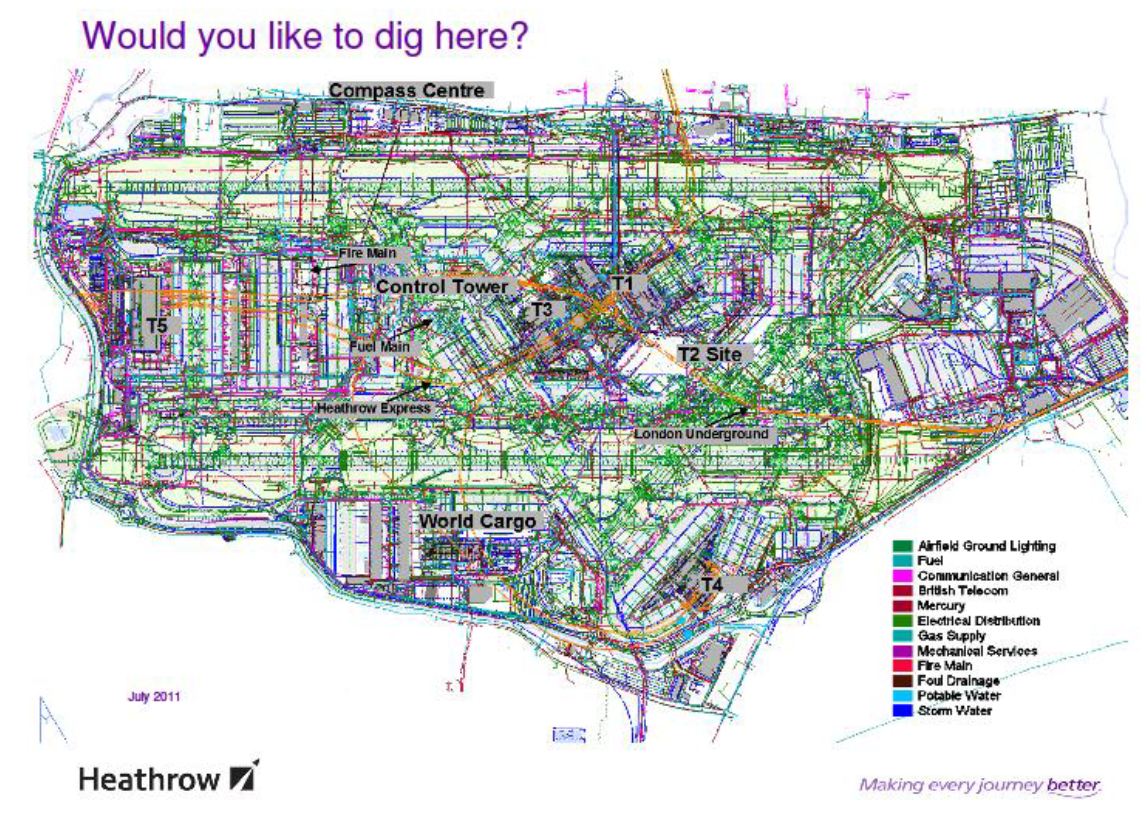 At the Geospatial World Forum, Nigel Stroud, Geometry Information Manager with the British Airports Authority (BAA) at Heathrow gave a fascinating talk about the Heathrow Map Live system which provides web-based access to high quality information about Heathrow’s infrastructure. The primary reason that access to quality information is important is for safety reasons, but there are also legal and contractual requirements, such as CDM (Construction Design Management) regulations. And there is an important efficiency dimension to this as well.
Single point of truth
To enable interoperability and open access to various types of data, Heathow has defined a Common Data Environment (CDE), the objective of which is basically a single point of truth. The objective of CDE is to cultivate a culture where data is created once only and used many times. Another way to put this is that each data element has a single owner and is shared across the organization. Implementing this is much more difficult than it sounds. In many organizations, different groups independently capture and maintain information about the same assets. For example, in a study of a single utility Gartner found that nine different groups were independently capturing and maintaining similar data about power poles. At Heathrow CDE means that standards, guidelines, and work processes are designed to support a single point of truth. The important business benefit from a cost perspective is that having a common data environment minimizes rework, increases re-use of designs and provides for efficient handover from design and construction to operations.
Data quality
 Because safety is Heathrow’s first concern, data quality is a top priority. Reliable data about infrastructure is required to respond effectively to an emergency as well as to provide information about the location of existing infrastructure to the more than a thousand contractors working at Heathrow at any given time. In 2002 40% of Heathrow’s underground facilities were mapped to within half a meter. Now 72% of the underground facilities are mapped to half a meter.
In my view, the most important thing that Heathrow has done is designing business processes to optimize data quality. For example, contractors at Heathrow are contractually obligated to progressively deliver as-builts over the lifetime of construction projects. In other words, as-builts are not only required at the end of the project, but during the progress of construction, so that they can reviewed by BAA as work proceeds.
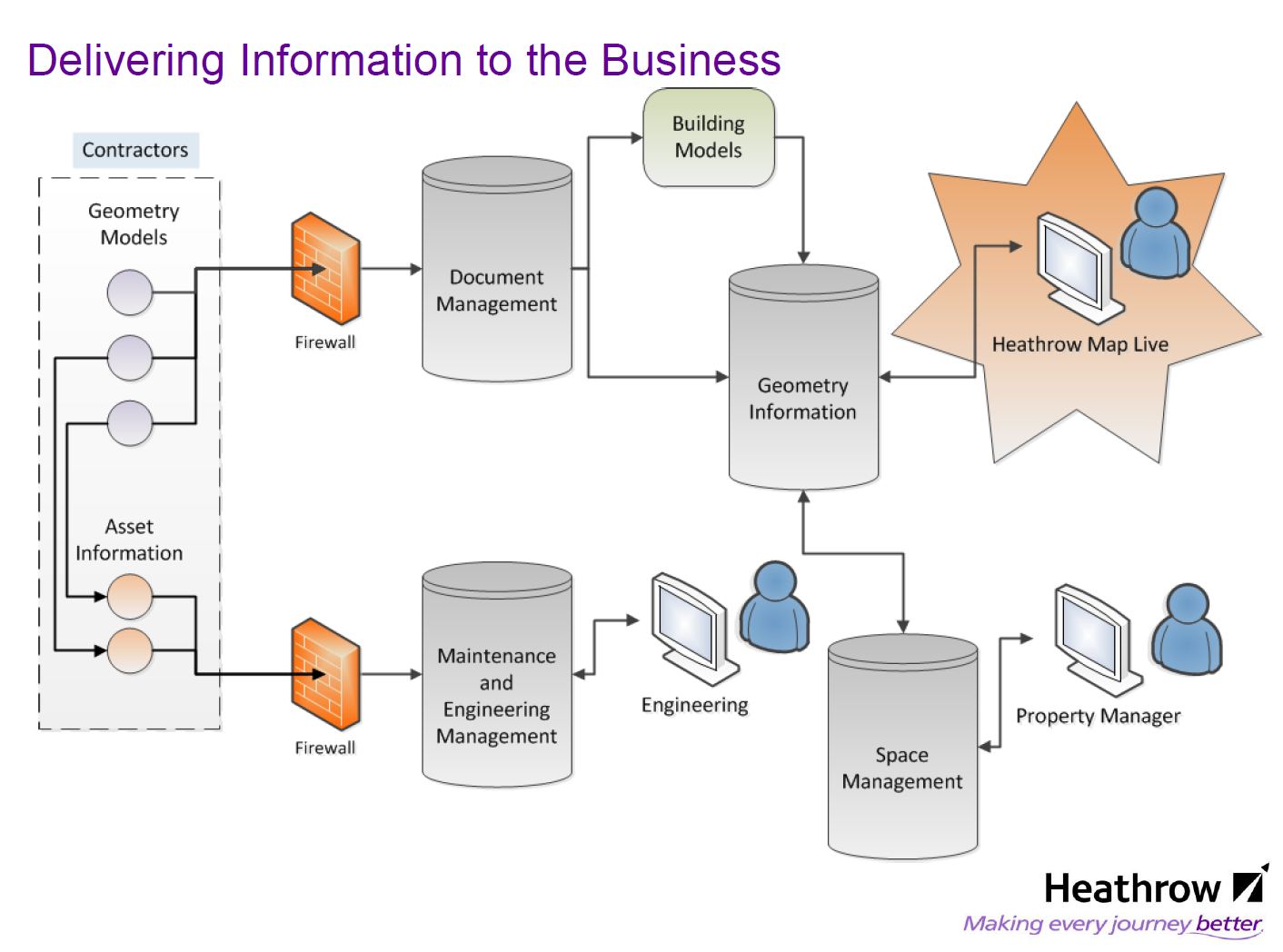
Heathrow has had an effective asset management system for capturing and maintaining information about infrastructure including infrastructure and building models, drawings, operations and maintenance reference manuals, and asset maintenance reports for many years, but has found it a challenge to provide access to this information across the business. This is what the Heathrow Map Live system accomplishes, a single, simple web-based tool based on an Oracle database that allows everyone within the business to query, retrieve and view information about Heathrow’s infrastructure.
 Avoiding underground infrastructure during excavation
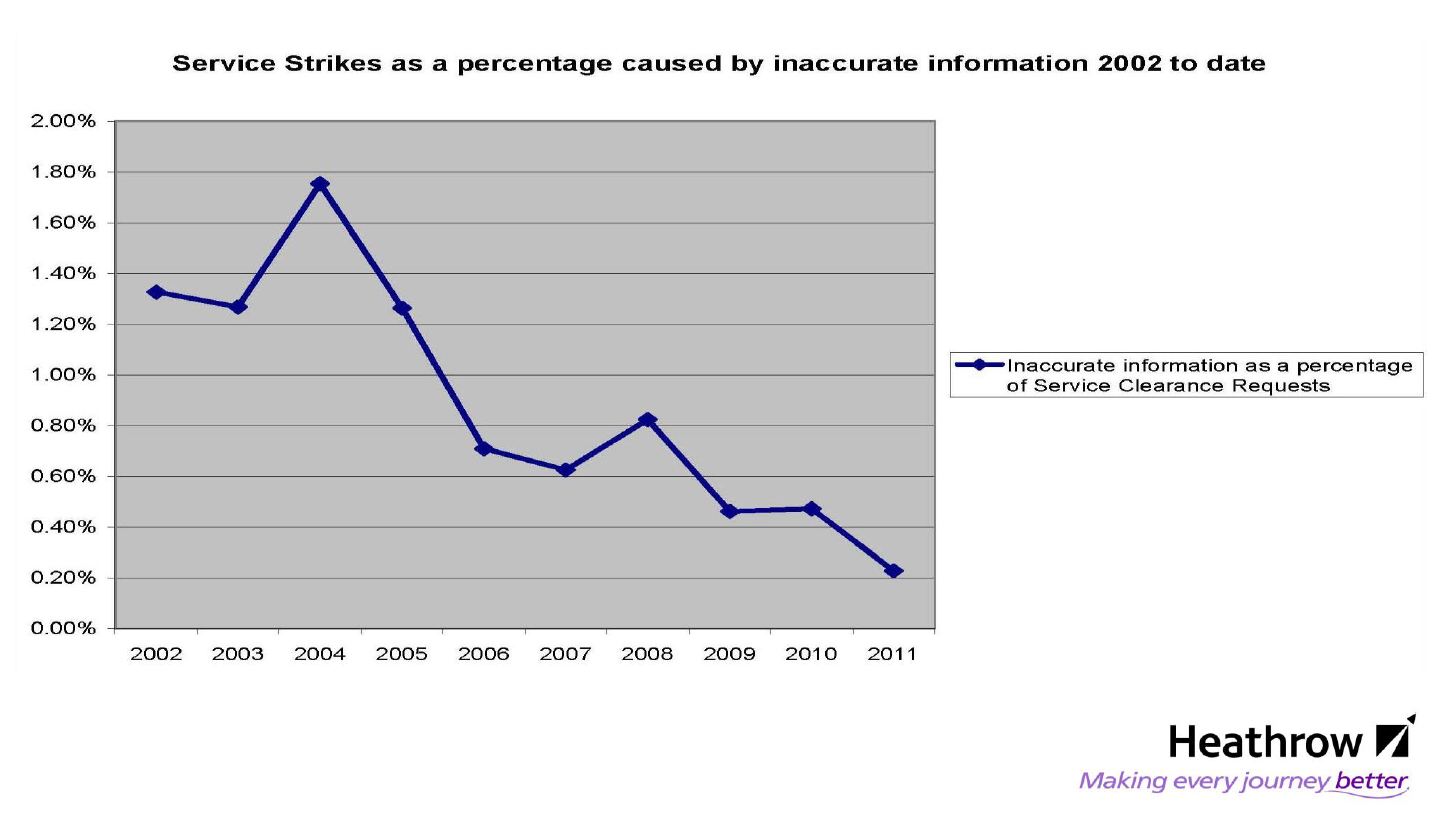
One of the major hazards of all construction activity is inadvertently hitting underground infrastructure. To give some idea of how frequent this occurs, in the US in 2010 there were 112,917 incidents where underground utility facilities were hit during excavation.
At an airport this is particularly hazardous because not only are there gas mains and electricity distribution cables, but also aviation fuel lines and very high voltage power lines. This is one of the biggest benefits of the Heathrow Map LIve system. At Heathrow statistics show that the proportion of events where underground facilities were hit during excavation as a result of inaccurate information decreased by a factor of 6x from 2002 to 2011, primarily as a result of access to high quality information including location about underground infrastructure provided by Heathrow Map Live.

Be the first to comment