
DLT Solutions organized a Geospatial Tech Day June 8 in Washington, DC. Mike Evanoff of Google Earth Enterprise gave the leadoff presentation. Jim Flyzik moderated a panel on geospatial trends that included Mike Evanoff, myself, and Steve Miller of GeoEye. Robert W. Burkhardt, the Army Geospatial Information Officer (GIO), was the keynote speaker.
Major themes
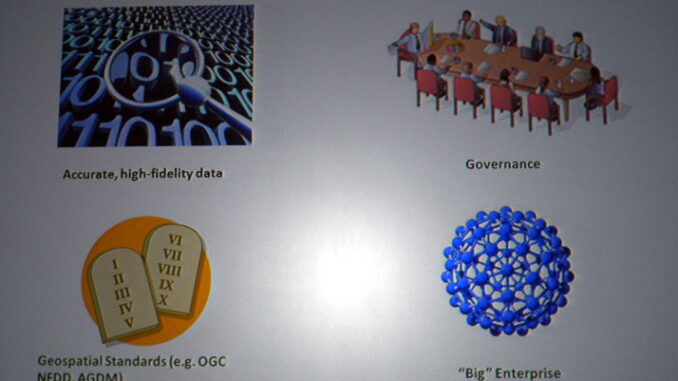
Robert Burkhardt focussed on four themes, ubiquitous high resolution spatial data, governance, geospatial standards, and the “big” enterprise.
Ubiquitous high resolution data
In the past the lack of data was a problem, now the challenge is increasingly being able to integrate and analyze in order to extract information from the huge volumes of data that are now available. Robert Burkhardt gave an example where web-based mapping helped expose patterns and extract actionable information from a huge, chaotic volume of data pouring out of many stovepipes.
Data models, critical for sharing complex geospatial data, were also mentioned, specifically NFDD, the National Geospatial-Intelligence Agency’s (NGA) data model, which may become the DoD’s geospatial data model in the future, and AGDM, which is the Army’s geospatial data model.
Steven Miller from GeoEye expects that in the future we will see increasing amounts of imagery from other than US sources. Increasing competition will drive up resolution, drive down costs and increase national security risks. He also expects that licensing models for data will change as more people demand access.
Data sharing
The Army GIO was unequivocal about the value proposition of sharing data, or what he called the “disciplined sharing of data”. Sharing data saves lives and saves money.
Open geospatial standards
Robert Burkhardt identified open geospatial standards as one the major advances enabling sharing geospatial data and mentioned OGC, FGDC, NFDD, and other standards.
Participation and crowdsourcing
Mike Evanoff talked a lot about participation because Google has recently introduced a crowdsourcing tools such as Map Maker which allows you to contribute data and customize your own maps. Many people are familiar with the contribution that the OpenStreetMap project made in the aftermath of the earthquake in Haiti and Mike mentioned it. But comprehensive street maps of Port-au-Prince were also produced, in just 72 hours, using Google Mapmaker.
Convergence (of geospatial, engineering design, 3D visualization)
This was a major recurring theme that just about every speaker talked about. It involves intelligent models such as BIM, which not only enable better design, but also sustainable design. In the future convergence will help us to model and design entire sustainable cities.
3d visualization
This was a theme that Jim Flyzik, who has had over 20 years experience in government, really picked up on, the importance in government of visualization for communicating technical information to citizens. In his summary of the panel discussion Jim highlighted what he thought were the three key takeaways, convergence, intelligent models, and especially visualization and how important visualization is for communicating to nontechnical people like politicians, bureaucrats and the man in the street.
Cloud computing
Mike Evanoff of Google talked about the advantages of cloud computing, and how Google does not consider itself a data vendor, but a vehicle for providing access to government and other data. It is interesting that as a result of Google’s crowdsourcing tools, Google Maps in North America now no longer relies on TeleAtlas or Navteq for their vector maps.
Importance of geospatial
It seems clear that the importance of geospatial within government will to continue to rise. The Army appointed its first GIO in 2001 and Robert Burkhardt predicted that we will see more GIO’s in the federal government in the future.
Be the first to comment