
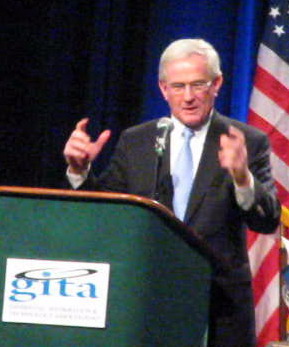
GITA 31 just kicked off this afternoon with a fascinating keynote by Tom Murphy, former Mayor
of
Pittsburgh. He made a number of interesting points but there are three that really hit the mark with the audience.
The first is that the Ozzie and Harriet life style that most North Americans have grown up and assumed is being threatened. Tom introduced the subject by asking the audience how many changed their lifestyle when gasoline reached $3.00/gal. A few hands went up, but when Tom asked how many were going to make some changes to their lifestyle when gasoline hits $10/gal, many more hands went up. Tom’s point is that
the North American lifestyle identified with Ozzie and Harriet is founded on cheap oil, and as oil prices continue to rise we are going to face profound changes in how we live and work and get between the two.
The second important point that Tom made was the deplorable state of American infrastructure, and as evidence of this he pointed 
to the the American Society of Civil Engineers’ (ASCE) Scorecard for America’s Infrastructure. All three of the remaining presidential candidates in the US have mentioned the problem of aging infrastructure. The Federal Highway Trust Fund — supported by a tax on gasoline — is up for renewal in 2009, and that may be an opportunity to motivate a national discussion on infrastructure renewal.
The third point that Tom made is that traditional sources of funding for infrastructure are drying up. The Federal government is basically out of the picture, but local and state governments have become creative in finding new ways to fund infrastructure projects. He mentioned several examples
where several local governments have joined forces to share tax revenues to support infrastructure programs. In St Paul Minneapolis 188 municipalities and 7 counties share 40% of t heir tax basis. In the Cleveland area five counties pooled tax revenue to support the Cleveland Metroparks system. In Denver the Fastrak Referendum approved a $2B bond issue shared by seven counties and 32 municipalities for 119 miles of light rapid transit to protect what people like about Denver.
Be the first to comment