
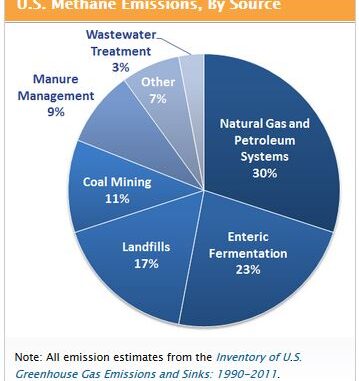
Methane has the second-largest global radiative forcing impact of anthropogenic greenhouse gases after carbon dioxide. In addition to anthropogenic sources, mainly fossil fuels, livestock and waste, natural methane sources include the biosphere (wetlands, termites, oceans, wildfires, and wild animals), volcanoes and geothermal emissions, and geological seepage where large quantities of natural gas migrate from shallow or deep rocks and reservoirs to the surface along faults and fractured rocks.
Estimates of emissions have come under increasing scrutiny. A recent study assessed the spatial distribution of anthropogenic methane sources in the United States by combining comprehensive atmospheric methane observations, extensive spatial datasets, and a high-resolution atmospheric transport model. It was concluded that the US Environmental Protection Agency (EPA) underestimates methane emissions nationally by a factor of 1.5.
The concentration of methane in the atmosphere stabilized from about 1999 to 2007. But here is evidence that since 2007 it began rising again. A recent study suggests that the more than 30% increase in U.S. methane emissions over the 2002–2014 period could account for 30–60% of the global growth of atmospheric methane seen in the past decade.
In a study just published the global methane budget and the contribution of the fossil fuel industry to methane emissions has been reevaluated. The ratio of carbon-13 to carbon-12 provides a signature which helps identify the source of methane. Both global methane and methane carbon isotope (carbon-13) records were used to compile what is believed to be the largest isotopic methane source signature database, including fossil fuel, microbial and biomass-burning methane emission sources. Total fossil fuel methane emissions from the fossil fuel industry plus natural geological seepage are 60 to 110 % greater than current estimates. After accounting for natural geological seepage, it is found that methane emissions from natural gas, oil and coal production and their usage are 20 to 60 % greater than current estimates.

Be the first to comment