
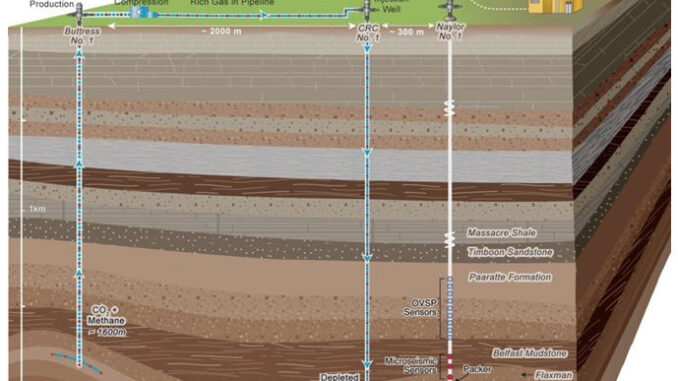
There’s an interesting article in the Globe and Mail entitled The Greening of Coal which outlines some of the things underway worldwide to reduce emissions from coal-fired power generation plants. Carbon capture and storage (CCS) technology has been researched for a long time, but has yet to be shown to be economic. At this point many folks in the industry believe that broad CCS adoption by the power generation industry will require government subsidies. The American Clean Energy and Security Bill passed by the US House of Representatives provides billions of dollars in incentives to induce owners of coal-fired power plants to try CCS. It makes the first 6,000 MW of new or retrofitted power plants eligible for up to US$90 for every ton of CO2 that is captured and stored. The bonus for early adopters of CCS exceeds many predictions of what carbon will cost on the open market if the climate bill becomes law. (Image CO2 CRC)
Enel SpA
 Enel SpA it is a publically traded company with about 95,000 MW of generating capacity whose strategic objective is zero-emission power generation from coal. The technology it is investing in was developed at the Canadian Centre for Mineral and Energy Technology (Canmet) research labs in Ottawa. Enel has done further research in its own labs and now plans to build a demonstration plant in Brindisi, Italy.
  The Canmet process captures CO2 as a compressed fluid, which can be sold as industrial CO2 or stored. In 2002, coal provided 22 per cent of the Enel’s power generation capacity. By 2012, coal will produce 50 per cent and renewable energy and natural gas 50 per cent of output.
Vattenfall
 Vattenfall, with about 35,000 MW of power generation capacity, 46% fossil-fuel, 31% nuclear, and 22% hydro, began construction in 2006 of a pilot oxyfuel plant including CCS with 30 MW generation capacity at its lignite-fired power plant at Schwarze Pumpe, Germany, which became operational in September 2008. Oxyfuel technology attempts to accelerate the combustion of coal using oxygen to improve efficiency and reduce CO2 emissions. The next step is a demonstration plant for which engineering is scheduled to begin in 2010.
Britain
The British government has mandated that no new coal-fired power plants will be built in Britain unless they capture and bury at least 25% of GHG immediately and 100% by 2025. The government has announced funding for four commercial-scale CCS demonstration power “clusters” generating a total of 2.5GW of electricity. Each cluster will have at least one new coal-fired power station able to collect carbon emissions and transport them out to sea, where they will be buried in redundant oil or gas fields. The new power stations are expected to begin production in 2015 and will be located in the Thames Gateway, on the rivers Humber and Tees and in the Firth of Forth in Scotland.
 The first UK pilot of CCS technology on a working coal-fired power plant started in Scotland in June of this year. Scottish Power started a seven-month trial of a 1 MW CCS unit at Longannet power station in Fife. The prototype has been retrofitted into the 40 year old power station and is a small scale model of the technology that could be used for the four demonstration projects announced by the British government.
Doosan Babcock Energy Co
 Doosan Babcock has announced the opening of the world’s largest OxyCoal™ clean combustion test facility which is a full-size 40MW burner. The interesting feature of this technology is that it can be used for new plants or for retrofitting existing coal plants. The project is a collaboration between Doosan Babcock, the UK Government (DECC), Scottish and Southern Energy, Air Products, Drax, DONG, EDF, E.ON, ScottishPower and Vattenfall, and UK Coal.
American Electric Power Co
 AEP, with 39,000 MW of generating capacity and which consumes 76 million tons of coal annually, has announced that it is applying for US$334 million of stimulus funds to cover 50% of the costs of expanding its CCS test project at its Mountaineer Power Plant in New Haven, West Virginia. The initial CCS project was designed to capture CO2 emissions corresponding to 30 MW of power generation. AEP is one of the first large investors in CCS. AEP and Alstom have funded most of the initial project themselves, though they did receive US$8 million from DoE for early drilling to identify the geologic formations where carbon dioxide will be pumped from the Mountaineer plant. AEP has planned to expand the initial test to an emissions stream equivalent to 230 MW, for which it is applying for Department of Energy stimulus funds.
RWE Power
 RWE has about 45,000 MW of generating capacity, of which 56% is lignite and hard coal, 16% gas, 14% nuclear, 3% renewable, and 11% other technologies. RWE is investing in a coal-fired power plant including carbon capture and storage (CCS) using Integrated Gasification Combined Cycle (IGCC) technology. RWE Power has been researching IGCC technology since the 1980s and 1990s. With this technology, carbon capture is relatively easy so CCS costs can be kept low. It is planned to build a new power plant at the RWE power plant site Goldenberg in Hürth near Cologne and operated using domestic lignite. The plant is estimated to have a gross capacity of 450 MW and could go on stream by the end of 2015. In the IGCC process, the gasification of lignite is combined with carbon capture, and electricity is generated in downstream gas and steam turbines.
Department of Energy
 The Department of Energy’s Pacific Northwest National Laboratory (PNNL) has looked at the feasibility of a national CO2 pipeline network to determine the potential scale of a CO2 pipeline network in the US. They found that 95 % of the largest stationary CO2 sources, such as large coal power plants, are within 50 miles of existing storage sites. Consequently, there is no need for long transcontinental CO2 pipelines. At the present time, there are 3,900 miles of CO2 pipelines in the US, built primarily in the 1980s and 1990s for CO2-driven enhanced oil recovery projects. PNNL estimate that between 11,000 and 23,000 miles of additional dedicated CO2 pipeline will be required to support CCS.
Australia
 80% of Australia’s power production is coal. Australia’s coal resources are so large that they could be significant in the global energy mix for several hundred years. Australia opened its first CCS plant in April of last year in the Otway Basin near Nirranda South in southwestern Victoria. This is the world’s largest demonstration of deep geological storage of CO2. The CO2 is injected into a geological formation two km underground. Up to 100,000 tonnes of CO2 will be injected over a period of one to two years. The Otway Basin Project was developed by the Cooperative Research Centre for Greenhouse Gas Technologies (CO2 CRC).

Be the first to comment