
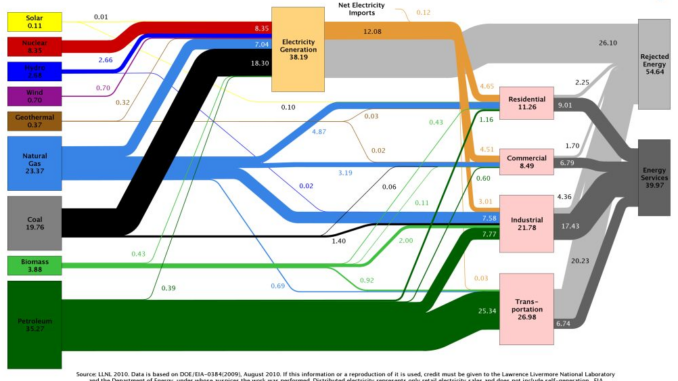
Shale gas has been seen as an economical way to reduce green house gas emissions from electric power generation. It has been asserted that natural gas power plants, which are responsible for 21% of power generation in the US, produce 50% less emissions than coal-fired plants. However, in the past the amount of methane gas that leaks from pipes and is vented from gas wells has not been included in the calculation. A recent EPA analysis doubles its previous estimates for the amount of methane gas that leaks from pipes and is vented from gas wells, which significantly changes the emissions picture.
Methane is one of the more potent greenhouse gases for global warming, but it is not clear just how much more potent methane is than CO2. The EPA has estimated a factor of 21 times compared to carbon dioxide. But Robert Howarth, an environmental biology professor at Cornell University, has suggested that it is actually 72 times as powerful as carbon dioxide in terms of its warming potential. This is critical, because if the climate effect of methane from natural gas is 72 rather than 21 times that of carbon dioxide from burning coal, natural gas may even turn out to be worse than coal in terms of global warming. Howarth has said that the type of shale gas drilling taking place in Texas, New York and Pennsylvania generates particularly high emissions of methane and could be as dirty as coal.
A new study by Robert W. Howarth, Renee Santoro, and Anthony Ingraffea has concluded that the emissions of methane from shale gas wells are between 30% and 100% more than methane emissions from conventional natural gas wells. The study estimates that between 3.6% to 7.9% of the methane from
shale-gas production escapes to the atmosphere in venting and leaks over the lifetime of a well.
As a result the study found that the greenhouse gas (GHG) footprint for shale gas is greater than that for conventional gas or oil. When compared to coal, which is responsible for nearly 50% of electric power generation in the US, the GHG footprint of shale gas is estimated to be 20% to 100% greater than coal over a 20 year period. Over a 100 years, the study concludes that the GHG impact of shale gas is comparable to coal.

Be the first to comment