
Utility locating involves remote-sensing and safe excavation technologies for identifying, detecting, and labeling the underground utility infrastructure including telecommunication, storm and sanitary sewers, water, electricity distribution, natural gas, cable television, fiber optics, heating and others. Remote-sensing tools for underground utility detection have been available for decades. Among the widely used detection devices, ground penetrating radar (GPR) not only can detect nonmetallic objects but also provide 3D location – reporting depth as well as X,Y location – which makes GPR a superior mapping technology for many applications. GPR has become almost mandatory in the water industry that is increasing its use of plastic piping. GPR does have drawbacks. The most important is that it requires an expert, typically a trained geophysicist, to interpret the scans. Secondly, most current devices are intended to operate at a walking pace making GPR inefficient compared to mobile laser scanning, for example. In addition identifying the type of utility (water, electric, fiber optic) generally requires supplementary information from other sources. In some soil types such as aggregate and clay GPR does not perform well.
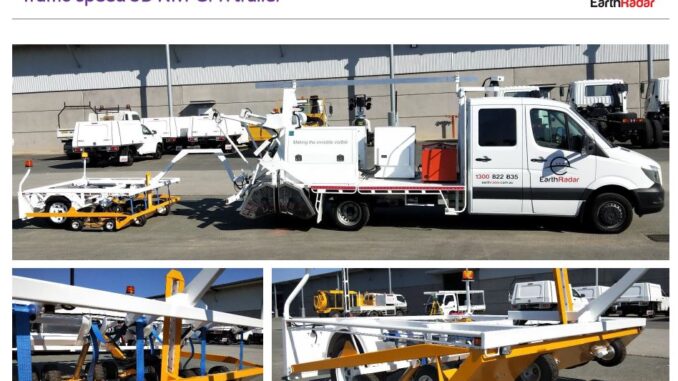
Recently there have been important advances in GPR that is beginning to transform subsurface utility mapping. Hexagon AB/Leica Geosystems acquired IDS GeoRadar several years ago. For a GPR survey in London an IDS Steam-EM array was combined with a Pegasus Two LiDAR scanner to capture above and below scans with a towed trailer at up to 15 km/hour. T2 Utility Engineers, based in Whitby, Ontario, reported commercially using a Hexagon IDS GeoRadar Stream EM multi-channel ground penetrating radar (GPR) array towed at 10-12 km/hr to capture subsurface data. In a separate initiative a successful proof of concept was reported by DGT Associates in Mississauga, Ontario in which data collected by a Siteco rig combining a Faro mobile laser scanner and Sensors and Software GPR arrays collected data simultaneously above and below ground at roadway speeds of 80 to 90 km/hr. Most recently I blogged about an important software development for the Leica Geosystems DSX GPR device. The DXplore software displays a tomographic display (no hyperbolas !) of what the radar has detected. There have also been important advances in radar detection technology. ImpulseRadar, a company based in Malå, Sweden, has developed a unique ground penetrating radar (GPR) technology which uses real-time sampling (RTS) to gather data thousands of times faster than a conventional GPR. This makes possible GPR scans of underground utilities with a commercial product at highway speeds up to 130 km/hr. In a separate development, Earth Radar, based in Brisbane, Australia, has applied Noise-Modulated Penetrating Radar (NM-GPR) in its Sparas product, a trailer based 3D GPR that can collect measurements at 60mm intervals along the road at a speed of up to 100 km/hour.
An analysis by Markets and Markets estimated that the global ground penetrating radar market (GPR) is US$ 493 million in 2019 and would grow by over 6% per year to reach US$ 726 million by 2024. The analysis included IDS Georadar (Italy), Sensors & Software Inc. (Canada), Guideline Geo (Sweden), Chemring Group (UK), Geophysical Survey Systems, Inc. (US), Leica Geosystems AG (Switzerland), Radiodetection (UK), Penetradar Corp. (UK), Utsi Electronics Ltd. (UK), Hilti ( Liechtenstein), Pipehawk PLC (UK), and Geoscanners (UK).

Be the first to comment