
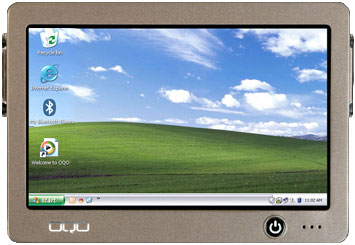
Up until a year ago the only handheld alternatives that utilities
and telcos had for their field staff were either PDAs or notebooks such
as Panasonic Toughbooks.
PDAs
PDAs, while fine for tabular information, simply don’t have enough graphic real estate for most graphic applications. Also they run specialized operation systems such as Windows CE, PocketPC, Mobile5, or PalmOS. I know of several companies that tried PDAs, but ultimately replaced them with notebooks.
Notebooks
There are problems with notebooks as well. They are too bulky to take up poles or down manholes. They are also expensive. Some companies bolt them to their trucks so they can’t be lost or dropped.
Pocketable
Since early 2005 there has been an alternative. For over a year I’ve been carrying an OQO
(www.oqo.com), which is a handheld small enough to go in your pocket (called “pocketable”) , with enough screen resolution, 800 x 480, to support serious graphical applications like DWF Viewer and Autodesk Design Review, and able to run full XP Professional. I have shown the device to many utilities and telcos, and the things that
appeal most about it are the form factor, the graphic real estate, and its
ability to run full XP. The latest device, Model 01+, has 512 MB RAM and a 30 GB hard drive and supports Wi-Fi, Bluetooth, Firewire,and USB. Literally you can run AutoCAD on this device. The screen is transflective, which means you can see it in bright sunlight. And it’s reliable. I picked up a USB GPS and have taken the device cross country skiing, hiking, and carried it around the world on airplanes (I like to stick the GPS up against the window on planes to track where we are). The only serious problem I have had is losing the stylus.
Carry with you UMPCs
Now there is another alternative. Last week at Cebit in Hannover, three devices that are similar to
the OQO, but larger were shown. These devices are called ultra mobile PCs or UMPCs and are “carry with you” as opposed to pocketable. All three UMPCs at CeBit had touch-sensitive color screens, measure 7
inches across diagonally, and support Wi-Fi, Bluetooth and USB. They weigh just under a kilo, which is twice as much as the OQO, and have 30GB to 60GB hard drives, run on Intel’s ultralow-power
Pentium and Celeron chips, and support Windows XP Tablet PC Edition with an additional piece of software
called the Touch Pack, which provides an on-screen keyboard that you can type with your thumbs. Microsoft refers to this platform as Origami. Intel sees a tremendous future for these small mobile devices. Last year they created a new division for mobile devices, called the LPIA Division.
With these devices currently you can get about two hours of usage. But as a result of reduced power consumption especially by the screen and improved battery technology, Intel is projecting lower power consumption and improved battery technology so that over the next few years you can expect to see “all day” devices.
UMPCs are in the US$1100 to 1200 range, which compares favourably with most notebooks.
The important trend I see here is that increasingly you will see low cost all day handhelds with a range of form factors, but able to run standard operating systems like XP, Linux, and Max OS X. This will enable a revolution in mobile computing solutions with full connectivity over W-Fi and 3G and intelligent applications on the handheld that I expect will dramatically improve the productivity of field workers.

Be the first to comment