
Horizontal BIM, heavy BIM, VDC, civil information modeling, BIM on its side, or BIM for infrastructure are terms used in the construction industry for the application of model-based technologies and processes to non-building projects. This includes infrastructure for dams, waste facilities, rail, transit, aviation, energy, public parks and recreation, bridges, roads and highways, and water and wastewater. The term vertical BIM is often used to differentiate BIM for buildings.
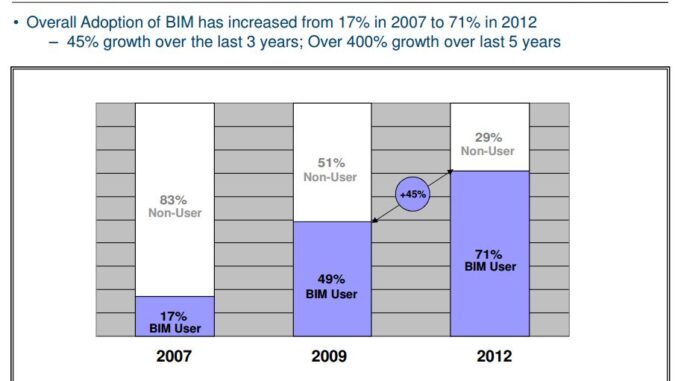
BIM has achieved incredible penetration in the vertical market. The latest McGraw-Hill Construction report Business Value of BIM in North America 2012 reports that overall Adoption of BIM has increased from 17% in 2007 to 71% in 2012, which represents 45% growth over the last 3 years.
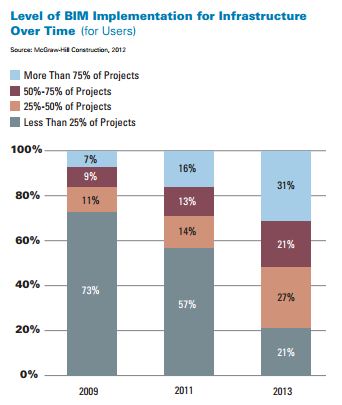
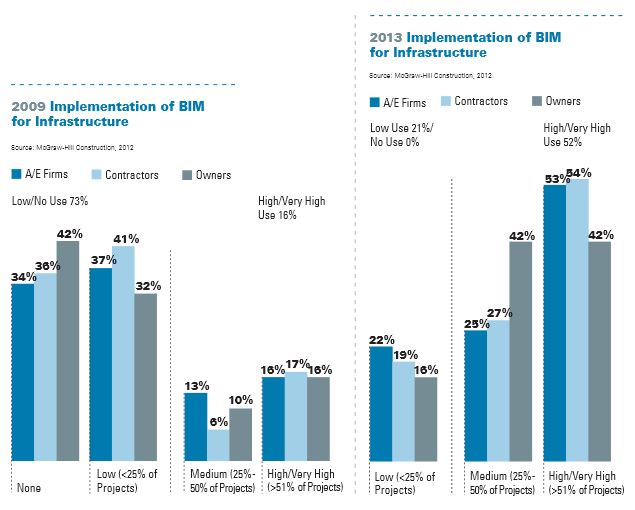 A recent McGraw-Hill SmartMarket Report The Business Value of BIM for Infrastructure suggests that BIM is beginning to significantly impact the infrastructure construction industry. High/very high use of BIM for infrastructure projects among owners, contractors, and A/E firms was only 16% in 2009. In 2013 it has reached 52%. In 2009 73% for firms reported no or low use of BIM on infrastructure projects. In 2013 only 21% of firms report low or no use of BIM.
One of the most important findings of the research is that firms involved in vertical BIM projects in the past are more likely to use BIM for infrastructure as well. The report finds a positive correlation between BIM penetration in the vertical market and BIM use for infrastructure. McGraw-Hill suggests that the result will be that BIM adoption in the horizontal market will occur at a faster rate than the rate of adoption of BIM in the vertical market. It is interesting that contractors followed closely by owners are leading high/very high adoption of BIM.
Some of the interesting findings of the report are
- Almost half (46%) of the firms surveyed report using BIM on their infrastructure projects, up from 27% two years ago.
- The percentage of those using BIM on more than 50% of their projects is expected to grow from 30% now to 52% in just two years.
- 79% of current non-users of BIM feel positively about future adoption of BIM, with only 4% actually opposed.
- 67% of all users report a positive ROI on their BIM investments, even higher than the 63% of BIM users for buildings who reported the same in 2009.
Benefits of BIM for Infrastructure
The top benefits reported for BIM for infrastructure are
- lower project risk and better predictability of project outcomes (60%) as a top benefit in the next five years

- reduced conflicts and changes (58%)
- improved project quality (48%)
Adoption of BIM for infrastructure projects
According to the McGraw-Hill report on BIM in North America many organizations have been using BIM on vertical building projects for a number of years. The infrastructure report finds that the adoption of BIM for infrastructure projects lags BIM for buildings. According to McGraw-Hill the use of BIM for infrastructure is about three years behind its use on vertical projects. As evidence McGraw-Hill has compared the length of time firms have used BIM for infrastructure to that for
building projects reported in McGraw-Hill Construction’s 2009 BIM SmartMarket Report.
Years using BIM: 1–2 Years
2012 Infrastructure: 50%
2009 Buildings: 48%
Years using BIM: 3–4 Years
2012 Infrastructure: 27%
2009 Buildings: 28%
Using BIM more than 5 years
2012 Infrastructure: 23%
2009 Buildings: 24%
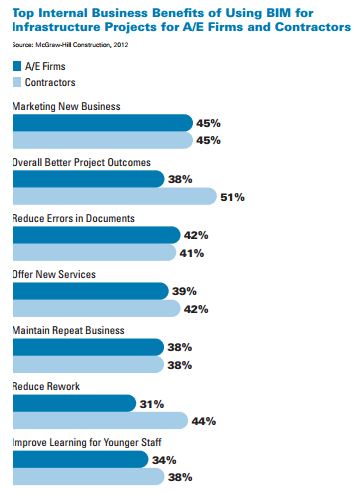 Benefits of BIM for Infrastructure
Top business benefits for A/E firms
- Marketing new business
- Reduced erroors in documents
- Offer new services
- Better project outcomes
- Better project outcomes
- Maintain repeat business
- Improved learning for younger staff
- Reduced rework
Top business benefits for contractors
- Better project outcomes
- Marketing new business
- Reduced rework
- Offer new services
- Reduced errors in documents
- Improved learning for younger staff
- Maintain repeat business
Top business benefits for BIM for infrastructure for owners
- Better project outcomes 44%
- Reduced rework 44%
- Fewer claims/litigation 38%
- Reduced errors in documents 33%
- Reduced workflow cycle time 33%
- Reduced project duration 33%
- Reduced construction cost 22%

Be the first to comment