
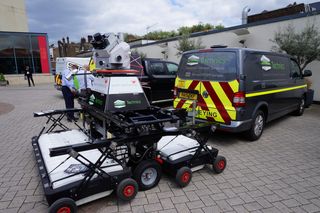
One of the most exciting presentations at the annual Hexagon conference HxGN Live in Anaheim from the viewpoint of practical application of new technology was a talk given by Gilbert Roulier of Grunder Ingenieure AG, who reported on a pilot project in Berne, Switzerland, to map underground utilities using combined mobile laser-scanning (mobile LiDAR) and ground penetrating radar (GPR). The objective of the pilot was to asses the capability of the equipment to capture in 3D culverts and water pipelines under streets in Berne with an accuracy of +/- 10 cm.
Equipment
The equipment used was a Leica Pegasus: Stream comprised of a Leica Pegasus:Two integrated with a Stream EM and towed by a vehicle. One of the advantages of the Stream EM is that it is comprised of three antenna arrays – two for main line detection and one array for crossing line detection. The Stream EM captures real-time tomography of the subsurface to about 4 meters in depth. The combined LiDAR and GPR array can be towed at a speed of about 15 km/h. In addition to capturing subsurface structures, the combined device also captured above ground structures. Manholes and other visible surface infrastructure were used as ground control points.
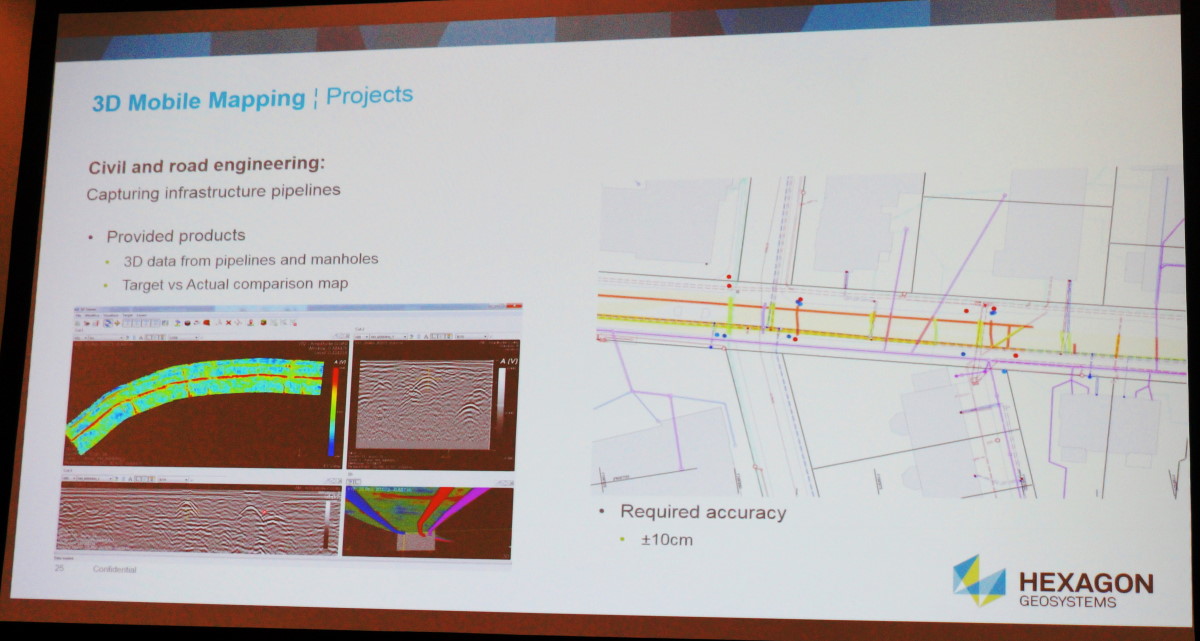 After data capture there is a combined workflow that post processes the data captured by the Pegasus:Stream. The final result is 3D data that can be imported into ArcGIS and AutoCAD. As part of the pilot the data was compared to existing records and maps prepared showing the divergence.
Results and Benefits
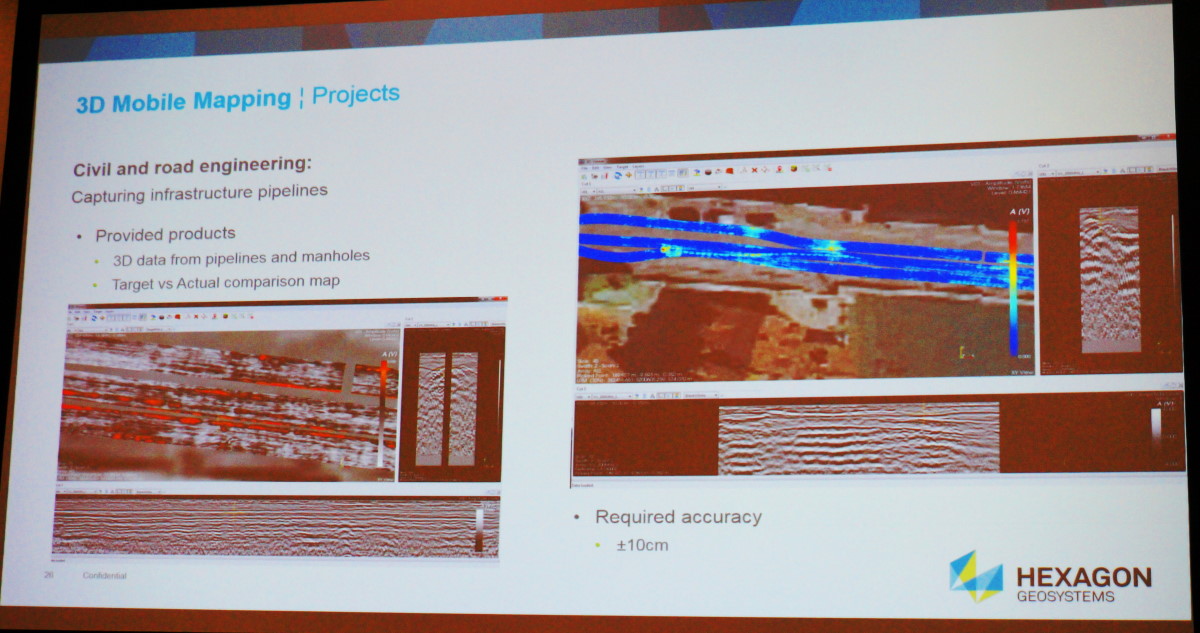 The pilot revealed significant benefits from using combined LiDAR and GPR array. First of all that the laser scanning and GPR equipment worked simultaneouly reduced traffic disruption. It also dramatically improved productivity – up to 100 km could be captured and processed per day – including both above ground information about road structure and condition and below location of underground utilities in 3D. An important advantage of the Stream EM array from a productivity perspective is that data collection was only required in one direction since the Stream EM array includes an array for transverse scanning of infrastructure crossing the direction of the scan. An important advantage of the combined system is that it is capable of +/- 10 cm in locating underground infrastructure in 3D. Finally, the combined Pegasus: Stream array was much safer for the operator.
From Grunder’s perspective the pilot was successful and they report that they are seriously considering investing in the Pegasus:Stream. Grunder sees the potential users of the combined system surveying companies and utility companies – both public and private. It believes that the equipment could be used routinely for mapping of underground assets including pipe and cable detection and mapping, but also for road maintenance and renewal, subsurface cavity detection and in a modified form for ballast monitoring on rail lines.
Future
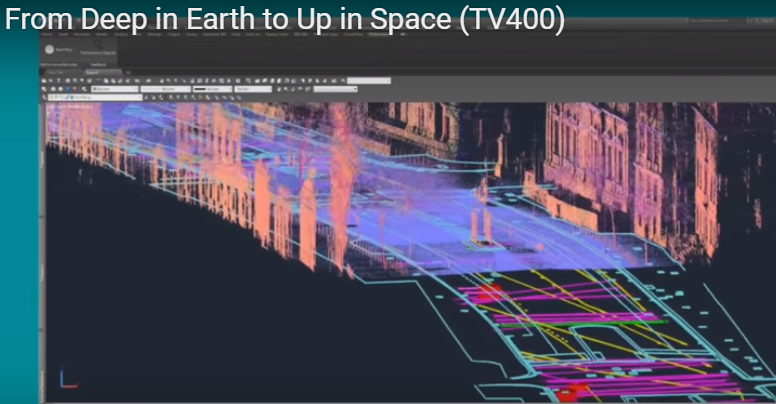 In his keynote at HxGN LIve Hexagon Geosystems President Juergen Dold made it clear that mapping digital realities above and below streets is a key technology for Hexagon Geosystems. Very recently Hexagon announced the establishment of a georadar portfolio with three releases to provide applications in utility mapping, asset detection and mapping, and monitoring. Included in the georadar portfolio is the Leica Pegasus:Stream which Hexagon sees as enabling mass digitization of infrastructure assets, such as telephone cabinets above and cable conduits below, by collecting data in less time without needing to stop traffic, increasing the safety of the road work crew. They emphasize that the Pegasus:Stream has the potential to collect up to 100 km per day at 15 km/hr, providing digital documentation for GIS and CAD modelling.
I had an opportunity for a brief chat with Stuart Woods, Leica Geosystems Vice-President of Mobile Mapping, about Hexagon’s plans for the Leica Pegasus: Stream. According to Stuart Hexagon is planning to invest in the technology such as enhancements to the antenna arrays to increase the precision of the radar record. They also intend to investigate translating the radar record into something more understandable like a point cloud.
Conclusion
The very exciting conclusion I draw from this is that the technology for underground remote sensing has finally gotten good enough that a major company sees an important market opportunity and is seriously investing in the technology and business of developing and manufacturing devices for detecting and mapping underground utilities.

Be the first to comment