I was fortunate to catch an excellent presentation at the SPATIALInfo User Conference by Geoff Cameron of AGSI, who is based in Ontario and has had a lot of experience working in the power utility industry, primarily in Ontario. Ontario is a hot bed of smart grid activity for a variety of reasons, among which probably the most important is the passage earlier this year of the Ontario Green Energy and Economy Bill, which places on Ontario utilities two important obligations (among others)
to connect renewable energy generation sites to the grid
to buy renewable electricity at above-market rates set by the government (feed-in tariff)
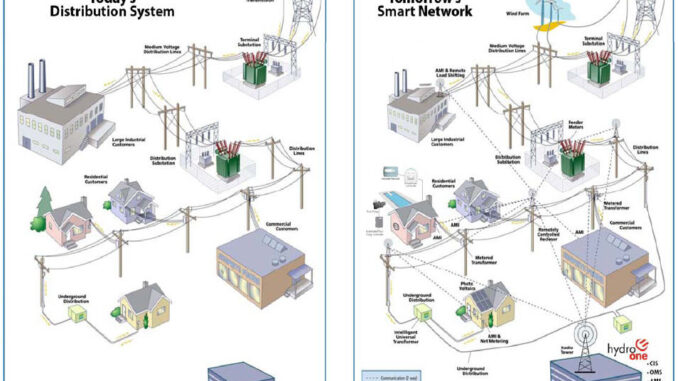
What is a smart grid ?
The smart grid is something that you hear a lot about, but is really something that is not well-defined. We all have a concept of what comprises a smart grid, but the current reality is that each utility is figuring out how to implement a smart grid for themselves. According to Geoff the key elements of a smart grid that are emerging are
Customer focus
Currently our relationship with our local energy utility is we get monthly bills and we call them when we have an outage or other problem. Under a smart grid regime, there will be a much more bidirectional relationship with customers, which means a dramatic increase in customer call volume. If the utility has to handle a million customer calls per year now, in the future they will have to handle a hundred times that.
Green energy
Utilities will have to connect green energy generation sites to the grid and pay above-market rates for green energy. The cost to build the infrastructure to do this, new transmission lines, upgraded and new substations, storage, and associated communications network is going to be massive.
Asset management
The objective is a dramatic increase in network reliability which includes self healing and real-time asset condition monitoring using techniques such as reliability centered maintenance and stress monitoring. And most crucially 100% reliable and real-time data about the network. I have blogged on a number of occasions about the poor quality of records (aka network facilities documentation or GIS) data not only in North America but around the world, so this is going to require a radically different approach to maintaining information about network facilities.
Outage restoration optimization
Being able to automatically identify network outages and restore service is going to require integration of SCADA, OMS, CIS, GIS, and other enterprise systems and the build-out of a wireless communications network to support mobile field technicians.
Network asset planning and analytical tools
This will require aggregating operational data from SCADA, OMS, and other operational systems, network connectivity, weather, and other sources, maintaining historical data, and being able to analyze and simulate complex power networks.
Requirements of a smart grid
The pieces that a smart grid implementation requires include
Wide area bidirectional network, typically comprised of fiber and wireless which may be built and maintained by the utility itself, or owned and managed by telecommunications partners
Smart devices including switches, sensors, remote trip protection, and other IP addressable devices
AMI/AMR or advanced metering infrastructure and automated meter reading
Mobile work force with access to real-time infrastructure data
Operations center or hub
Geospatial back office system requirements
The geospatial back office system requirements include real-time data integration, an open architecture based on geospatially-enabled RDBMS and web services technology, and data archiving for planning and analysis. In Geoff’s view, it is not possible to meet the real-time geospatial requirements of the smart grid with traditional GIS tools, and that new tools are required. (Image Hydro One)
Geoff Zeiss
Geoff Zeiss has more than 20 years experience in the geospatial software industry and 15 years experience developing enterprise geospatial solutions for the utilities, communications, and public works industries. His particular interests include the convergence of BIM, CAD, geospatial, and 3D. In recognition of his efforts to evangelize geospatial in vertical industries such as utilities and construction, Geoff received the Geospatial Ambassador Award at Geospatial World Forum 2014. Currently Geoff is Principal at Between the Poles, a thought leadership consulting firm. From 2001 to 2012 Geoff was Director of Utility Industry Program at Autodesk Inc, where he was responsible for thought leadership for the utility industry program. From 1999 to 2001 he was Director of Enterprise Software Development at Autodesk. He received one of ten annual global technology awards in 2004 from Oracle Corporation for technical innovation and leadership in the use of Oracle. Prior to Autodesk Geoff was Director of Product Development at VISION* Solutions. VISION* Solutions is credited with pioneering relational spatial data management, CAD/GIS integration, and long transactions (data versioning) in the utility, communications, and public works industries. Geoff is a frequent speaker at geospatial and utility events around the world including Geospatial World Forum, Where 2.0, MundoGeo Connect (Brazil), Middle East Spatial Geospatial Forum, India Geospatial Forum, Location Intelligence, Asia Geospatial Forum, and GITA events in US, Japan and Australia. Geoff received Speaker Excellence Awards at GITA 2007-2009.

Be the first to comment