

The International Energy Agency (IEA) has released its first report on energy efficiency.
It estimates that investment in energy efficiency worldwide totalled US$ 300 billion in 2011. In 11 IEA member countries (Australia, Denmark, Finla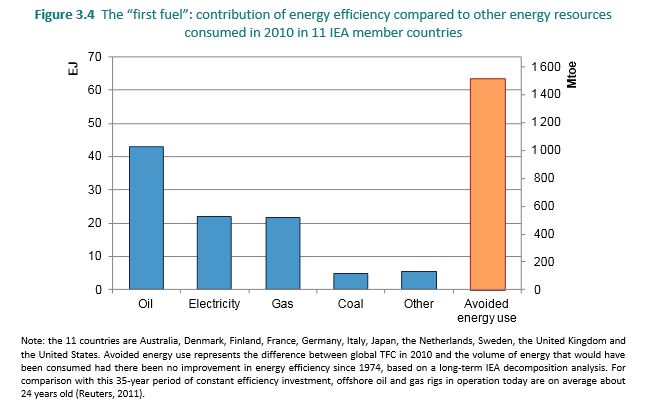 nd, France, Germany, Italy, Japan, the Netherlands, Sweden, the United Kingdom and the United States), energy efficiency (avoided energy use) contributed more “fuel” than any other single fuel including oil, electricity, gas, or coal.
The IEA assessment considers three aspects of energy efficiency,
- investments in energy efficiency by direct public expenditure, private actors, commercial and multilateral development banks, manufacturers and consumer spending.
- energy savings delivered as a result of these investments: measured in the units of energy avoided, such as million tonnes of oil equivalent (Mtoe),megawatt hour (MWh) or tonnes of oil.
- monetary value of these savings: enerally measured in terms of the monetary value of the avoided energy.
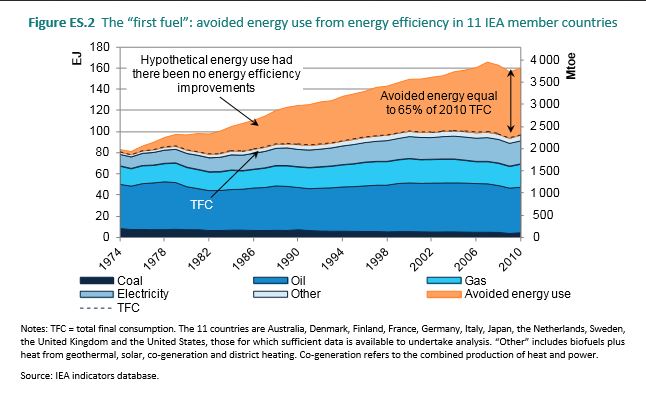 The iEA estimates that 5% more energy would have been consumed by the 11 countries it has reliable data for between 2005 to 2010. This is equivalent to 570 Mtoe of crude oil valued at USD 420 billion at a price of USD 100 per barrel.
Over the past five years, investment in energy efficiency in most regions has been stimulated by government policy. In some regions it has also been driven by higher energy prices.
The IEA report includes some examples of government stimulated investment.
Germany The government development bank KfW provided US$ 12.7 billion in loans for energy efficiency investments in the residential buildings sector in 2012, and it estimates that this stimulated US$ 35 billion in home efficiency refurbishments.
New Zealand A home insulation programme has invested US$ 243 million over the last four years, wirh benefits estimated at US$ 1.2 billion..
French public spending on energy efficiency in the residential sector reached US$ 473 million in 2011. It is estimated that is “white certificate” scheme could trigger private spending amounting to 20 times this amount.
Mexico The Green Mortgage Programme involved US$ 1 billion in public subsidies and nearly US$ 500 million in additional lending by mortgage providers to over three million householders between 2009 and 2012.
United States Utility and energy service companies (ESCO) schemes have driven growth in energy efficiency markets. Spending on ratepayer-funded efficiency programmes have grown from US$ 1 billion in 2000 to US$ 7 billion in 2011.
Korea Annual turnover for Korean ESCOs reached US$ 330 million in 2011. ESCO activity in Korea avoided the consumption of energy equal to 1.3 Mtoe in 2011.
Future growth of energy efficiency markets
Energy efficiency markets are expected to grow in all the regions examined in this report, driven by price and policy. Most of the growth is expected to be the result of private investment, motivated by government policy, rather than from direct public investment.
The new Canadian National Energy Code is expected to save US$ 350 million in 2020.
The French government is considering a nearly threefold increase in the target for the Certificats d’économie d’énergie obligation scheme to 600 TWh, stimulating energy efficiency investments in the building and transport sectors.
Germany’s 2010 Energy Concept could avoid US$ 42 billion in energy costs in 2020. A mandated 2% renovation rate requirement for existing buildings will drive energy-efficient retrofits.
The market for fuel-efficient vehicles is accelerating rapidly in South Korea, with a requirement that suppliers shift to 100% compliance with a fuel efficiency standard of 17 kilometres per litre of fuel by 2015.
Standards entering into force for a range of appliances in the United States will lead to over 80 TWh of annual electricity savings by 2020. ESCO revenues are projected to double to US$ 13 billion by 2020.
From 2014, energy suppliers in EU member states will be required to achieve annual energy savings equivalent to 1.5% of their energy sales volume through to 2020.

Be the first to comment