
The International Energy Agency (IEA) has released its annual World Energy Outlook for 2011 (WEO-2011).
2000-2010
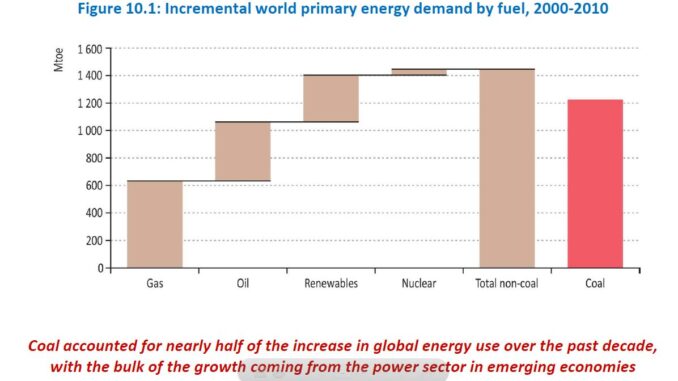
In the past decade 2000 to 2010, almost half of the world’s demand for energy has been provided by coal, driven primarily by increasing demand from the emerging economies. Currently fossil fuels provide about 81% of total primary energy consumption. Renewables represent about 13% of total primary energy demand in 2010 supported by a total of $66 billion in subsidies. In 2010 fossil fuel subsidies amounted to $409 billion.
 New Policies Scenario 2010-2035
The WEO-2011 has projected future demand for three scenarios with different levels and patterns of worldwide energy use according to different assumptions about government policies on energy and climate change. The central scenario is called the New Policies Scenario which assumes that recent government policy commitments are implemented conservatively, and no new ones are introduced.
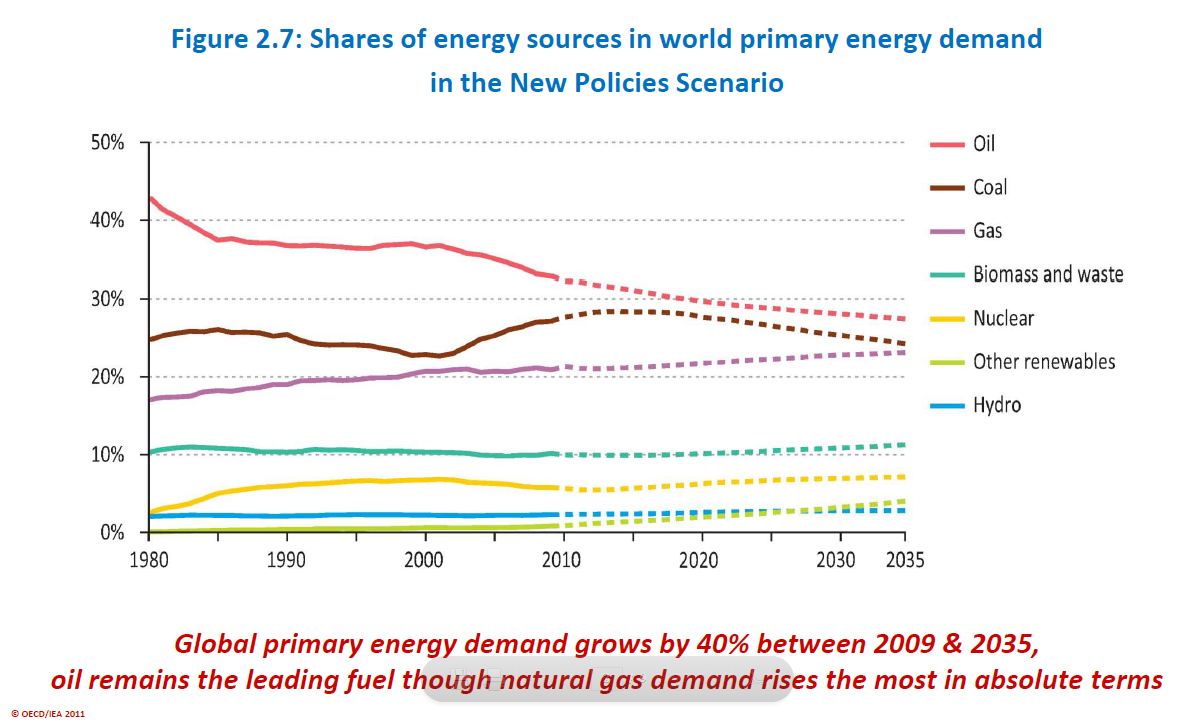
According to this scenario, world primary energy demand increases by one-third between 2010 and 2035 with 90% of the growth in non-OECD economies. China becomes the world’s largest energy consumer with per capita demand in China rising to somewhat less than half the level in the United States. The rates of growth in energy consumption in India, Indonesia, Brazil and the Middle East are projected to exceed China’s.
 The share of fossil fuels in global primary energy consumption is projected to decrease to 75% in 2035. Renewable energy would increase to 18% in 2035 driven by subsidies that increase from $66 billion in 2010 to $250 billion in 2035. Natural gas is the only fossil fuel to increase its proportion of the global mix through 2035. Oil demand increases by 15% driven by transportation. Coal demand increases but plateaus at a level about 17% higher than 2010.
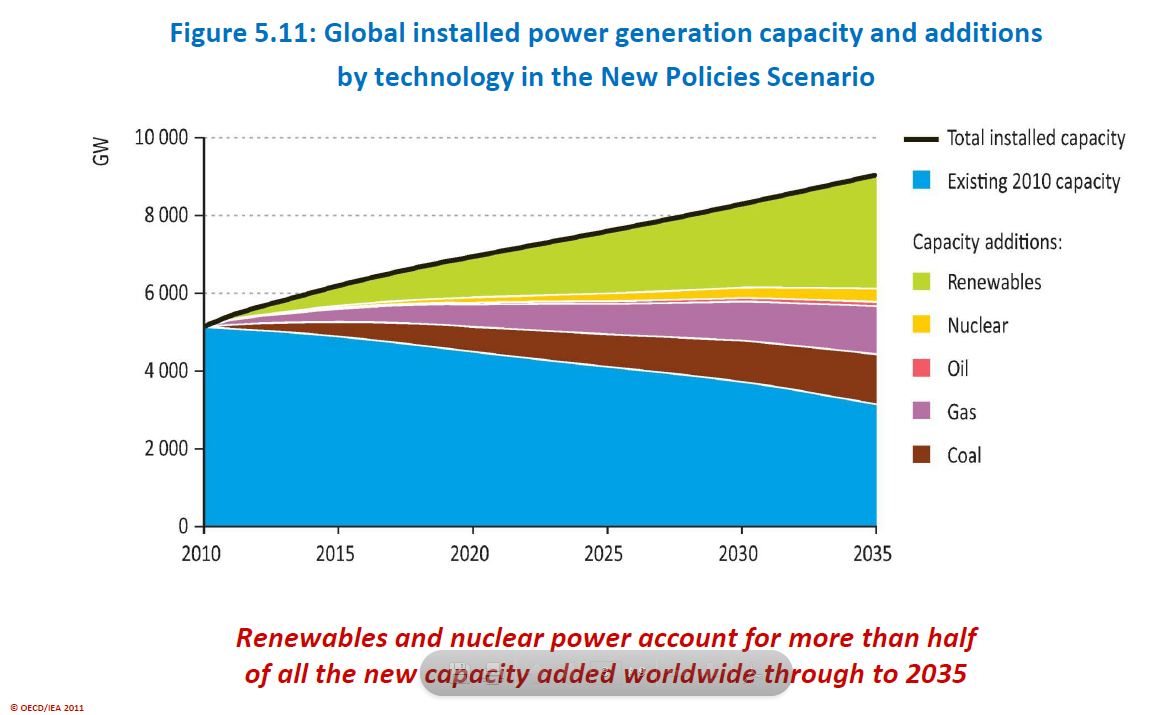
In the electric power sector, nuclear generation increases by 70%, primarily due to China, Korea and India. Renewable energy technologies, primarily hydroelectric and wind, are projected to represent half of new capacity installed between 2009 and 2035.
 Energy Infrastructure Investment
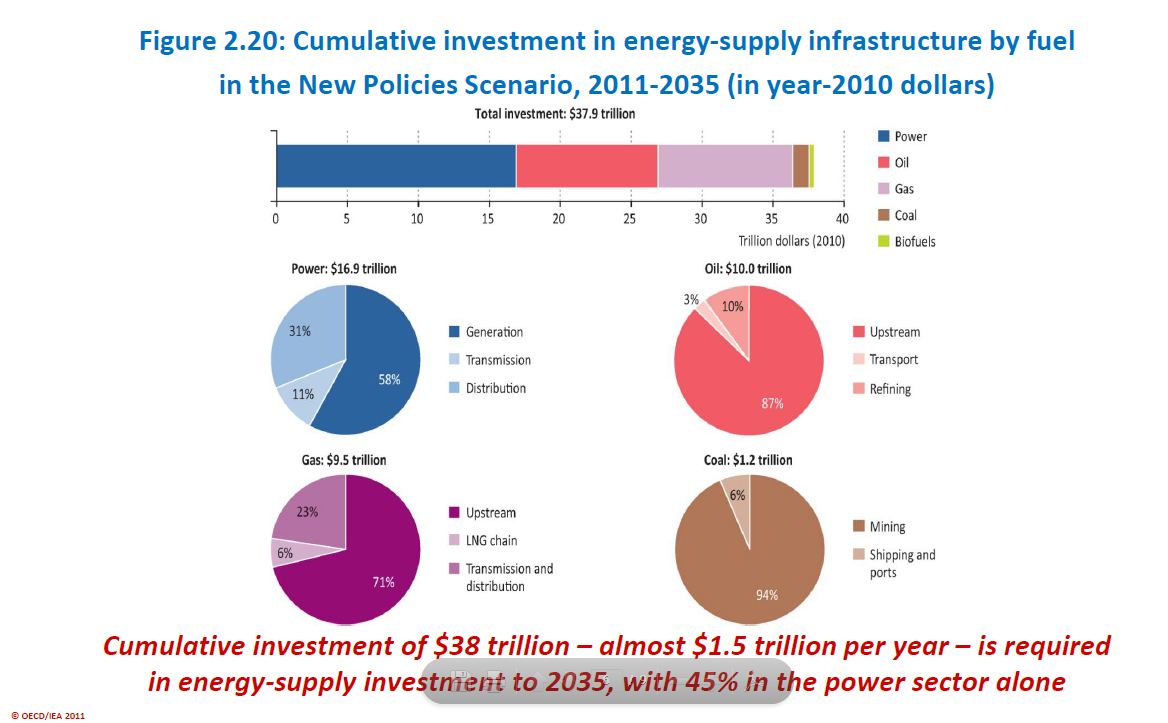
In the New Policies Scenario, massive investment in energy supply infrastructure is required. In the New Policies Scenario, $38 trillion in global investment in energy-supply infrastructure is required from 2011 to 2035 with 45% going to the electric power sector.
- Power $17 trillion
- Gas $9.5 trillion
- Oil $10 trillion
- Coal $1.2 trillion
- Total $38 trillion
Two-thirds of this investment is projected to occur in non-OECD countries.
CO2 Emissions
In 2010 CO2 emissions reached an all time high. Non-OECD countries, primarily India and China, contributed most of the increase in energy-related CO2 emissions to a new high of 30.6 gigatonnes (Gt) in 2010. On a per capita basis, OECD countries still represent by far the largest producers of emssions at 10 tonnes/person/year, compared with 5.8 tonnes for China and 1.5 tonnes in India. 44% of the CO2 emissions in 2010 came from coal, 36% from oil, and 20% from natural gas.
In the New Policies Scenario energy-related CO2 emissions are projected to increase by 20% reaching 36.4 Gt in 2035. WEO-2011 says this is consistent with a long-term global temperature increase of more than 3.5°C.

Be the first to comment