
Brazil’s economic expansion over the past few years has been impressive. In 2010 91 million Brazilians, nearly half the population, were part of the middle class. By comparison in 2003, the Brazilian middle class totalled 64.1 million people (37% population). Over the next few years Brazil will be getting even more international attention because it will be hosting the FIFA World Cup in 2014 and the summer Olympics in 2016.
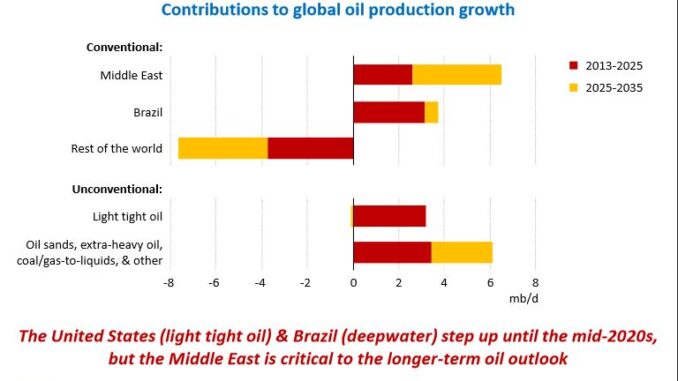
In this year’s just released World Energy Outlook 2013 the International Energy Agency (IEA) has made Brazil a special focus, probably because Brazil is set to become a leading global energy producer. A series of recent offshore discoveries is projected to make Brazil the world’s sixth-largest
oil producer. The IEA projects that natural gas production will also expand dramatically, enough to meet all of Brazil’s domestic demand by 2030.
One of the most important infrastructure sectors that has enabled Brazil’s very rapid economic development is electric power. The IEA projects that Brazil’s energy demand will increase by 80% through 2035, driven by national objectives such as universal access to electricity. This will require doubling electricity generation. 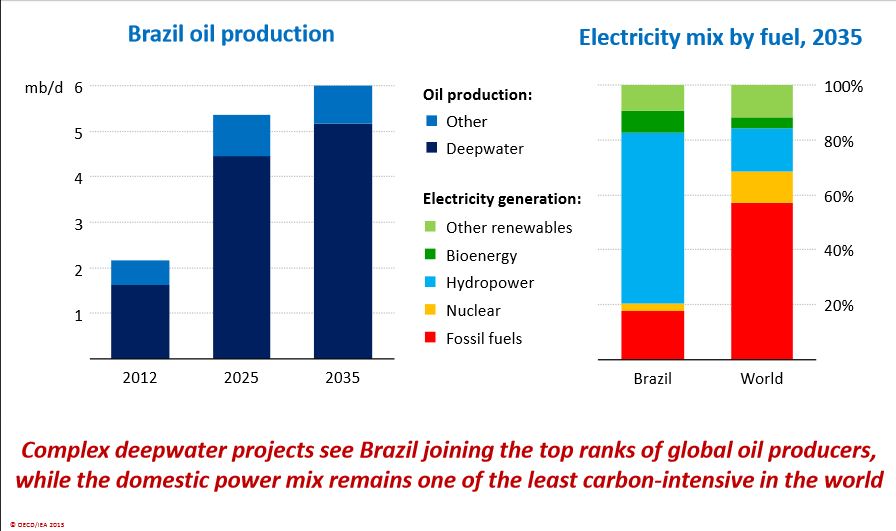 Among major industrial powers, Brazil is unique in that most of its electric power generation is from clean energy sources. 72% of Brazil’s electric energy capacity (74GW) is hydroelectric generation. A by-product bagasse of the production process of the world’s most successful alternative fuel, sugar cane ethanol, contributes 3% of Brazil’s electric power generation. Achieving Brazil’s energy goals will require substantial investment throughout the energy system, estimated by the IEA at about $90 billion per year on average,
Brazil is already a world-leader in renewable energy, which contribute a 43% share of the domestic energy mix. According to the IEA renewable energy production is set to almost double by 2035. Most of Brazilian electricity comes from hydropower. Currently over 25% of Brazil’s electric power comes from one hydroelectric plant, the 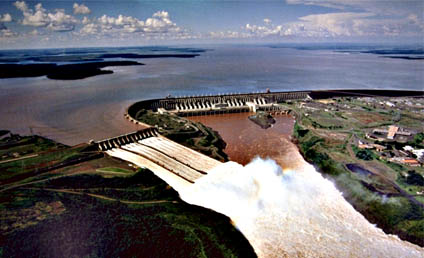 14 GW Itaipu dam, located between Brazil and Paraguay on the Paraná River. Additional very large hydroelectric power projects are underway for a total additional potential capacity of 31 GW. The largest is the 11 GW Belo Monte Dam in the state of Pará. But as a percentage of the national energy mix hydropower is projected to decline, as Brazil diversifies its energy production. The IEA projects that onshore wind
power, natural gas and electricity generated
from bioenergy (bagasse primarily) will increase dramatically.
According to the IEA, Brazil is already the world’s second largest producer of biofuels for transportion. I mentioned in a previous blog post that sugar cane is arguably the world’s most successful alternative fuel. The energy balance (ratio of energy produced to input energy) of sugar cane ethanol is 8.3 to 10.2 and it is estimated that the CO2 emission reduction is 86-90% compared to gasoline. For comparison the energy balance of corn ethanol produced in North America is 1.3 to 1.6. A University of Minnesota study concluded that corn ethanol may be worse for air quality than gasoline. An important reason that sugar cane ethanol is so much more efficient than corn ethanol or gasoline is that the energy in the bagasse (residual from sugar cane) that might otherwise have been waste is used productively, some for distilling the ethanol and the remainder to generate electric power (cogeneration).
The IEA projects that Brazil’s production of sugarcane ethanol will more than triple by 2035. This will require the cultivation of much more sugar cane, but suitable agricultural land for this exists without impacting environmentally sensitive areas. The IEA projects that by 2035, Brazilian biofuels will satisfy one-third of domestic demand for road-transport fuel. It is also projected that Brazil’s biofuel exports will account for 40% of the world’s biofuels trade.

Be the first to comment