
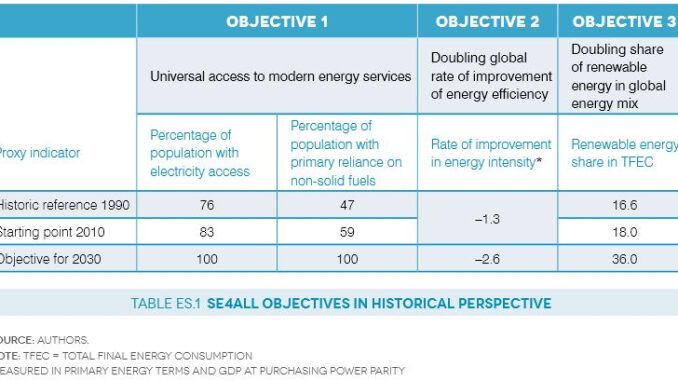
The Global Tracking Framework, an effort led by the International Energy Agency (IEA) and the World Bank, tracks progress which the Sustainable Energy for All initiative (SE4ALL) has made towards three objectives by 2030,
- achieving universal access to modern energy services
- doubling the global rate of improvement in energy efficiency (energy required per dollar of GDP)
- doubling the share of renewable energy in the global energy mix
The latest Global Tracking Framework report from the IEA estimates that as of 2010,
- 17% of the global population did not have access to electricity
- 41% still relied on wood or other biomass for cooking and heating
- 18% of the global energy mix was renewable energy
- global energy efficiency had improved by 1.3% per year since 1990.
The report says that the world has made major advances during the last 20 years,
- 1.7 billion people gained access to electrification
- 1.6 billion people gained access to less-polluting non-solid fuels
- Energy intensity dropped significantly, reducing cumulative global energy demand by more than 25 percent over 1990–2010
- Energy onsumption in 2010 was more than a third lower than it would otherwise have been
- A cumulative total of more than 1,000 exajoules (278 gigawatt-hours) of energy was supplied by renewable energy over 1990–2010 (roughly the cumulative final energy consumption of China and France over the same period)
But factorng in that the global population grew by 1.3 % per year between 1990 and 2010,and total energy consumption grew 1.5 % annually
- the share of renewable energy increased from 16.6 % in 1990 to 18.0 % in 2010.
- the population with access to electricity grew 1.2 % annually
- the population with access to non-solid fuels grew 1.1 % annually
- renewable energy consumption grew 2 % annually
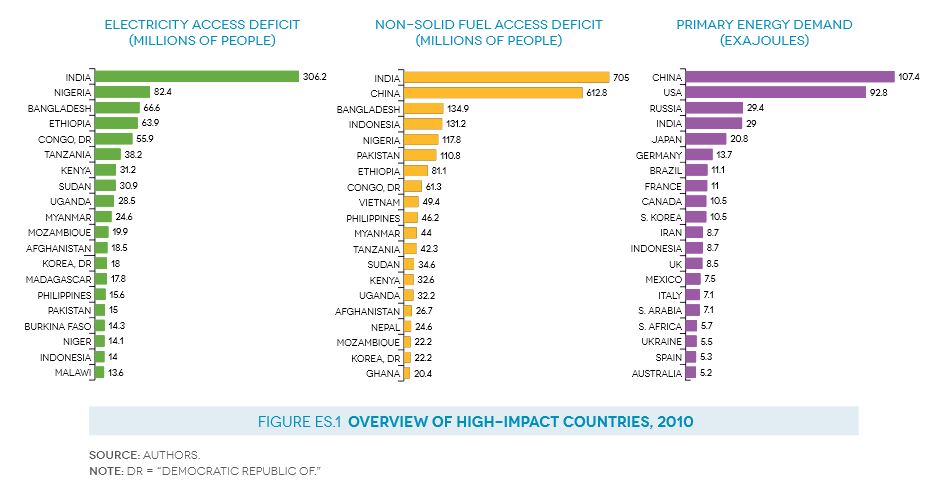 High-impact countries
The report identifies 20 “high-impact” countries that are crucial to making major progress. On all three aspects of energy sector development, China, and to a
lesser extent India, stand out as being both high-impact and fast-moving
countries.
Two overlapping groups of 20 high impact countries in Asia and Africa
account for about two-thirds of the global electrification deficit and
four-fifths of the global deficit in access to non-solid fuels. With respect to electrification and cooking fuel, the most fast-moving countries have expanded access by around 3–4 percentage points of their population each year.
A group of 20 high-income and emerging economies accounts for four-fifths of global energy consumption. The most rapid improvements in energy intensity with a compound annual growth rate of -4 to –8 %, have been achieved in countries that began with high levels of energy intensity, where efficiency gains were relatively easy to make. In the case of renewable energy, the fastest-moving countries have experienced compound annual growth rates of 10–15 percent in the consumption of energy from renewable sources, but from a very low starting base.
Future
IEA finds that neither energy efficiency nor renewable energy measures alone will be sufficient to contain global warming to within two degrees Celsius by 2030. However, the two together could bring that objective much closer. At the same time, achieving universal access to modern energy would raise global carbon dioxide emissions by only 0.6 % compared to business as usual.
The Global Tracking Framework has set goals against which progress will be measured
- The rate of access to electricity will have to increase from 83 % in 2010 to 100 % by 2030.
- The rate of use of non-solid fuel as the
primary fuel for cooking will have to increase from 59 % in 2010 to 100 % by 2030. - The rate of improvement of energy intensity will have to double from –1.3 % for 1990–2010 to –2.6 % for 2010–30.
- The share of renewable energy in the global final energy mix will have to double from an estimated 18 % in 2010 to 36 % by 2030.
Meeting the universal access objective globally will depend critically on the progress that can be made in 20 high impact countries in Asia and Africa.
The achievement of the global SE4ALL objectives for renewable energy and energy efficiency will not be possible without major progress in 20 high-income and emerging economies.
The report also finds that achievement of the SE4ALL goals requires energy investments to increase by at least $ 600 billion per year until 2030, compared with the level currently expected.
- universal electricity access – an additional $ 45 billion per year
- universal access to modern cooking – an additional $ 4.4 billion per year
- renewables – an additional $ 174 billion per year
- energy efficiency – an additional $ 394 billion per year.
The IEA syas that this investment must be accompanied by a comprehensive package of policy measures, including fiscal, financial and economic incentives, phasing out fossil-fuel subsidies, and pricing of carbon.
Be the first to comment