
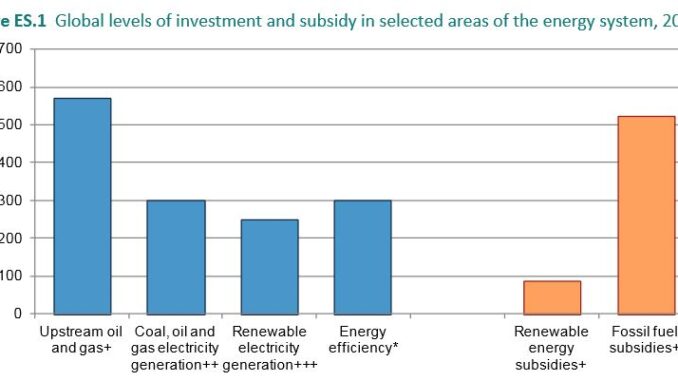
Energy efficiency markets provide goods and services that reduce energy consumption. The International Energy Agency (IEA) has released its first Energy Efficiency Market Report which attempts to quantify investments and market outcomes from avoided energy consumption.
The global energy efficiency market is challenging to define and measure. The IEA relies on three metrics to measure the energy efficiency market.
- Investments in energy efficiency – includes direct public expenditure; investments from private sources; investment funded by commercial banks; investment by manufacturers; and consumer spending.
- Avoided demand for energy – energy saving resulting from these investments measured in units of energy avoided: million tonnes of oil equivalent (Mtoe), megawatt hour (MWh) or tonnes of oil.
- Monetary value of these savings – generally measured in terms of the monetary value of the avoided energy.
Total investment in energy efficiency
The IEA estimates that investment in energy efficiency markets worldwide totalled US$ 300 billion in 2011. The IEA says that this is a conservative estimate based on an assessment of direct investment in identifiable energy efficiency initiatives by the public sector, multilateral finance institutions and major private institutions.
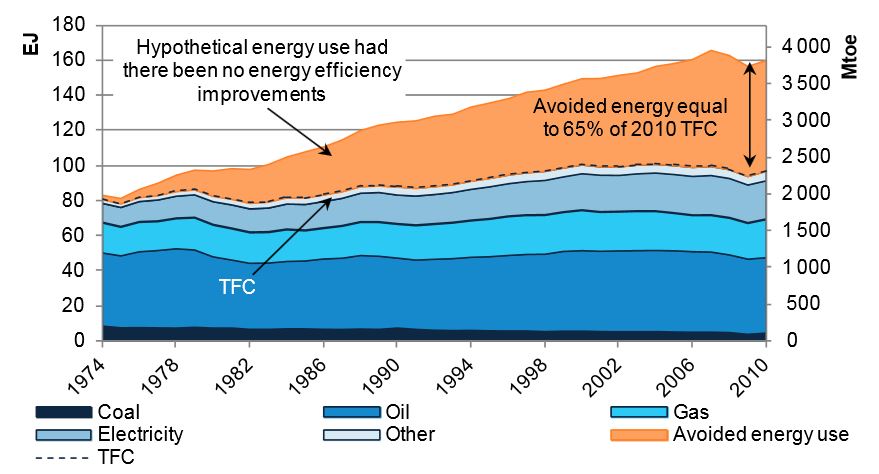 Avoided energy consimption
For 11 IEA member countries (Australia, Denmark, Finland, France, Germany, Italy, Japan, the Netherlands, Sweden, the United Kingdom and the United States), investment in energy efficiency over the five years between 2005 and 2010 has resulted in cumulative avoided energy consumption of 570 million tonnes of oil-equivalent (Mtoe). Assuming an oil price of US$ 100 per barrel, 570 Mtoe of crude oil would be valued at US$ 420 billion.
In 2010 energy efficiency investments have resulted in avoided energy consumption of 63 exajoules (EJ) (1.52 billiontonnes of oil-equivalent) in 11 IEA member countries. For comparison this amount was larger than the consumption of oil, electricity or natural gas in these countries in 2010.
- energy efficiency – 63 exajoules (EJ)
- oil – 43 EJ
- electricity – 22EJ
- natural gas – 22EJ

Be the first to comment