
In the Energy Information Administration’s (EIA) Annual Energy Outlook 2013 the Reference case, which only includes existing
legislation and regulations, forecasts U.S. 2020 emissions of 5,455 million tonnes, which is 470 million tonnes of carbon dioxide above the goal of 4,978 million tonnes (17% below below 2005 levels). The EIA has outlined other possible scenarios. Three of these make different technology
assumptions.
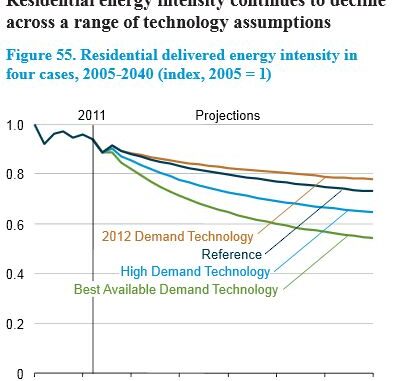
- 2012 Demand Technology
case – assumes no future improvement in efficiency for equipment or
building shells beyond what is available in 2012. - High Demand
Technology case = assumes higher efficiency, earlier availability, lower
cost, and more frequent energy-efficient purchases for some equipment. -
Best Available Demand Technology case – limits customer purchases of
new and replacement equipment to the most efficient models available at
the time of purchase regardless of cost. This case also assumes that new
homes are constructed to the most energy-efficient specifications.
Residential buildings
The graph shows the effect of the three alternative cases on residential energy intensity. From 2011 to 2040, household energy intensity declines by
17 percent in the 2012 Demand Technology case
31 percent in
the High Demand Technology case and by
42 percent in the Best Available
Demand Technology case.
Commercial buildings
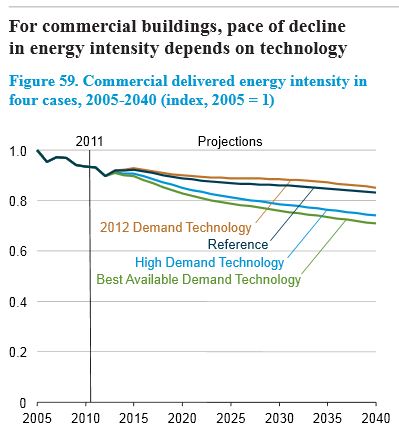 Average delivered energy consumption per square foot of commercial floorspace is projected to decline 0.4 % annually from 2011 to 2040 in the Reference case, while commercial floorspace grows by 1.0 % per year. Natural gas consumption increases at about one-half the rate of delivered electricity consumption, which grows by 0.8 percent per year in the Reference case. With ongoing improvements in equipment efficiency and building shells, the growth of energy consumption declines more rapidly than commercial floorspace increases, and the average energy intensity of commercial buildings is reduced.
Three alternative technology cases show the effects of efficiency improvements on commercial energy consumption. The 2012 Demand Technology case limits equipment and building shell efficiencies in later years to those available in 2012. The High Demand Technology case assumes earlier availability, lower costs, and higher efficiencies for equipment and building shells, and a 7-percent real discount rate for energy efficiency investments. The Best Available Demand Technology case assumes more efficient building shells for new and existing buildings than in the High Demand Technology case and limits replacement of new equipment to the most efficient models available in any given year.
The intensity of commercial energy use in the Reference case declines by 10.8 percent, from 105.2 thousand Btu per square foot in 2011 to 93.8 thousand Btu per square foot in 2040. By comparison, average commercial energy intensity drops by about
8.6 percent in the 2012 Demand Technology case
20.5 percent in the High Demand Technology case
23.9 percent in the Best Available Demand Technology case
Emissions
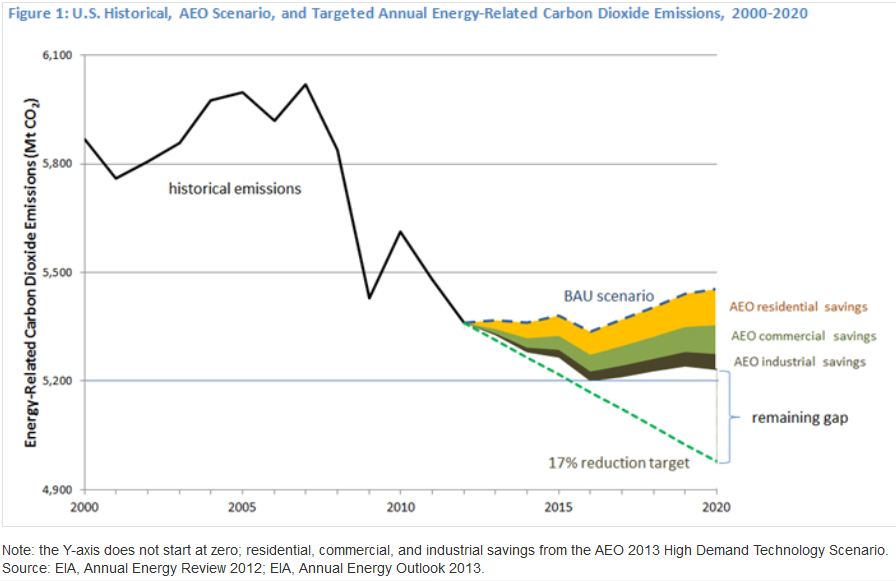 According to the World Resources Institute (WRI), energy efficiency improvements in the residential, commercial, and industrial sectors based on the the High Demand Technology scenario could cover 47 percent of the gap between business-as-usual emissions and the U.S. 2020 target.
Furthermore, the WRI compared the
potential impact of the the Shaheen-Portman Energy Efficiency Bill currently before Congress with the High Demand Technology scenario and concludes that the Shaheen-Portman bill in its current form is not likely to achieve 2020 sector emissions reductions as large as those projected for the High Demand Technology scenario.
Shaheen-Portman bill is not likely to achieve 2020 sector emissions
reductions as large as those described in the Department of Energy’s
ambitious AEO scenario – See more at:
http://insights.wri.org/news/2013/07/closer-look-shaheen-portman-energy-efficiency-bill#sthash.xmc83hrQ.dpuf

Be the first to comment